[Exclusive] "Stopping Repeated Industrial Accidents Before They Happen"... Legal Basis for State Support of Honorary Occupational Safety Inspectors
- Input
- 2026-01-25 14:57:09
- Updated
- 2026-01-25 14:57:09

[Financial News] A legal amendment is being pushed to reduce industrial accidents by shifting the focus from post-accident punishment to on-site prevention. Even after the enforcement of the Serious Accidents Punishment Act, which imposes strong criminal liability on management, industrial accidents have hardly decreased. Against this backdrop, the government is seeking to strengthen the role of Honorary Occupational Safety Inspectors, who continuously check and improve risk factors at worksites.
According to reporting by Financial News on the 25th, Park Hong-bae, a member of the National Assembly Committee on Climate, Energy, Environment and Labor from the Democratic Party of Korea (DPK), is set to introduce a partial amendment to the Occupational Safety and Health Act. The bill will explicitly establish a national-level legal basis for supporting Honorary Occupational Safety Inspectors.
Honorary Occupational Safety Inspectors are safety management personnel appointed by the Minister of Employment and Labor (MOEL) under Article 23 of the Occupational Safety and Health Act and its Enforcement Decree, based on recommendations from workers, labor unions, employer organizations, and industrial accident prevention organizations. They are authorized to participate in workplace self-inspections and labor inspections, take part in drawing up industrial accident prevention plans, request corrective measures and report violations to supervisory authorities, and request work stoppages when there is an imminent risk of an industrial accident. The system is designed to focus on identifying and blocking risk factors in advance rather than responding after an accident occurs.
However, the Honorary Occupational Safety Inspector system has so far been operated mainly at workplaces with 100 or more employees, and its limitations are clear. Critics point out that there is effectively a vacuum at construction sites and workplaces with fewer than 50 employees, which are particularly vulnerable to industrial accidents. In addition, guarantees for activity time and clear definitions of their roles have been lacking. There has also been growing criticism that, even as workplace safety management systems become more complex and specialized due to industrial restructuring and technological advances, there is no systematic, national-level basis for education and training to help Honorary Occupational Safety Inspectors effectively respond to evolving risk factors.
People on the ground have warned that if education and training for these inspectors are not sufficiently supported, the effectiveness of autonomous safety management at worksites will decline and the gap in safety-related information and expertise between labor and management will widen. Given the practical limits of managing all workplaces nationwide on a constant basis with only a limited number of public inspectors, observers say it is necessary to strengthen, through institutional measures, the expertise of Honorary Occupational Safety Inspectors, who know the sites best.
Lee Byoung-Hoon, a sociology professor at Chung-Ang University, noted, "A punishment-centered system is meaningful in that it makes employers take responsibility, but punishment itself is not a cure-all." He added, "Institutional support is needed to build the capacity of Honorary Occupational Safety Inspectors so that they can prevent industrial accidents directly at worksites."
Reflecting these concerns, Representative Park’s amendment adds provisions authorizing the Minister of Employment and Labor (MOEL) to provide education and training, as well as allowances and other necessary support within the budget, to enhance the occupational safety and health capabilities of Honorary Occupational Safety Inspectors and to support their activities. This is the first time that a direct basis for national support has been written into the legal provisions governing the Honorary Occupational Safety Inspector system.
Park said, "The amendment is intended to build an institutional foundation so that Honorary Occupational Safety Inspectors can go beyond simple monitoring and perform substantive preventive functions on site based on their expertise." He emphasized, "Along with making on-site inspections more substantive, I believe this will serve as an opportunity to shift the industrial safety paradigm from punishment-centered to prevention-centered."
Experts also assess that while the Serious Accidents Punishment Act is a system focused on holding parties accountable after an accident, the move to legislate state support for Honorary Occupational Safety Inspectors is an attempt to reinforce the preventive pillar that exposes and improves risk factors at an earlier stage. Since 2022, the Serious Accidents Punishment Act has applied to industrial worksites to strengthen the responsibility of prime contractors in order to prevent fatal accidents and other serious incidents, yet industrial accidents continue to occur even now, in the fifth year of its enforcement.
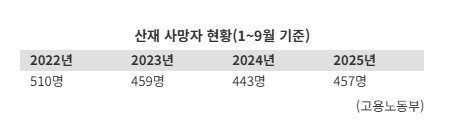
In fact, according to MOEL, 457 workers died in industrial accidents at worksites in the first three quarters of last year, a 3.2% increase from the previous year. This was the first increase since statistics began to be compiled in 2022. During the same period, deaths from industrial accidents in the construction industry and at workplaces with fewer than 50 employees rose by 3.4% and 10.4%, respectively, and the number of fatal accidents increased to 440 cases, up 7.1% year-on-year. The Serious Accidents Punishment Act has been fully enforced since January 27, 2022.
Attorney Yoon-ki Ko said, "If, through the amendment, the state pays allowances and guarantees their activities, Honorary Occupational Safety Inspectors will be able to free themselves, at least in part, from a subordinate relationship with employers and secure the status of quasi-third-party monitors." He added, "They can then be nurtured not just as simple worker representatives but as quasi-professionals."
[email protected] Kim Ye-ji Reporter