That old clothing you dropped in a collection bin—will it really be recycled? [Lee You-beom’s Eco & Energy column]
- Input
- 2026-01-24 06:00:00
- Updated
- 2026-01-24 06:00:00
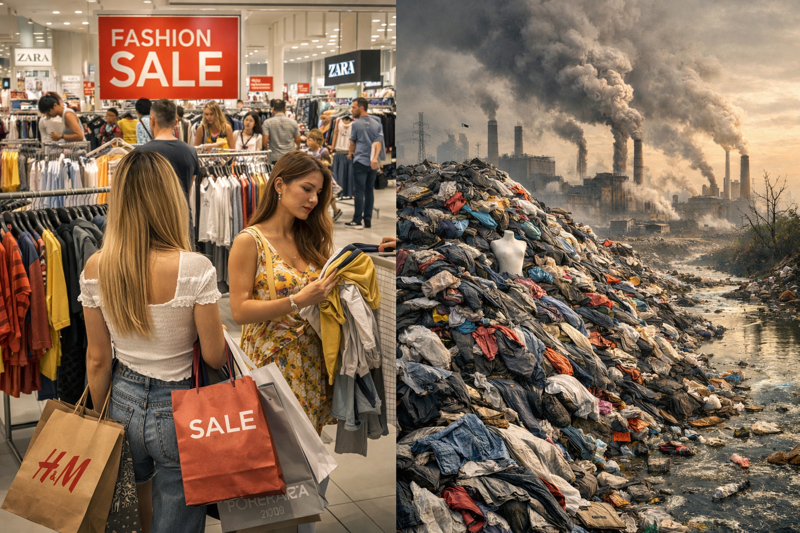
[The Financial News] Every year, more than 300,000 tons of used clothing are thrown away in Korea. As fast fashion trends change quickly and online shopping spreads, the lifespan of clothes has shortened, and discarded garments go straight into the trash. The problem is that most of this massive volume of textile waste is either incinerated or landfilled, leaving behind greenhouse gases, microplastics, and chemical pollution all at once. As the “wear-and-discard industry” reaches its limits, recycling of textile waste is emerging as a new environmental and industrial challenge.
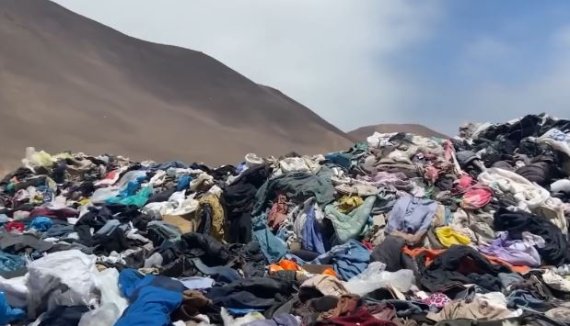
The illusion of a 70% recycling rate: most of it is actually downcycling
According to the Ministry of Climate and the Korea Environmental Industry & Technology Institute (KEITI) on the 23rd, Korea discards about 300,000 to 350,000 tons of used clothing each year. That works out to roughly 6 to 7 kilograms per person annually. Official statistics put the domestic recycling rate for used clothing at around 70%. But this figure is largely an illusion, because it lumps together reuse and conversion to industrial materials under the single label of “recycling.” Many analyses suggest that less than 5% of discarded clothing is actually turned back into textile feedstock. The rest is used for low-value applications such as rags, car interiors, filling materials, and insulation, and is eventually discarded again. The processes are simple and cheap, but fiber length shortens and quality drops sharply. In practice, repeated recycling is nearly impossible, making this closer to “delayed disposal” than true circularity.
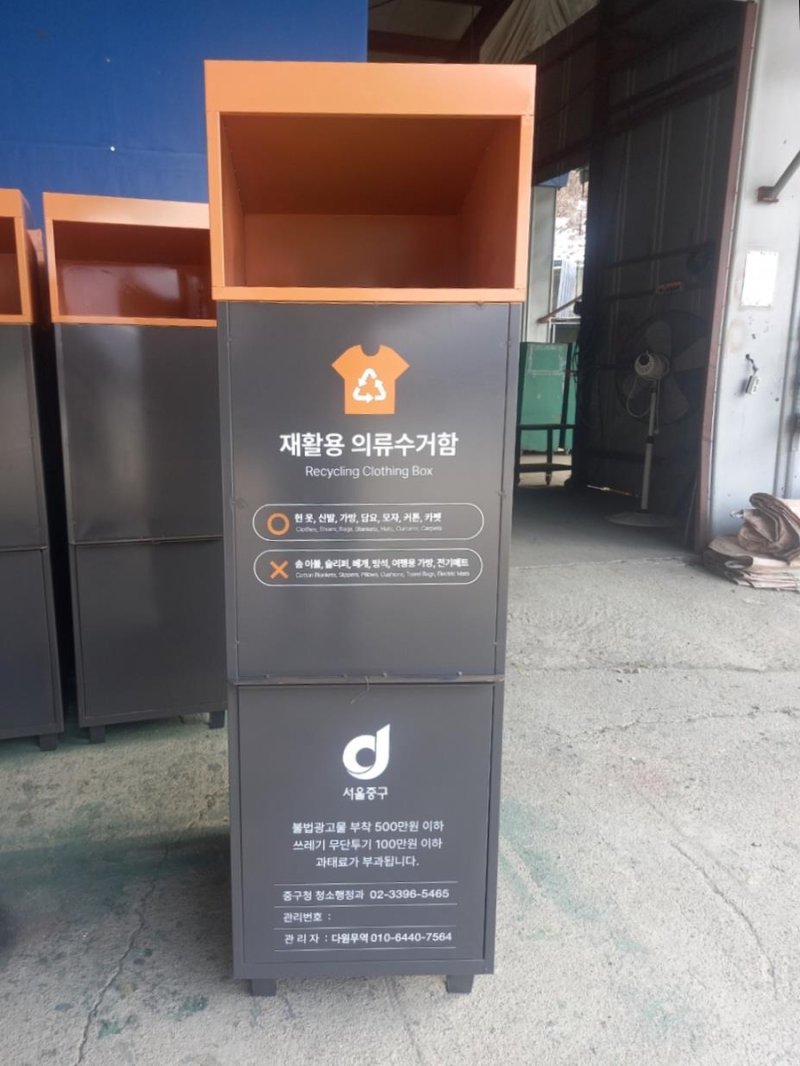
In Korea, the default method for handling used clothing is still incineration or landfilling. Only about 20% of what is collected through clothing donation bins is resold or exported as secondhand garments. The rest is rejected during sorting or found to be contaminated and sent to incinerators. As the share of synthetic fibers increases, so do the problems of carbon dioxide and microplastics released during incineration.
The main reason recycling is so difficult lies in material structure. More than half of the clothing sold in Korea is made from cotton–polyester blends. On top of that, dozens of chemicals used in dyeing and finishing, along with zippers, buttons, and labels, are all entangled in the fabric. Unlike single-material plastics, it is hard to obtain high-quality raw material through simple separation and washing.
Sorting itself is also a challenge. Today, most used clothing is still classified by hand, both in Korea and abroad. Workers rely on their experience to guess the material and separate items by color and shape. This process is slow, prone to misclassification, and virtually incapable of handling large volumes.
The problem does not end there. If sorting is inaccurate, the next stage of recycling technology becomes meaningless. Without precise classification into single-material streams, it is impossible to produce high-quality recycled fibers or raw materials.
Researchers and industry experts worldwide point to this stage as “the biggest bottleneck in textile circularity.” The issue is not that the technologies do not exist, but that the pre-treatment infrastructure needed to make recycling feasible is lacking.
Experts say mechanical recycling alone cannot transform the resource structure of the apparel industry. No matter how much you recycle, if the material cannot return to clothing, the effect on reducing the use of virgin fossil-based feedstocks remains limited.
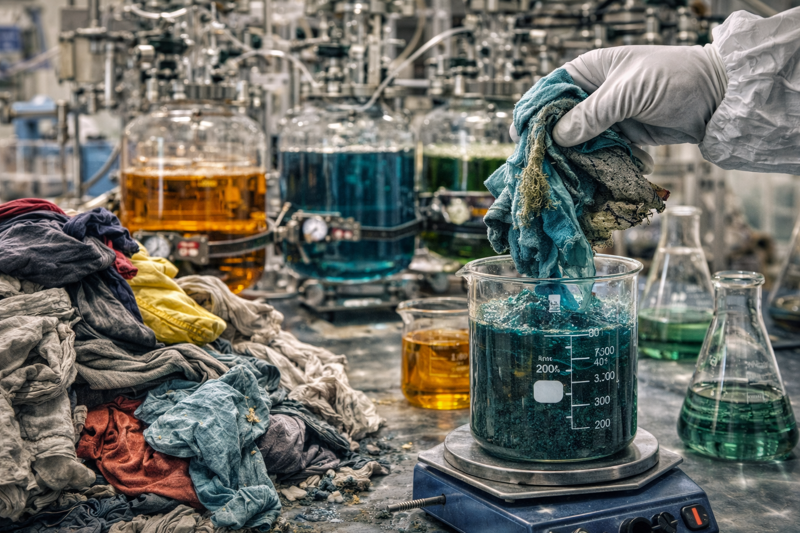
Chemical recycling emerges as an alternative
Chemical recycling is emerging as an alternative to these problems. This method chemically breaks down synthetic fibers such as polyester and nylon into their original monomers or intermediate raw materials, then uses them to produce new fibers. In theory, it allows repeated recycling without quality loss and can significantly reduce the use of petroleum-based feedstocks.
Global market research firms forecast that the recycled fiber market will grow by more than 10% annually and reach a value of about 50 trillion won by 2030. In Korea as well, technologies such as selective depolymerization of blended fibers, solvent-based separation, and depolymerization are entering the demonstration phase.
However, cost and energy use remain major obstacles. Chemical recycling processes require high temperatures and pressures, which means high energy consumption, and recycled raw materials are still 20–30% more expensive than virgin materials. Building commercial-scale plants and securing a stable supply of feedstock are critical challenges.
Some argue that the success or failure of recycling depends more on the system than on the technology itself, and that it is determined at the sorting stage. If waste clothing continues to be discharged in a mixed and contaminated state, even the most advanced technologies become useless. Accurate source separation, local collection infrastructure, and automated sorting systems are therefore essential.
Sorting facilities that automatically identify materials using near-infrared (NIR) sensors, and systems that track material information from the product stage using Radio-Frequency Identification (RFID) or digital tags, are being proposed as potential solutions. The idea is simple: “You can only recycle a garment if you know exactly what it is.”
EU to mandate separate collection from 2025
The European Union (EU) has mandated “separate collection” of clothing and textile waste in all member states starting January 2025. Clothes that were previously discarded with household waste must now be separated like paper and plastic. The European Commission (EC) explained the policy shift by stating that “textile waste has high recycling potential, but most of it is incinerated or landfilled due to mixed disposal.” The core of EU policy is the revised Waste Framework Directive (WFD), adopted in 2024. Under this directive, member states must introduce Extended Producer Responsibility (EPR) schemes for clothing, textiles, and footwear products by April 2028.
Once EPR is in place, all entities that sell clothing in the EU market—including brands, manufacturers, importers, and online retailers—will have to bear the costs of collecting, sorting, and recycling used clothing. From the moment a product is sold, responsibility for its end-of-life is assigned to the company. Products sold in Europe by non-EU companies, including those from China and Korea, are no exception.
The EU also plans to go beyond simple fee-based schemes and introduce an eco-modulation system. Under this approach, products made from single, easily recyclable materials, those with a high share of recycled content, and those with high durability will face lower fees, while blended fabrics and hard-to-recycle products will incur higher costs. The strategy is to push companies to design products with recycling in mind from the outset.
Korea is also considering introducing circular-economy policies for textiles and clothing after 2026. Proposals include mandatory minimum shares of recycled content, stronger take-back obligations, and eco-design standards. Industry players are concerned about the cost burden, but aligning with global brand supply chains is seen as an unavoidable trend.
Korea to launch full-scale R&D this year
As used clothing emerges as a major environmental issue, the Ministry of Climate, Energy and Environment and KEITI are embarking on Research and Development (R&D) not just for “recycling technologies,” but for building a “structure that makes recycling possible.” Starting in 2026, the Ministry of Climate, Energy and Environment will promote mid- to long-term R&D to tackle the used-clothing problem, with a focus on establishing automated sorting infrastructure and a full system for regeneration and productization.In the first phase, the plan is to build sorting systems that use AI and robots to automatically recognize garment shape, color, material, and blend composition, and then classify items in large volumes. The goal is to move away from manual work reliant on human eyes and hands, and to create industrial infrastructure that can serve as the starting point for recycling processes.
In the second phase, the project will pursue a dual strategy: “closed-loop” recycling that turns single-material garments back into recycled fibers, and upcycling of blended materials into products such as automotive and construction materials. Rather than trying to turn every garment back into clothing, the plan is to establish realistic circular pathways tailored to material characteristics.
A KEITI official said, “This project elevates used clothing from an environmental nuisance to a strategic resource and industrial issue, and it is the first attempt to design the entire chain from sorting and regeneration to productization and environmental performance verification.” The official added, “This marks the real beginning of an experiment to move beyond the mere possibility of recycling and build a ‘sustainable recycling structure.’”
Climate, environment, and energy are like two sides of the same coin. Depending on how energy is produced, it can accelerate global warming, while changes in climate and the environment, in turn, affect energy demand and supply.[Lee You-beom’s Eco & Energy column]brings readers in-depth coverage of climate, environmental, and energy issues—which are inseparable from one another—every Saturday. Subscribe to the reporter’s page to receive the column with ease.
[email protected] Lee You-beom Reporter