A genius who saved humanity but died in solitude: 100 minutes of immersion in the play “Turing Machine” [A Glass of Performances for the Weekend]
- Input
- 2026-01-24 10:00:00
- Updated
- 2026-01-24 10:00:00
[The Financial News]"Sometimes it is the people no one imagines anything of who do the things that no one can imagine."This line is often introduced as a famous quote by mathematician Alan Turing, but in fact it is a piece of dialogue created by screenwriter Graham Moore for the film “The Imitation Game.” The film “The Imitation Game” tells the story of Turing, who broke Nazi Germany’s Enigma machine code during World War II. Its original title refers to the test Turing proposed to determine whether a machine can be considered intelligent—the Turing test. In the film, the machine Turing builds to crack the Enigma machine is called the “Turing Machine.”
“Turing Machine” itself carries two meanings. One is the “computing machine” Turing conceived, the theoretical ancestor of today’s computers. The other is the stage play “Turing Machine,” written by Benoit Solès, which opened in January 2026 at the Sejong S Theater in the Sejong Center for the Performing Arts.
His solitude was more impenetrable than any code: Alan Turing
To fully appreciate the play “Turing Machine,” it helps to understand its protagonist, Alan Turing (1912–1954). Turing was a British mathematician and logician who became a war hero by deciphering the German military’s Enigma machine, long considered unbreakable, and thereby helping secure victory for the Allied Forces in World War II. He also devised the concept of the “Turing Machine,” the foundation of modern computing, and created the “Turing test,” which remains a benchmark for artificial intelligence. For this, he is often called the father of computer science.
Yet his life was as tragic as his achievements were monumental. As the film “The Imitation Game” vividly portrays, he is credited with saving an estimated 14 million lives by cracking the Enigma machine, but once his homosexuality became known, he was branded a criminal overnight. Homosexuality was illegal in the United Kingdom at the time, and Turing was ultimately sentenced to chemical castration. Two years later, at the age of 41, he bit into an apple laced with cyanide and died alone. The play “Turing Machine” focuses precisely on this point, shining a light on the profound loneliness of the man behind the great achievements and on the violence of an unjust era.
If the film portrayed the loneliness of a hero, the play portrays the loneliness of a human being
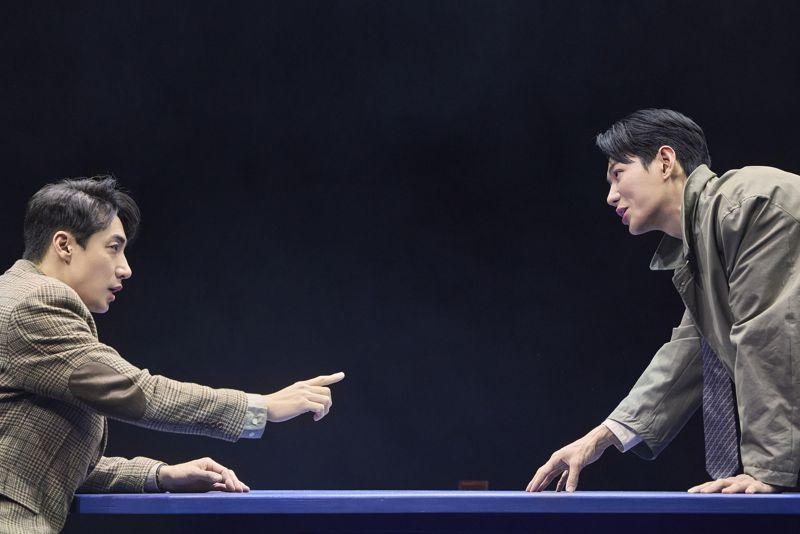
The play opens with Turing calling the police to report a burglary at his home. Detective Michael Ross suspects Turing of being a spy and begins to interrogate him, but Turing, seemingly oblivious, starts talking instead about his “thinking machine” and the Turing test. As Ross, who initially suspects Turing of being a Soviet spy, gradually comes to understand him, the audience’s gaze settles on Turing himself—eccentric, isolated, and brutally honest as he looks back on his own life.
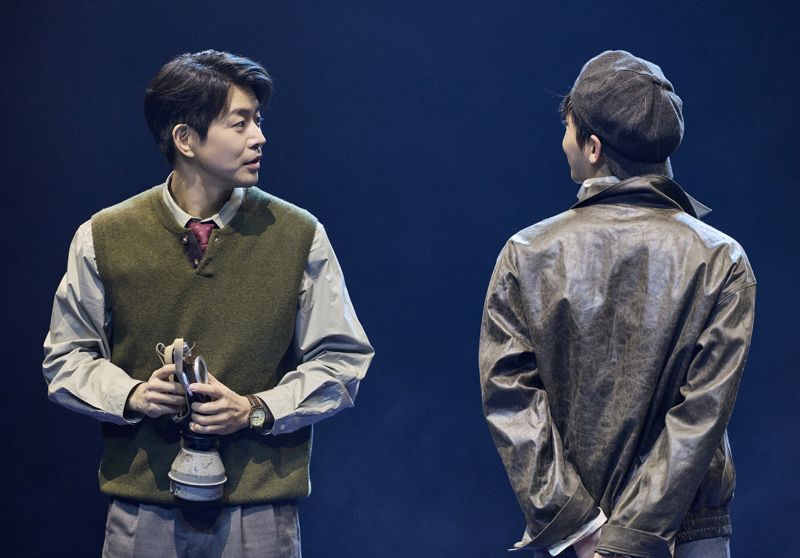
While the film focuses on the breaking of the Enigma machine and depicts Turing as a war hero, along with the shadows and loneliness behind that image, the play quietly follows his identity, the social persecution it brought, and the psychological path that led him, in the end, to bite into that apple. Through this process, the audience joins in deciphering the man Turing, who once seemed like an “inscrutable code,” and comes to resonate deeply with the loneliness he must have felt.
As in its 2023 Korean premiere, the revival is directed by Shin Yu-cheong. The production again uses a four-sided stage, with the audience surrounding the performance space on all sides. Because the seats encircle the stage, spectators can watch Turing from behind or face-to-face, taking in every trembling fingertip and fleeting expression. We in the audience become witnesses to his life and his solitude.
Three Turings, three shades of loneliness
Only two actors appear on stage. The role of Alan Turing is shared by Lee Seung-joo, who played Turing’s counterpart in the premiere, along with Lee Sang-yun and Lee Dong-hwi. Lee Seung-joo heightens Turing’s loneliness with finely tuned emotional detail, while Lee Sang-yun brings a completely different Turing to life—calm yet awkward, emotional, and suffused with quiet isolation. Lee Dong-hwi was injured during rehearsals and is scheduled to make his first appearance on stage on the 1st of next month.
Alongside them, Lee Hwijong, Choi Jung-woo, and Moon Yu-gang each take on multiple roles, including Detective Michael Ross, who interrogates Turing; Arnold Murray, Turing’s lover; and Hugh Alexander, a chess champion and colleague who fought alongside him to crack the Enigma machine. Their performances provide a solid backbone for the play. “Turing Machine” runs through March 1 at the Sejong S Theater in the Sejong Center for the Performing Arts in Gwanghwamun, Seoul.
"What’s actually worth seeing these days?"Each weekend, this performance-obsessed reporter shares stories about the stage with you. In a flood of new productions, many audience members struggle to decide what to see. For them, I introduce works I have personally watched and carefully selected—offering tips for a rich cultural life to brighten your weekend,[A Glass of Performances for the Weekend]Stay tuned.
bng@fnnews.com Kim Hee-sun Reporter