He nodded as Yoon went to declare martial law... Han Duck-soo ultimately stayed silent
- Input
- 2026-01-23 06:56:49
- Updated
- 2026-01-23 06:56:49
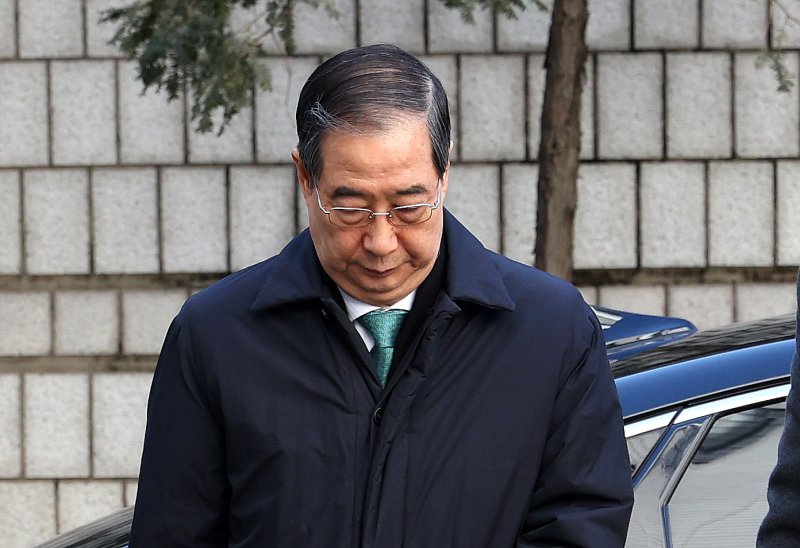
[The Financial News] The court has rejected former Prime Minister Han Duck-soo’s claim that he opposed the declaration of emergency martial law, relying on his appearance in closed-circuit television (CCTV) footage from the Office of the President of South Korea that recorded the “night of martial law” on December 3, 2024.
According to the legal community on the 22nd, Criminal Division 33 of the Seoul Central District Court, presided over by Presiding Judge Lee Jin-kwan, analyzed the presidential office CCTV footage from the time of martial law in intervals of seconds and minutes in its written first-instance judgment on former Prime Minister Han Duck-soo’s case on charges including performing key duties in an insurrection. The court is said to have used this analysis to establish that his statements were false.
Former Prime Minister Han Duck-soo in the ‘night of martial law’ CCTV... only watching Yoon
Former Prime Minister Han Duck-soo has argued that, after hearing of former President Yoon Suk Yeol’s plan to declare emergency martial law, he proposed convening the State Council to gather the views of cabinet members opposed to martial law and thereby dissuade him. However, contrary to his assertion that he requested the State Council meeting in order to block martial law, the CCTV footage shows former Prime Minister Han merely watching the deputy prime minister trying to stop the president. After the two‐minute State Council meeting ended, he even nodded to former President Yoon as Yoon left to declare martial law.
Former Prime Minister Han Duck-soo had previously stated, “It suddenly occurred to me that a State Council deliberation was required in order to declare emergency martial law,” adding, “I was worried that, if I left things as they were, Yoon Suk Yeol would be able to declare emergency martial law as he wished, so I thought, ‘I must persuade Yoon Suk Yeol, who is both a lawyer and a politician, through the mechanism of the State Council.’”
The court, however, concluded that there was no scene in which former Prime Minister Han Duck-soo told cabinet members arriving at the Office of the President of South Korea to try to dissuade former President Yoon. According to the summary of the CCTV footage attached as an appendix to the judgment, at around 10:04 p.m. on the day martial law was declared, while then Deputy Prime Minister for Economic Affairs Choi Sang-mok and then Minister of Foreign Affairs Cho Tae-yul were trying to persuade former President Yoon in the Main Reception Room, former Prime Minister Han remained silent.
The footage also shows that, after the State Council meeting began at 10:16 p.m. and ended two minutes later at 10:18 p.m., former Prime Minister Han Duck-soo nodded to former President Yoon and appeared to say something just before Yoon left the Main Reception Room to declare martial law. The court interpreted this nod as indicating that he was conveying the idea that “the State Council deliberation has been completed.”
At around 10:23 p.m., former Deputy Prime Minister Choi Sang-mok and former Prime Minister Han Duck-soo were seen talking. At that time, Choi reportedly said to Han, “Why didn’t you actively oppose it?” to which former Prime Minister Han replied to the effect that “I did oppose it.” The court stressed regarding this part, “The defendant only insisted, after Yoon had left the room, that he too had opposed the measure.”
Court: “We do not believe the testimony that there were no discussions about cutting off electricity and water”
The court found that at around 11:02 p.m., after the declaration of emergency martial law, then Minister of the Interior and Safety Lee Sang-min showed former Prime Minister Han Duck-soo documents related to martial law, and the two discussed them. This was one of the reasons the court stated it did not believe Lee’s testimony that he had never discussed cutting off electricity and water supplies with former Prime Minister Han.
In the presidential office CCTV footage, then Minister Lee Sang-min is seen in the Main Reception Room between 9:16 p.m. and 9:26 p.m. making a chopping motion with the side of his left hand four times. Former President Yoon likewise makes a downward chopping motion with the side of his right hand, after which Lee nods. The court stated, “Such gestures generally convey the meaning of cutting something off,” and added, “In light of other circumstances, they are understood to signify cutting off electricity and water supplies.”
Meanwhile, former Prime Minister Han Duck-soo initially told the Special Prosecutor's Office for Insurrection that he “seems to have received the proclamation in the president’s office,” but later reversed himself in court, saying he had “spoken speculatively in response to the prosecutor’s questions.” The court nonetheless recognized the evidentiary value of his earlier statement to the special prosecutor and went further, using the protocol concerning interrogation of criminal suspect prepared by the special prosecutor as evidence to undermine the credibility of his in-court testimony.
[email protected] Reporter Kim Hee-sun Reporter