[Editorial] KOSPI 5,000 Sets a New Record, but Stronger Economic Fundamentals Are Needed to Sustain It
- Input
- 2026-01-22 18:25:29
- Updated
- 2026-01-22 18:25:29
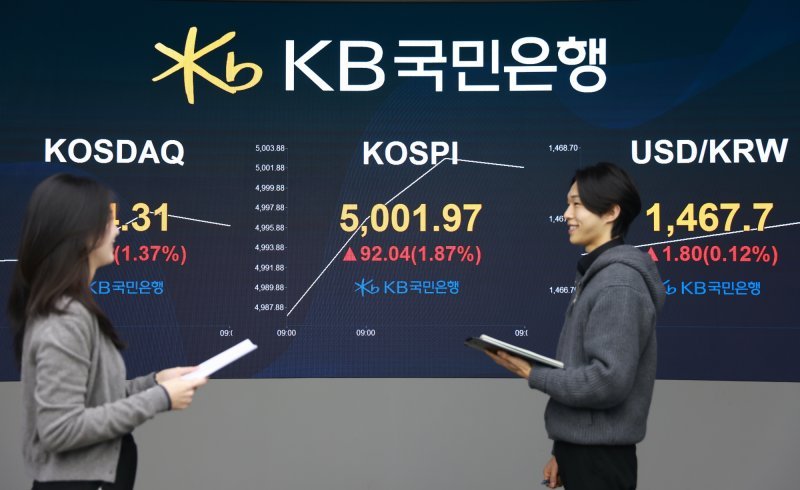
As recently as the first half of last year, the domestic stock market was stuck in a late‐2,000‐point trading range, weighed down by the so‐called Korea discount. While global stock markets climbed steadily higher, Korea’s market alone was left behind. A series of shareholder‐friendly measures rolled out after President Lee Jae-myung took office provided important momentum for domestic share prices. Concerns remain about side effects, but amendments to the Commercial Act of the Republic of Korea, including stronger directors’ fiduciary duties, have helped draw more investors into the market.
Above all, abundant liquidity from global interest‐rate cuts and a rebound in the semiconductor cycle driven by artificial intelligence (AI) demand have been the main forces lifting the market. Much of the increase in KOSPI’s total market capitalization has come from just two stocks, Samsung Electronics and SK hynix. Hyundai Motor Company has also surged in recent days, fueled by heightened expectations for its humanoid robot "Atlas," unveiled at the Consumer Electronics Show (CES), the world’s largest consumer electronics and information technology (IT) trade show. Bloomberg News highlighted the role of these companies in driving the index higher and assessed that Korea has become a key beneficiary of the global AI boom. Coupled with the semiconductor super‐cycle, expectations are growing that the domestic market still has room to climb further.
Riding this momentum, many hope the KOSPI can race on to 6,000 and even 7,000. All the more reason, however, to keep a cool head about the reality. The underlying strength of Korean companies, excluding semiconductors and automobiles, has already been severely eroded. We must face the fact that core industries that once outclassed China—such as steel, petrochemicals, refining and batteries—are now confronting the worst crisis since their founding. It is unrealistic to expect the market to be supported by a handful of large technology stocks alone.
The Bank of Korea (BOK) announced that economic growth in the fourth quarter of last year turned negative from the previous quarter, delivering a considerable shock. Growth came in at minus 0.3%, below earlier expectations. Full‐year growth barely reached 1%. Without rounding, the rate was 0.97%, effectively growth in the 0% range. This was the outcome even though semiconductors enjoyed a major export boom and the auto industry performed well despite U.S. tariff risks. It is a report card that must be taken to heart.
Growth of around 2% is expected this year, but much of that reflects a base effect from last year’s weak performance. The fact that the US Dollar–South Korean Won exchange rate remains stubbornly high, despite even the U.S. Treasury Secretary stepping in verbally, reflects concerns that Korea’s low growth may become entrenched. An economy trapped in a combination of high exchange rates and low growth, with only the stock market on fire, is not a sustainable structure. Corporate earnings and economic fundamentals must support the market if growth, the exchange rate and stock prices are all to find a healthy balance. For that reason, stopgap policies aimed solely at propping up share prices are bound to have limits.
The Commercial Act of the Republic of Korea, which has already been amended twice, has in fact been a negative factor in terms of securing corporate growth potential. Even so, the ruling party is now trying to push through the Third Amendment to the Commercial Act, which would make the retirement of treasury shares mandatory. This would heighten uncertainty and tie the hands of management. The more policies there are that energize companies, the stronger the stock market will become. Policymakers must first focus on strengthening corporations and the economy’s underlying resilience.