Supreme Court of Korea: "Statute of limitations remains on May 18 bereaved families’ claims for consolation money"...quashes lower court ruling and remands
- Input
- 2026-01-22 15:32:26
- Updated
- 2026-01-22 15:32:26
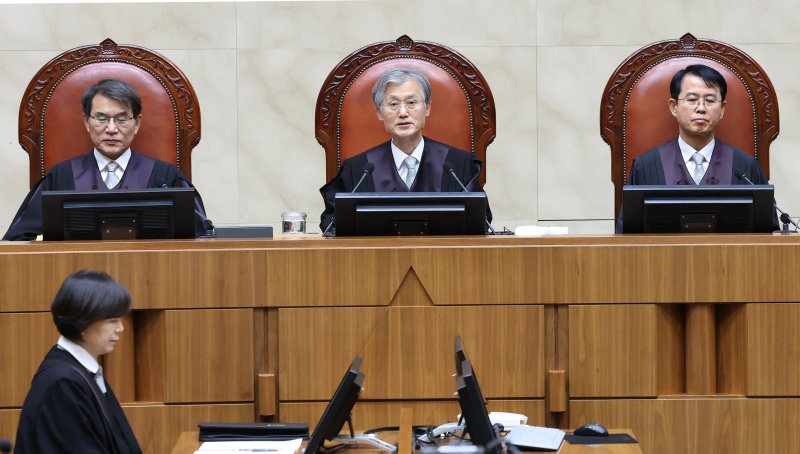
[The Financial News] The Supreme Court of Korea has ruled in favor of the bereaved families of the Gwangju Uprising (May 18 Democratization Movement) in their lawsuit seeking damages for emotional distress from the state.
The Supreme Court Grand Bench, with Tae-ak Rho, Justice of the Supreme Court of Korea, as the presiding justice, on the 22nd quashed a lower court ruling that had dismissed a damages claim filed by 33 plaintiffs, including a bereaved family member identified as Yoo, against the state, and remanded the case to the Gwangju High Court.
The case stems from a provision in the May 18 Democratization Movement Compensation Act, enacted in the 1990s, which has been interpreted to mean that if those involved in the May 18 incident or their bereaved families received compensation under the Act, they could no longer hold the state liable for that incident.
The bereaved families were recognized as persons related to the Gwangju Democratization Movement by the Compensation Deliberation Committee between 1990 and 1994 and, after giving their consent, received compensation payments. On this basis, it was argued that the three-year short statute of limitations for state compensation had already expired. The defendant, the state, contended that there was therefore no further liability for damages for emotional distress.
However, in 2021 the Constitutional Court of Korea held that applying this provision to bar state compensation claims for emotional harm was unconstitutional.
Following that decision, the bereaved families filed lawsuits seeking consolation money for emotional harm, and the court of first instance ruled in their favor. The trial court found that "the ex gratia payment is merely a sum of money with a social-security character and is distinct from consolation money as damages for emotional distress," and concluded that "it cannot be regarded as compensation for emotional harm."
The appellate court, however, reached a different conclusion. The second-instance court held that "it is reasonable to view the three-year short statute of limitations as having begun to run, at the latest, on the date when the persons concerned received the decision from the Compensation Deliberation Committee granting payment of compensation and other benefits," and ruled that "the plaintiffs’ independent claims for consolation money have already been extinguished by prescription." In other words, it found that the claims were time-barred and that additional lawsuits were no longer possible.
On Thursday, however, the Supreme Court Grand Bench emphasized that, until the unconstitutional provision was struck down, the bereaved families had been unable to bring lawsuits against the state, and it underscored the state’s responsibility to provide compensation.
The Supreme Court of Korea stated, "The plaintiffs were unable to exercise their right, as family members of those involved in this case, to claim consolation money for emotional distress until May 27, 2021, the date of the unconstitutional decision in this case," and held that "there existed an impediment that prevented the exercise of the family members’ independent right to claim consolation money."
The Court went on to point out that "in the process of belatedly enacting and implementing the relevant compensation statutes, the state defined the subjects and scope of compensation narrowly and sought to bring the compensation procedures to a swift close, which contributed to this outcome."
[email protected] Lee Hwan-joo Reporter