“Aging Countryside” Farm Population Falls Below 2 Million
- Input
- 2026-01-22 13:27:58
- Updated
- 2026-01-22 13:27:58
[The Financial News] The number of people living in farming households in Korea has fallen below 2 million for the first time. While aging in rural areas is accelerating, fewer young people are moving to the countryside. With the number of people working in agriculture, forestry, and fisheries also declining, concerns are growing that rural communities face an existential crisis.
Kim Yonglyoul, head of the Agricultural Outlook Center at the Korea Rural Economic Institute (KREI), stated at the “Agricultural Outlook 2026” event held on the 22nd at Lotte Hotel in Songpa District, Seoul, that “the farm population last year was 1.982 million, down 22,000 people (1.1%) from the previous year.” This is the first time the farm population has dropped below 2 million.
KREI expects this downward trend in the farm population to continue. According to the institute, the farm population this year is projected to fall to 1.945 million, a further decrease of 37,000 people (1.9%) from last year. As recently as 2010, the farm population was still in the 3 million range, but it has plunged by more than 1 million in just 15 years.
The number of farming households is also shrinking. The 970,000 farming households recorded last year are expected to decline to 963,000 this year. The number of farming households has already been below 1 million since 2023.
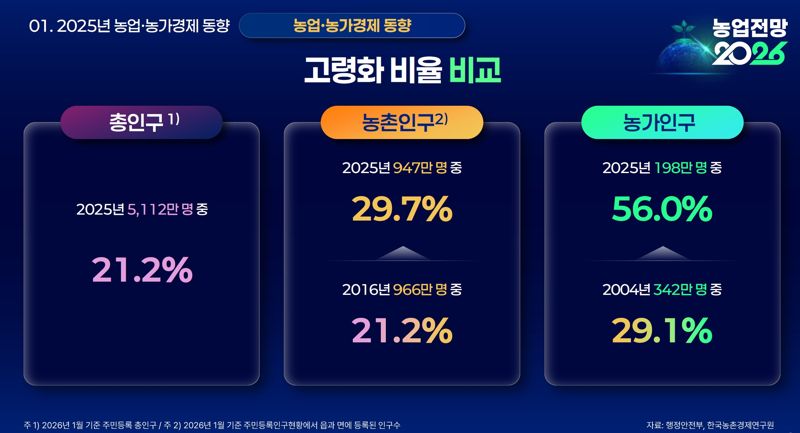
The main driver of the farm population decline is aging. As of last year, people aged 65 or older accounted for 56.0% of the farm population, up 0.2 percentage points from the previous year. This share is forecast to rise further to 56.6% this year.
This situation is far more serious than aging in the overall population. Last year, people aged 65 or older made up 21.2% of the total Korean population, but the share in rural towns and townships (eup and myeon areas) reached 29.7%.
Kim said, “We need to compare the pace of aging in rural areas with that of the overall population,” noting that “the point at which the overall population’s aging rate reached 21.2% was 2016, meaning rural areas are experiencing aging about 10 years earlier.” He stressed, “Changes in the rural population are an indicator that shows what Korea will look like 10 years from now.”
Along with the decline in the farm population, the number of people employed in agriculture, forestry, and fisheries, as well as young farmers, is also falling rapidly. The number of people employed in agriculture, forestry, and fisheries last year was estimated at 1.395 million, down 90,000 from 1.485 million in 2024. This figure is expected to drop further to around 1.38 million this year.
The population of young farmers aged 20 to 39 plummeted from 769,000 in 2000 to 136,000 in 2024. Over the same period, the number of rural towns and townships with fewer than 3,000 residents—classified as depopulated areas—increased from 458 to 725, a 1.58-fold rise.
[email protected] Reporter Choi Yongjun Reporter