Effect of 13 trillion won in consumption coupons has faded: Q4 growth at -0.3%, government still sees a "recovery trend"
- Input
- 2026-01-22 11:32:15
- Updated
- 2026-01-22 11:32:15
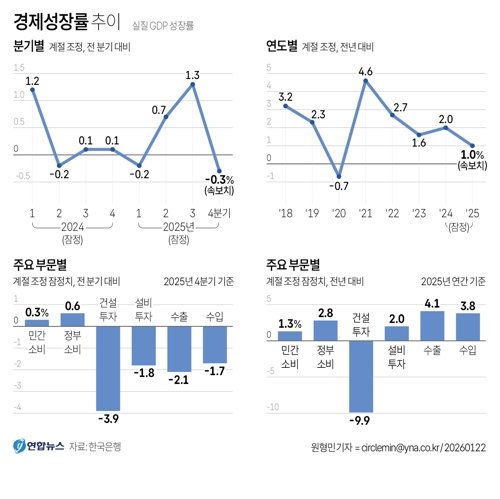
According to Financial News, last year’s fourth-quarter Gross Domestic Product (GDP) growth rate was recorded at minus 0.3%. The decline was largely driven by a contraction in construction and facility investment, as well as base effects after strong growth in the previous quarter. Overall, however, full-year growth barely scraped by at 1.0%, falling short of the estimated potential growth rate of 0.8%. The effect of the 13 trillion won in consumption coupons distributed nationwide in the second half of last year under the Livelihood Recovery Subsidy program effectively vanished after just one quarter. The government’s growth target for this year is 2.0%, and it expects a modest recovery to continue, but high exchange rates, persistent inflation, and tariffs imposed by the United States are creating significant uncertainty.
On the 22nd, the Ministry of Economy and Finance stated that "the underlying economic recovery trend is continuing" as it presented the government’s assessment of last year’s fourth-quarter and annual preliminary growth figures.
According to the BOK and the Ministry of Finance and Economy, GDP in the fourth quarter of last year grew 1.3% from a year earlier but fell 0.3% from the previous quarter. The quarterly growth rate had dropped to -0.2% in the first quarter, then rebounded to 0.7% in the second quarter and 1.3% in the third quarter. In the fourth quarter, however, it slipped back into negative territory.
On an annual basis, last year’s growth rate was 1.0%.
Kim Jae-hoon, Director-General for Economic Policy at the Ministry of Finance and Economy, explained, "In the third quarter of last year, growth reached its highest level in 15 quarters, so base effects, along with the impact of the Chuseok holiday falling in October for the first time in eight years, led to a quarter-on-quarter decline." He added, "However, compared with a year earlier, the economy grew in the mid-1% range, so the underlying recovery trend is being maintained."
Specifically, due to martial law and other political turmoil, growth in the first half of last year was limited to 0.3%. From the second half, when the Lee Jae-myung administration took office, the growth rate expanded to 1.7%. Quarter-on-quarter, growth averaged 0.2% in the first half and 0.5% in the second half. Kim noted, "The 0.5% growth rate in the second half is in line with the potential growth rate of around 0.4–0.5%."
The full-year growth rate of 1.0% last year is broadly in line with projections made by major domestic and international institutions. Forecasts for this year’s growth range from 1.8% to 2.1%.
By sector, private consumption slowed to 0.3% in the fourth quarter of last year, but the recovery trend continued. In the previous quarter, the third quarter, private consumption had surged 1.3%, the strongest increase in three years, thanks to the 13 trillion won in consumption coupons. Because that effect did not carry over into the fourth quarter, it confirmed that cash-type coupons are a short-lived policy tool with highly temporary impact.
Aside from private consumption, which grew 0.3%, all major components were in negative territory: construction investment fell 3.9%, facility investment declined 1.8%, and exports dropped 2.1%.
Among these, the construction sector poses the biggest risk to the economy. Construction investment in the fourth quarter of last year fell 3.9% from the previous quarter, weighed down by base effects, the October Chuseok holiday, and the impact of the fire at the National Information Resources Service. However, major institutions expect construction investment to return to positive growth this year, supported by the completion of semiconductor plants, an increase in the infrastructure budget, and improved order intake.
Kim projected, "Last year, construction investment significantly dragged down overall growth, but this year, as leading indicators such as cement shipments improve, it is expected to become a positive factor for the economy."
[email protected] Jung Sang-geun, Kim Chan-mi Reporter