"This came out of her?" A huge mass found in a 6-year-old girl’s abdomen turns out to be hair [Health Talk]
- Input
- 2026-01-22 10:26:47
- Updated
- 2026-01-22 10:26:47
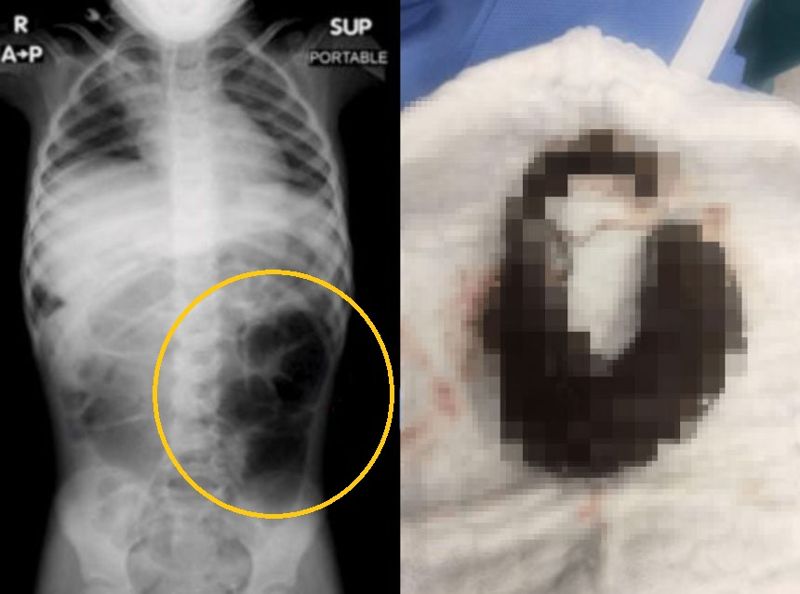
[The Financial News] A case has been reported in which a clump of hair was found inside the abdomen of a 6-year-old girl who had been complaining of abdominal pain.
According to a report published on the 22nd in the Cureus medical journal, a 6-year-old girl in the Kingdom of Saudi Arabia (KSA) underwent testing after suffering abdominal pain and persistent indigestion. The examination revealed a large foreign body in her stomach.
Surgery later revealed that the foreign body in her stomach was actually a mass of hair. The hairball extended in a long strand from the stomach down into the small intestine.
The medical team stated, "When recurrent abdominal pain, vomiting, and loss of appetite persist for a long time, this condition should be suspected." They emphasized, "It is crucial to detect it early through imaging studies and to initiate prompt treatment."
Similar cases of large hair masses in the stomach have been reported multiple times in the past. In 2014, a 2.4-kilogram hairball was removed from the abdomen of a 19-year-old woman in the Republic of India. In 2019, a 4.5-kilogram mass was taken out of the body of an 18-year-old girl living in the United States of America (U.S.). She had developed intestinal obstruction, suffered severe abdominal pain, and experienced significant weight loss.
Compulsive hair-eating behavior
Rapunzel syndrome is a rare disorder in which Trichotillomania (hair-pulling disorder) and trichophagia (hair-eating) occur together. Patients pull out their own hair, eat it, and the hair accumulates in the stomach as a solid mass.
The name comes from the fairy tale Rapunzel by the Brothers Grimm. In the story, the girl Rapunzel, locked in a tower, connects with the outside world through her long hair hanging down. Similarly, in this syndrome, a hair mass that begins in the stomach extends like a long strand into the intestines, which inspired the name.
The condition is reported relatively more often in girls during childhood and adolescence. Hair is not digested and tends to accumulate in the stomach. Over time, it hardens into a compact mass that can fill the stomach and, in severe cases, extend into the intestines, causing serious symptoms such as abdominal pain, vomiting, malnutrition, and bowel obstruction.
In the early stages, there are often no symptoms, which makes the condition difficult to detect. By the time symptoms appear and the problem is discovered, the hairball has usually grown large and firm enough to severely block the stomach. Possible symptoms include abdominal pain, abdominal bloating, nausea, weight loss, vomiting after meals, and pain or discomfort beneath the rib cage. As the hair mass enlarges over time, the risks increase for obstructive jaundice, physical blockage of the abdomen or small intestine, erosion of the stomach and intestinal walls, perforation of the small intestine, peritonitis, and acute pancreatitis.
Hair that accumulates in the stomach can clump together into a hard, ball-like mass and damage the digestive tract. In severe cases, it can be fatal. In 2017, a girl in the United Kingdom of Great Britain and Northern Ireland (UK) who had Rapunzel syndrome died after hair blocked her digestive system, a case that was reported in the medical literature.
Diagnosis is made through abdominal examination, stool tests, and imaging studies such as computed tomography (CT) and X-ray imaging. Because the behavior often arises as a way for children and adolescents to cope with psychological instability or stress, psychiatric treatment is provided alongside medical care. Surgery involves removing the hair bezoar that extends from the stomach into the small intestine.
Even after surgery, psychiatric counseling and long-term follow-up are essential to understand why the urge to eat hair developed and to prevent the behavior from recurring.
moon@fnnews.com Moon Young-jin Reporter