A ‘permanent membership’ for $1 billion in frozen assets: Vladimir Putin’s bet on Donald Trump’s Board of Peace
- Input
- 2026-01-22 10:24:49
- Updated
- 2026-01-22 10:24:49
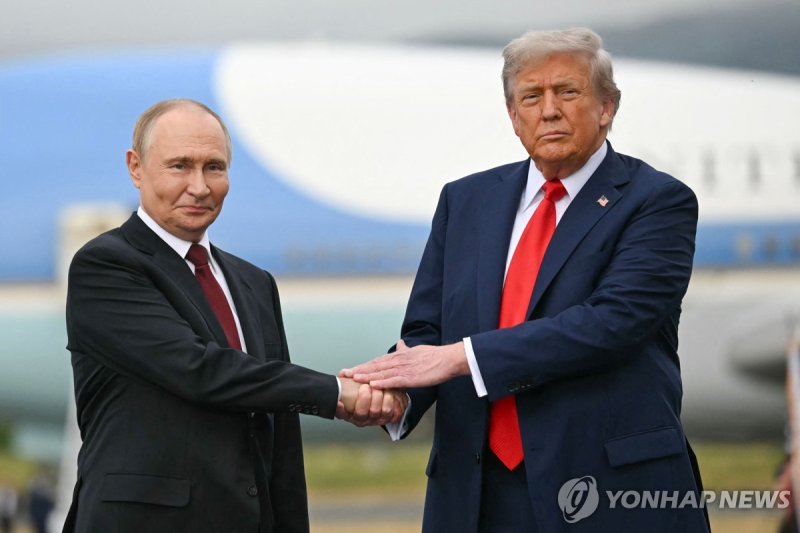
[The Financial News] Russian President Vladimir Putin has expressed his willingness to contribute $1 billion (about 1.45 trillion won) to the Board of Peace on the Gaza Strip being pushed by U.S. President Donald Trump and to join as a "permanent member state." The move is seen as an attempt to widen Russia’s diplomatic room for maneuver after it became isolated by the Russo-Ukrainian War.
According to TASS Russian News Agency, Vladimir Putin said on the 21st (local time) at a meeting of Russia’s Security Council that Donald Trump had asked him to join the Board of Peace and that he was discussing whether to participate. He indicated that the $1 billion required as a condition for obtaining a "permanent member" status with no term limits could be paid out of Russian assets frozen by the U.S. government.
Vladimir Putin stated, "The frozen assets remaining in the United States can be used to rebuild areas damaged by the war after a peace agreement is signed between Russia and Ukraine." By doing so, he directly floated the idea of repurposing frozen assets as reconstruction funds once the Russo-Ukrainian War ends.
The West has imposed sweeping financial sanctions on Russia to hold it accountable for its February 2022 invasion of Ukraine. The European Parliamentary Research Service (EPRS) and the U.S. Department of the Treasury (Treasury Department) estimate the value of Russia’s frozen assets at about $300 billion. Most of these funds are locked up in Europe, while assets frozen in the United States of America (USA) amount to roughly $5 billion.
Western countries have regarded these frozen assets not merely as a sanctions tool, but as a core pool of collateral to secure postwar reparations and the costs of rebuilding Ukraine. In their plan to clearly establish Russia’s responsibility for violating international law and to recoup, in monetary terms, the damage caused by the invasion, the frozen assets carry both symbolic and practical weight.
For this reason, in Donald Trump’s blueprint to lead peace talks to end the war in Ukraine, defining the nature of Russia’s invasion and deciding how to handle the frozen funds are seen as key issues. Russia does not acknowledge that it launched an invasion and maintains its long-standing position that the conflict is a "defensive war" triggered by the West’s expansion into Eastern Europe.
Against this backdrop, Vladimir Putin’s declaration that he is willing to use frozen assets linked to the Russo-Ukrainian War to help fund the Board of Peace led by Donald Trump is being viewed as an attempt to use Trump as leverage to redefine the nature of the war. Since the start of his second term in office, Donald Trump has taken the lead in cease-fire talks on Ukraine and has repeatedly adjusted his stance under pressure and lobbying from both sides.
Taking into account Donald Trump’s political leanings and negotiating style, Russia has pursued a strategy of offering public praise and economic incentives in an effort to shape a favorable negotiating environment. Observers also interpret Vladimir Putin’s emphasis on a membership status without term limits as signaling Russia’s desire to return as a "rule-maker" amid the current turmoil in global governance.
Donald Trump has suggested that the Board of Peace, initially aimed at ending the war and rebuilding the Gaza Strip, could later be expanded to resolve other regional conflicts and effectively replace some functions of the United Nations (UN). However, since its invasion of Ukraine, Russia’s isolation in the international community has deepened due to collective sanctions by the West and the erosion of its soft power.
In particular, Vladimir Putin is wanted by the International Criminal Court (ICC) on war crimes charges, including the alleged abduction of Ukrainian children. Permanent members of the United Nations Security Council (the five veto-wielding powers) such as France and the United Kingdom (UK) are taking a negative stance on joining the Board of Peace, citing the fact that Russia, which they view as a war-crimes state, has been invited.
In contrast to Donald Trump, who has treated Vladimir Putin’s participation as a foregone conclusion, Vladimir Putin stressed that Russia’s entry into the Board of Peace has not yet been finalized and that he will continue to watch the international response. He said he would review the relevant documents received by the Minister of Foreign Affairs, consult with Russia’s strategic partner countries, and then announce an official position.
On the 22nd, Vladimir Putin is scheduled to hold talks with Palestinian Authority (PA) President Mahmoud Abbas to discuss arrangements for interim governance in the Gaza Strip and the future direction of the Board of Peace’s activities.
#Putin #Trump #GazaStrip #BoardOfPeace #RussianFrozenAssets
[email protected] Kim Kyung-min Reporter