[Editorial] Grand Leap Vision Is Welcome, but National Unity Must Come First
- Input
- 2026-01-21 18:13:14
- Updated
- 2026-01-21 18:13:14
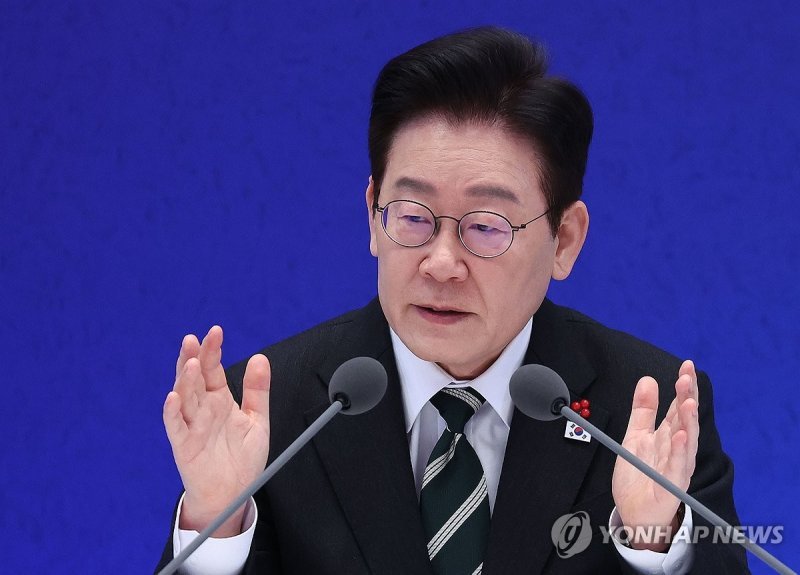
The Lee Jae Myung administration began its term amid political turmoil, including a martial law crisis and impeachment proceedings in its first year. Having overcome that chaos, its second year is a crucial period in which it must restore public trust through visible results. The president’s repeated declarations of a "great leap" can be seen as an expression of that determination.
The governing philosophy outlined by the president can be summed up as pragmatic realism that moves beyond ideology, factionalism, and political strife. To put this into practice, however, strong driving power is essential. Over the past year, Korean society has squandered too much time and energy in the vortex of martial law and impeachment. If the engine of national unity does not start first, the ignition for a great leap forward will not catch. In the current climate of deep conflict and division, talk of a great leap risks remaining an empty slogan.
In that regard, some of the president’s answers were disappointing. On the controversy surrounding Lee Hye-hoon, the nominee for minister of the Ministry of Planning and Budget, he stated that "there do seem to be issues, but it is only fair to hear her explanation first." Lee Jae Myung appointed a conservative figure in an attempt to move toward a more unified nation. In reality, however, voices questioning the nominee’s qualifications are growing louder across both the ruling and opposition camps.
Some are even calling within the Office of the President of South Korea for her nomination to be withdrawn. There appears to be a gap between this broad public sentiment and the president’s perception. Even if the intention is good, making a firm and swift decision on appointees whose problems have come to light is the way to uphold the spirit of unity.
Regarding calls from the opposition party leader for a one-on-one summit, the president effectively declined, saying, "For now, dialogue between the ruling and opposition parties should come first." In principle, it is reasonable to insist that working-level consultations between the parties precede any summit. Yet it is also important to recognize that Korean society is suffering from intense ideological conflict and partisan confrontation, and to treat this as a key yardstick in major decision-making.
At times like this, direct dialogue between top political leaders can serve as a lever to bring together public opinion that has been split into rival camps. The ruling party, which holds an overwhelming majority in the National Assembly, is almost certain to dominate the legislative agenda. The opposition party will then attack, claiming that Cheong Wa Dae (the Blue House) and the ruling party are railroading bills and running state affairs unilaterally. The path toward "smooth implementation of state tasks through compromise and concessions" could become far more treacherous.
The five growth strategies presented by the president are positive in terms of their overall direction. Yet all of these plans can only be realized if the foundation of national unity, mentioned earlier, is solid. Prosecution Reform and other social reforms, a major shift in economic policy, and steps toward peace cannot move forward even one step without broad public consensus and cooperation from the political sphere. This is a moment that calls for a delicate sense of balance: maintaining reform momentum while at the same time building social agreement.
If the Lee Jae Myung administration, now entering its second year in power, truly seeks a great leap forward, it must first demonstrate unifying leadership. It should establish a thorough pre-appointment vetting system and exercise great caution with nominees who run counter to public opinion. It must also keep channels of communication with the opposition party wide open and take the lead in practicing the spirit of cooperative governance. That is the true spirit of unity, and it is the first step toward the genuine great leap that the public is hoping for.