"One in Two People Plans to Spend More"...Rising Hopes for Economic Recovery in the Second Half
- Input
- 2026-01-22 06:00:00
- Updated
- 2026-01-22 06:00:00
[The Financial News] More than half of Koreans plan to increase their consumption this year compared with last year. However, spending sentiment diverges sharply by income level, and many households are still judged to have little actual capacity to spend.
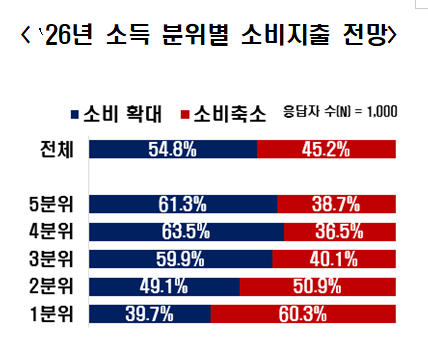
The Federation of Korean Industries (FKI) announced on the 22nd the results of its "2026 Household Consumption Expenditure Plan Survey," conducted by polling agency Mono Research on a sample of 1,000 people aged 18 and older. According to the survey, 54.8% of respondents said they plan to spend more this year than last year, while 45.2% said they intend to cut back, indicating that expectations for higher consumption are dominant overall.
A clear polarization emerged by income level. Among the bottom 40% of households (1st and 2nd income quintiles), more respondents said they would reduce spending, whereas the top 60% (3rd to 5th quintiles) expressed an intention to increase consumption.
Reasons cited for planning to spend more included changes in living environment and personal values (18.7%), expectations of higher employment and labor income (14.4%), and price stabilization (13.8%). In contrast, those planning to cut spending most often pointed to high inflation (29.2%), concerns about declining income (21.7%), and reduced asset income (9.2%).
Households' actual capacity to spend remains limited. A total of 41.2% of respondents said their room to spend was "insufficient," while only 8.3% answered that it was "sufficient." To make up for this shortfall, respondents said they were considering measures such as taking on side jobs or part-time work (34.0%) and cashing out savings or installment deposits (27.4%).
The biggest risk factor for consumption this year was high inflation and a weak currency, cited by 44.1% of respondents. This was followed by the burden of taxes and public utility charges (15.6%), and private-sector debt and financial instability (12.1%).
In total, 53.3% of respondents expected consumption to pick up in the second half of this year or later. Specifically, 22.4% pointed to the second half of 2026, 19.3% to 2027, and 11.6% to 2028 or beyond. As policy priorities, respondents highlighted stabilizing prices and exchange rates (44.0%), easing the burden of taxes and public fees (19.2%), and expanding livelihood support (12.3%).
Lee Sang-ho, Head of the Economic and Industrial Affairs Division at the Federation of Korean Industries (FKI), said, "Even though households have limited capacity to spend, people are showing a willingness to increase consumption," adding, "It is necessary to improve the consumption environment through measures such as expanding income tax deductions, cutting individual consumption taxes, and easing regulations on large discount stores."
[email protected] Reporter Lee Dong-hyuk Reporter