"Korean men are getting this cancer the most"... It is not lung cancer but prostate cancer [Health Issue]
- Input
- 2026-01-21 10:18:03
- Updated
- 2026-01-21 10:18:03

[The Financial News] In 2023, prostate cancer ranked first for the first time ever among cancers diagnosed in Korean men. The five-year survival rate for cancer patients over the most recent five-year period also reached about 74%, continuing its steady improvement.
The Ministry of Health and Welfare and the Korea Central Cancer Registry (KCCR) at the National Cancer Center (NCC) announced the "2023 National Cancer Registration Statistics" on the 20th, which contained these findings.
Prostate cancer tops the list for men... Driven by aging population and Westernized diets
A total of 288,613 new cancer cases occurred in 2023. Of these, 151,126 were men and 137,487 were women. This represents a 2.5% increase from the previous year and is about 2.8 times higher than in 1999, when cancer statistics were first compiled and 101,854 cases were recorded.
When men and women are combined, thyroid cancer was the most common cancer, followed by lung, colorectal, breast, stomach, prostate, and liver cancer. Among women alone, the most common cancers were breast, thyroid, colorectal, lung, stomach, and pancreatic cancer, in that order.
Among men in particular, prostate cancer overtook lung cancer for the first time since statistics began and became the most frequently diagnosed cancer. Prostate cancer ranked only ninth in 1999, but cases have risen rapidly due to accelerated population aging, Westernized eating habits, and increasing obesity.
Lee Jung-gyu, Director General for Public Health Policy at the Ministry of Health and Welfare, explained, "This result symbolically shows that changes in the population structure are reshaping the overall pattern of cancer incidence."
Assuming the current cancer incidence rates remain unchanged, the lifetime probability of developing cancer is estimated at about 1 in 2 for men (44.6%) and about 1 in 3 for women (38.2%).
Seven out of ten cancer patients survive at least five years
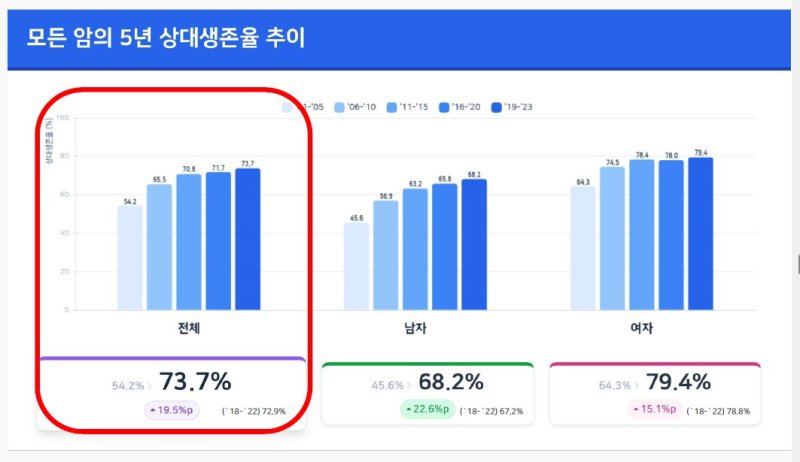
Thanks to advances in medical technology and early screening, survival rates have continued to rise. The five-year relative survival rate for patients diagnosed over the most recent five years (2019–2023)—that is, the probability of surviving five years compared with the general population—was 73.7%. This is 19.5 percentage points higher than the 54.2% relative survival rate for patients diagnosed between 2001 and 2005.
For cancers detected at an early stage, the survival rate was 92.7%. However, among patients diagnosed after distant metastasis, the survival rate dropped to 27.8%. This underscores how critical early diagnosis is.
By cancer type, thyroid cancer (100.2%), prostate cancer (96.9%), and breast cancer (94.7%) showed high survival rates. In contrast, liver cancer (40.4%), lung cancer (42.5%), and pancreatic cancer (17.0%) had relatively low survival rates. That said, survival for lung, stomach, and liver cancer has improved dramatically—by around 20 percentage points—compared with 20 years ago.
Era of 2.73 million people living with cancer... "Mortality is lower than in major countries"
As of 2023, 2,732,906 people were living with or had been cured of cancer—1,193,944 men and 1,538,962 women—meaning about 1 in every 19 residents. Here, "people living with cancer" refers to those who were diagnosed with cancer between 1999 and 2023 and were still undergoing treatment or considered cured as of January 1, 2024.
Korea’s cancer incidence rate was 288.6 cases per 100,000 people, similar to that of other major countries. However, the cancer mortality rate was 64.3 deaths per 100,000 people, significantly lower than Japan’s 78.6 and the United States’ 82.3. The Ministry of Health and Welfare attributed this to continued improvements in early detection and treatment outcomes.
Yang Han-kwang, President of the National Cancer Center, noted, "With 2.73 million people in our country now living with cancer and the number of elderly cancer patients increasing, the importance of cancer control is growing even further." He emphasized, "Through the national cancer control program, we will systematically promote not only prevention and treatment but also support for cancer survivors."
[email protected] Kim Hee-sun Reporter