"Nvidia down 4%"... Debt‐fueled retail investors who poured 3 trillion won into Samsung and SK hynix wake up to an uneasy morning
- Input
- 2026-01-21 05:51:42
- Updated
- 2026-01-21 05:51:42
Financial News –As the stock market rallies, so-called "debt-fueled" investing, where people borrow money to buy stocks, continues to surge.
5 trillion won a day leaving banks... margin loans hit a record 29 trillion won
According to the Korea Financial Investment Association (KOFIA) on the 21st, demand deposit balances at the five major commercial banks have been shrinking by an average of 5 trillion won a day. In contrast, customer deposits at securities firms have increased by 40 trillion won from a year earlier, surpassing 90 trillion won, while the number of new stock trading accounts has been growing by 30,000 a day, adding up to 12 million new accounts.
Outstanding margin balances used for leveraged stock purchases have also jumped. As of the 16th, domestic margin loan balances stood at 28.7456 trillion won, the highest level on record. That represents a surge of 75% compared with 16.4215 trillion won on January 15 last year.
Recently, margin financing has been concentrated in large-cap names such as Samsung Electronics Co., Ltd. (Samsung Electronics), with 2.8785 trillion won, and SK hynix Inc. (SK hynix), with 1.8445 trillion won. Analysts say this concentration somewhat reduces the risk of forced liquidations.
Samsung Electronics, whose share price has risen more than 20% so far this year, had margin balances of 1.8872 trillion won as of the 19th, based on settlement date. That is a 126% jump from 834 billion won at the end of June last year.
Margin balances for Hyundai Motor Company (Hyundai Motor), which has begun to be re-rated as a robotics company, have also surged this month. The balance, which stood at 285.7 billion won at the end of last year, swelled 45% in just two weeks to 414.4 billion won.
SK hynix’s margin balance, which had plunged to 884.1 billion won in December of the same year after it was designated an investment warning stock, climbed back to 1.3108 trillion won as of the 19th of this month.
For some small and mid-cap stocks, margin balances amount to as much as 6–7% of total listed shares. At present, the stock with the highest margin balance ratio on the main board is YG Plus Inc. (YG Plus) at 7.08%. It is followed by Dawon Cable Co., Ltd. (Dawon Cable) at 7.07%, ILSHIN STONE CO., LTD. (ILSHIN STONE) at 6.63%, Dongbang Transport & Logistics Co., Ltd. (Dongbang Transport & Logistics) at 6.52%, and DAEHO AL Co., Ltd. (DAEHO AL) at 6.49%.
Some analysts warn that the Korea Composite Stock Price Index (KOSPI) has entered a short-term overheating phase and could remain highly volatile for a while. With only about 110 points left before the KOSPI reaches 5,000, margin trading by individual investors has expanded sharply.
Investor deposits, the cash that investors park at securities firms for stock trading, have exceeded 90 trillion won for the first time ever this year. When the KOSPI first hit 4,000 points on October 27 last year, investor deposits stood at 80.091 trillion won and then jumped 3.43% in a single day to 83.8731 trillion won on the 28th. Riding the bull market, investor deposits continued to climb and reached 92.603 trillion won on the 15th.
US big tech stocks tumble... Wall Street’s fear gauge spikes
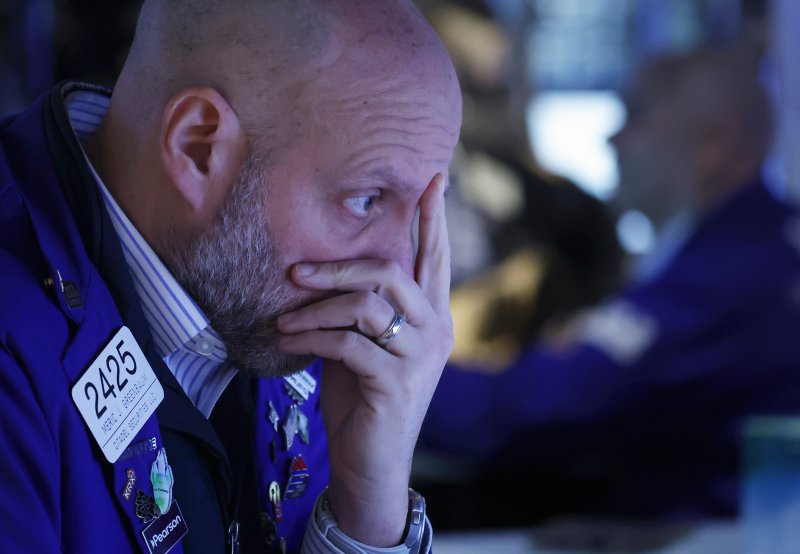
Meanwhile, New York stocks slumped on fears of a trade war over Greenland.
The Dow Jones Industrial Average (DJIA) fell 870.74 points, or 1.76%, from the previous session to close at 48,488.59. The S&P 500 Index plunged 143.15 points, or 2.06%, to 6,795.86. The NASDAQ Composite Index (NASDAQ) also tumbled 561.07 points, or 2.39%, to finish at 22,954.32.
Losses deepened, led by big tech names. Nvidia Corporation (Nvidia) sank 8.16 dollars, or 4.38%, to 178.07 dollars, while Alphabet Inc. (Alphabet) slid 8.18 dollars, or 2.48%, to 322.16 dollars. Tesla, Inc. (Tesla) dropped 18.25 dollars, or 4.17%, to close at 419.25 dollars.
The Cboe Volatility Index (VIX), often called Wall Street’s "fear gauge," spiked higher. The VIX jumped 1.25 points, or 6.63%, to 20.09, breaking above the psychologically important 20 level.
[email protected] Moon Young-jin Reporter