Han Duck-soo faces first-instance verdict in ‘aiding insurrection ringleader’ case in one day: key legal issues
- Input
- 2026-01-20 15:53:45
- Updated
- 2026-01-20 15:53:45
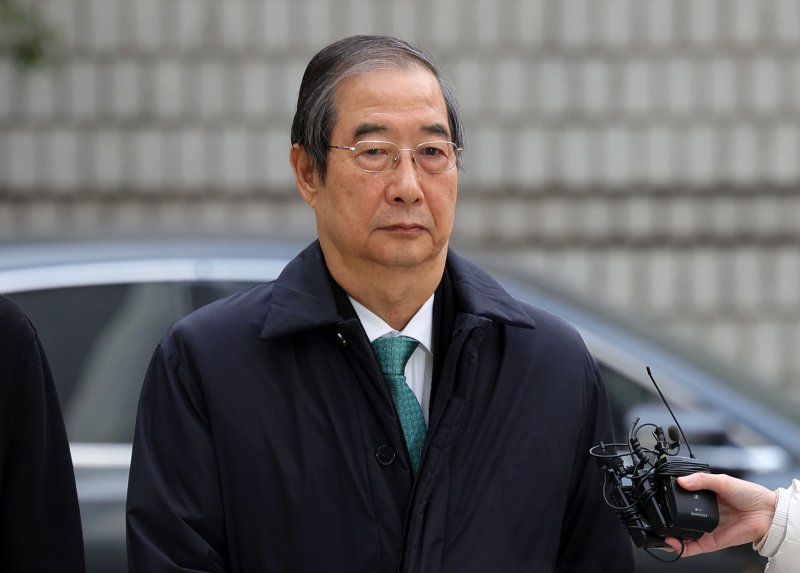
[The Financial News] The first-instance verdict for former Prime Minister of South Korea Han Duck-soo, who has been put on trial on charges of failing to actively block and effectively abetting former President Yoon Suk Yeol’s December 3 emergency martial law, will be handed down on the 21st. The court is expected to assess the legal issues surrounding the degree of Han’s awareness and his actual conduct. As this is the first ruling in the series of cases involving insurrection charges related to the December 3 emergency martial law, it is drawing significant attention and is expected to have a major impact on subsequent trials of other defendants, including former President Yoon, on insurrection charges.
According to the legal community on the 20th, Criminal Division 33 of the Seoul Central District Court, presided over by Judge Lee Jin-kwan, will on the 21st deliver the first-instance verdict for former Prime Minister Han on charges including aiding the ringleader of insurrection.
Han is accused of having learned in advance of former President Yoon’s plan to declare emergency martial law on December 3, 2024, yet failing to stop it and instead going along with it. The Special Prosecutor Team for Insurrection and Treason, led by Cho Eun-seok, concluded that he did not fulfill the constitutional duty imposed on the Prime Minister of South Korea to check the president’s exercise of independent powers. He also faces additional charges, including: discussing with former Minister of the Interior and Safety Lee Sang-min the implementation of orders to blockade the National Assembly and cut off power and water to media outlets; drafting and later destroying the martial law proclamation after the fact; and committing perjury before the Constitutional Court of Korea.
As this will be the first court ruling on insurrection charges related to the December 3 emergency martial law, it is attracting intense public attention. The decision could serve as a bellwether for the verdicts to be handed down on former President Yoon, who has been indicted as the “ringleader of insurrection” with the death penalty sought, as well as former Minister of National Defense Kim Yong-hyun, former Commissioner General of the Korean National Police Agency Jo Jiho, and other military and police leadership figures. The special prosecutor team has requested a total of 15 years in prison for Han. It has explained that if the court imposes at least the statutory minimum of five years’ imprisonment for aiding the ringleader of insurrection, core accomplices such as former Minister Kim will inevitably face even heavier sentences. A legal source commented, “Han is the accomplice and former President Yoon is the principal offender, so this will have a major impact on Yoon’s sentencing,” adding, “If the accomplice’s insurrection is recognized, then the insurrection of the principal and key accomplices is also recognized.”
Legal experts predict that the court will place the greatest emphasis on determining the scope of Han’s awareness of the emergency martial law. Although Han had already been summoned by former President Yoon before the declaration and thus knew of the plan in advance, the key question is how much he knew. A central issue is whether, as the special prosecutor alleges, Han was also aware of unconstitutional elements such as the blockade of the National Assembly and measures banning assemblies and demonstrations after the declaration of martial law. Han has argued that he had no perception whatsoever that the emergency martial law was aimed at subverting the constitutional order and that he actively tried to dissuade former President Yoon.
A lawyer who previously served as a presiding judge explained, “Ultimately, the determination of insurrection comes down to the seizure of power, and in this case there was an attempt to neutralize and seize the power of the legislature, the National Assembly,” adding, “Looking at the contents of the proclamations, the crucial question is whether Han recognized that they amounted to subverting the constitutional order.”
Another key issue is whether Han in practice went along with the emergency martial law measures. The special prosecutor team suspects that Han, together with Lee Sang-min, discussed unconstitutional measures such as cutting off power and water to media outlets and blockading the National Assembly. Han’s side counters that the special prosecutor has interpreted the discussions arbitrarily and that it has not been proven that they were actually about cutting power and water. Observers note that if the court concludes that these discussions were held for the purpose of implementing power and water cutoffs, it could effectively find that Han participated in the emergency martial law with the aim of subverting the constitutional order. Another lawyer who formerly served as a presiding judge stated, “If discussions about cutting off power and water and similar measures are acknowledged, it will be impossible to avoid a conviction for insurrection.”
The legal community largely expects Han to receive a custodial sentence. Many believe he is unlikely to avoid conviction for aiding the ringleader of insurrection, which carries a minimum sentence of five years in prison. However, taking into account factors such as his not having been involved from the initial planning stage of the emergency martial law and the fact that other accomplices have yet to be sentenced, some predict a sentence in the range of seven to eight years. At the same time, because the allegation that the martial law proclamation was drafted after the fact was already recognized in the earlier ruling on former President Yoon’s “obstruction of arrest” case, there is also the variable that Han’s sentence could be increased.
[email protected] Jung Kyung-soo Reporter