Police to Shift Paradigm in Responding to Assemblies and Demonstrations...Riot Units to Be Deployed for Everyday Public Safety
- Input
- 2026-01-20 12:00:00
- Updated
- 2026-01-20 12:00:00
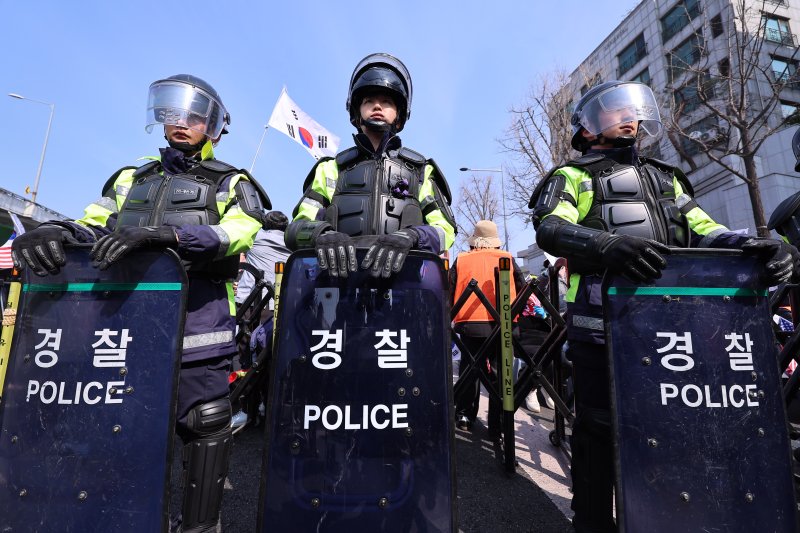
[Financial News] The police will shift their role at assemblies and demonstrations from advance control to maintaining order and ensuring safety after the fact. By doing so, police plan to more actively deploy riot units, whose burden in handling assemblies will be reduced, to the front lines of everyday public safety.
According to the police on the 20th, the Korean National Police Agency (KNPA) is pushing to change the paradigm of how it responds to assemblies and demonstrations and manages its police forces. In line with the purpose of the Assembly and Demonstration Act, the principle will be that organizers themselves autonomously maintain order under their own responsibility, while the police role will be shifted from advance, preventive control to post hoc, supplementary management. At the same time, the way police forces are deployed will be overhauled accordingly. This move comes as the number of violent or illegal protests requiring large-scale riot unit deployments has recently declined and on-site police response capabilities have improved.
To this end, the KNPA on the 6th launched the Task Force on Shifting the Paradigm of Assembly and Demonstration Response and Police Force Management, headed by the deputy commissioner general. Under the task force, it has formed the Task Force Subcommittee on Shifting the Approach to Assemblies and Demonstrations and the Task Force Subcommittee on Utilizing Police Riot Units for Public Safety, which are currently reviewing detailed tasks.
The Task Force Subcommittee on Shifting the Approach to Assemblies and Demonstrations, led by the Intelligence Bureau with cooperation from relevant departments such as security, traffic, and investigations, is focusing on five key tasks: strengthening advance and post-event safety assessments, improving methods of managing assemblies, enhancing the response capabilities of local police stations, reinforcing the roles of organizers and related agencies, and amending the Assembly and Demonstration Act and related regulations.
More specifically, to strengthen advance and post-event safety assessments, the police plan to assign appropriate levels of manpower across four tiers based on risk analysis for public safety, including the size of the assembly and surrounding conditions. Through pre- and post-event safety assessments, they will evaluate whether the deployment and operation of riot units were appropriate and thereby make riot unit deployment more efficient.
Regarding improvements to assembly management methods, the police are reviewing measures under which organizers are responsible for maintaining order, while riot units respond only in a post hoc and supplementary manner when autonomous order maintenance becomes difficult. To enhance the response capabilities of police stations, the police plan to strengthen communication and consultation with organizers through dialogue police officers, establish dialogue police teams at the station level, improve their expertise, and expand education on the Constitution and human rights.
To reinforce the roles of organizers and related agencies, the police will actively support organizers in effectively deploying order-keeping personnel in accordance with the Assembly and Demonstration Act, and will work with local governments and other relevant bodies to prevent safety accidents and minimize inconvenience to citizens.
In terms of amending the Assembly and Demonstration Act and related regulations, the police will seek to introduce an online system for filing assembly notifications in order to strengthen basic rights of citizens. They also plan to revise Article 10 (prohibited hours) and Article 11 (prohibited locations), which were ruled unconstitutional, in line with the intent of the Constitutional Court of Korea, and to establish new provisions to protect the personal rights of others from hate assemblies.
The Task Force Subcommittee on Utilizing Police Riot Units for Public Safety, led by the Security Bureau in cooperation with departments responsible for crime prevention, traffic, and investigations, will define in detail the missions, roles, and operational methods of riot units so that their mobility and organizational strength can more systematically support police activities related to everyday public safety.
To this end, the KNPA will designate and operate "riot units dedicated to everyday public safety" in all provincial and regional police agencies except in Seoul, where there is high demand for security at assemblies and demonstrations. These dedicated units will be assigned to police stations or local police substations with heavy public safety workloads and provide focused support. In principle, they will be removed from duties related to assemblies and demonstrations and instead be deployed to everyday public safety tasks such as reinforcing investigative manpower, crime prevention and patrols, traffic control and drunk-driving crackdowns, and disaster and crowd management.
A KNPA official said, "Within January, we will consolidate the results from the two subcommittees and finalize our plan," adding, "We will begin implementation in stages starting with the Seoul Metropolitan Police Agency (SMPA), minimize the deployment of riot units at assemblies and demonstrations, and actively utilize them for everyday public safety."
[email protected] Jang Yu-ha Reporter