Semiconductor Upswing Drives Producer Price Index Higher for Fourth Consecutive Month
- Input
- 2026-01-20 06:00:00
- Updated
- 2026-01-20 06:00:00
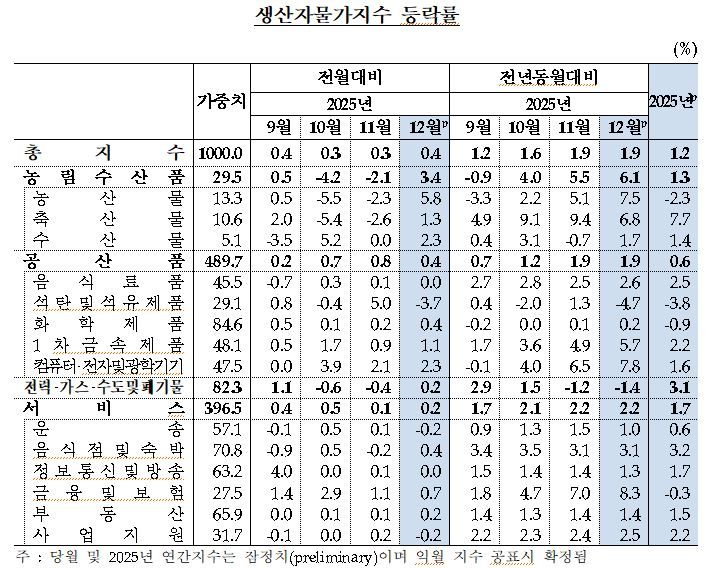
According to the Bank of Korea (BOK) on the 20th, the Producer Price Index for December last year increased 0.4% from the previous month. This follows gains of 0.4% in September, 0.3% in October, and 0.3% in November, marking four straight months of increases. On a year-on-year basis, the index rose 1.9%, the same rate as the previous month, which had been the highest since July 2024 (2.6%)—a 16‐month high.
Agricultural products rose 5.8% and livestock products 1.3%, pushing overall agriculture, forestry, and marine products up 3.4% over the period, a turnaround from a 2.1% decline the previous month. Among manufactured goods, computers, electronic and optical equipment including semiconductors climbed 2.3%, and primary metal products rose 1.1%, leading manufactured goods as a whole to increase 0.4% from the previous month.
Electricity, gas, water, and waste services rose 0.2% during the month, reflecting higher prices for city gas for industrial use (up 1.6%) and sewage treatment (up 2.3%), reversing a 0.4% decline in the previous month. Service prices increased 0.2%, driven by restaurant and accommodation services (up 0.4%) and financial and insurance services (up 0.7%).
For full-year 2025, the Producer Price Index rose 1.2% from the previous year.
Moon-hee Lee, head of the Price Statistics Team in Economic Statistics Department 1 at the BOK, said, “With excess demand persisting in the global semiconductor market, we expect the favorable economic conditions to continue over the medium to long term,” adding, “In the case of agricultural and livestock products, prices were affected by seasonal supply fluctuations and supply disruptions caused by delayed harvesting of some fruit items.”
The Producer Price Index is a statistic that tracks price changes for goods and services supplied to the domestic market by domestic producers. It is used as an indicator for assessing economic conditions and as an input for calculating the Gross Domestic Product (GDP) deflator, among other purposes. However, because it measures price changes, it does not represent absolute price levels.
Looking at the special classifications beyond the five basic sectors, food prices rose 1.5% from the previous month, and fresh food prices jumped 7.5%. Energy prices fell 0.9%, while information technology (IT) products increased 1.4%. Prices excluding food and energy were up 0.4%.
In December, the Domestic Supply Price Index rose 0.4% from the previous month. Both domestic shipments (up 2.5%) and imports (up 1.6%) increased, pushing up raw materials by 1.8% and leading to gains in both intermediate goods (up 0.4%) and final goods (up 0.2%).
For 2025 as a whole, the Domestic Supply Price Index increased 0.7% compared with the previous year.
The Domestic Supply Price Index is a metric designed to more comprehensively capture price changes in goods and services supplied domestically by combining prices of “domestically produced and domestically shipped” items with those of “overseas produced and domestically imported” items.
The Gross Output Price Index rose 0.4% from the previous month, as prices for manufactured goods increased 0.5% and agriculture, forestry, and marine products climbed 3.2%. The index has now been on an upward trend for six consecutive months since a 0.5% rise in July. On an annual basis, the Gross Output Price Index was up 1.5% from the previous year.
The Gross Output Price Index serves as a benchmark for gauging overall price movements of domestically produced goods by combining the Producer Price Index with the export price index to include prices of goods and services destined for overseas markets.
[email protected] Tae-il Kim Reporter