Number of Children Entering Elementary School Nationwide Down 130,000 From Five Years Ago, Continuing Annual Decline
- Input
- 2026-01-19 11:14:37
- Updated
- 2026-01-19 11:14:37
Kim Dae-sik, a Member of the National Assembly representing Sasang District in Busan for the People Power Party, announced on the 19th the results of his analysis of data titled “Status of School-Age Children Eligible to Start School, 2021–2026,” submitted by metropolitan and provincial offices of education nationwide.
The data highlight how the decline in the school-age population has become entrenched in South Korea. Among the survey years, 2024 saw the steepest drop, with a decrease of 48,323 children. After that shock, the decline temporarily eased to 25,951 last year, but this year the number fell again by 30,662, widening the downward gap.
The downward trend is spreading nationwide, regardless of region. In particular, South Gyeongsang Province recorded the sharpest drop, with numbers plunging by 37.8% over five years. It was followed by North Jeolla Province (34.7%), North Gyeongsang Province (34.3%), Busan Metropolitan City (33.9%), and Seoul Special Metropolitan City (33.1%), with most major metropolitan regions seeing declines of more than 30%.
Kim noted, “The number of children eligible to start school can fluctuate each year due to administrative factors such as changes in resident registration, early enrollment, and deferred enrollment.” He added, “However, the fact that many regions have seen simultaneous and drastic declines goes beyond simple statistical variation and shows that the education system has reached a dangerous state.”
He pointed to an even more serious issue: the collapse of the “baseline” that local governments had long maintained. As of the preliminary enrollment date for 2026, the number of children eligible to start school in Gyeonggi Province has fallen below 100,000 for the first time, to around 95,000. Seoul City has also dropped below 50,000 for the first time, to about 46,000. North Chungcheong Province, Daejeon Metropolitan City, and Gwangju Metropolitan City have likewise all fallen below the 10,000 mark they had previously maintained.
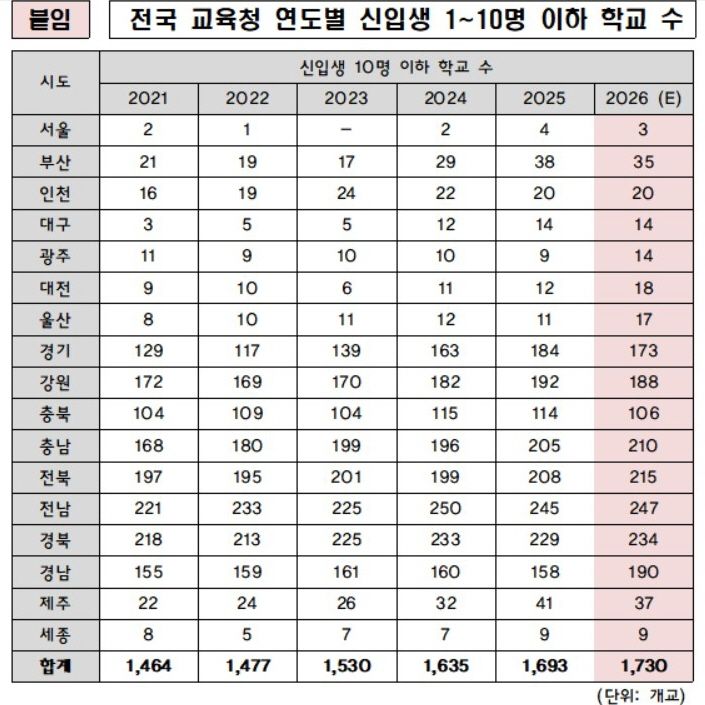
The crisis in the education field is also becoming visible in the numbers. This year, the number of schools nationwide expected to have zero new first graders is projected to reach 200. Schools with only 1 to 10 new students—too few to sustain even a single class—number around 1,730.
Kim warned, “The sharp drop in the number of children entering elementary school will accelerate a phenomenon that shakes the very existence of middle and high schools and, eventually, universities. Since a crisis in higher education directly leads to regional extinction, we must recognize the enrollment cliff as a warning sign of the collapse of the higher education ecosystem.” He added, “It is time for a major policy shift at the macro level, including multi-purpose use of school facilities and the introduction of region-specific specialized education models.”
[email protected] Byun Ok-hwan Reporter