[Editorial] Persistent U.S. Semiconductor Tariff Threats Demand Thorough Risk Management
- Input
- 2026-01-18 19:09:37
- Updated
- 2026-01-18 19:09:37
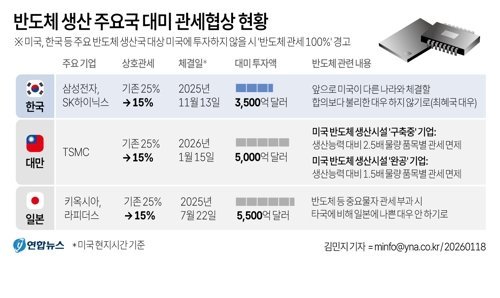
South Korea and the U.S. reached a trade negotiations agreement last year under which most South Korean products would be subject to a 15% tariff, but semiconductor tariffs were left undecided at that time. Instead, Washington made only a general pledge that South Korea would not be treated less favorably than its competitor Taiwan. Taking into account the large-scale semiconductor investments South Korean firms are already making in the U.S., most observers believed there would be no major risks going forward. However, as time passes, the situation is evolving into a phase that is far harder to predict.
If the original understanding were to be honored, it would be natural for the U.S. to extend to our companies the same zero-tariff treatment it has now guaranteed Taiwan. Yet immediately after reaching the semiconductor tariff agreement with Taiwan, the U.S. announced, with South Korea clearly in mind, that there would be “separate agreements by country.” This can be interpreted as an attempt to pressure additional semiconductor investment from South Korean firms. Even executing the investment amounts already planned is a heavy burden for our companies. Excessive U.S. demands for further investment are something the government must step in to rein in at an early stage.
The U.S. has made it clear that preferential semiconductor tariff treatment will be tied to new production facilities built on its own soil. Under its agreement with Washington, Taiwan has pledged an astronomical package of investments and guarantees totaling 500 billion dollars (about 736 trillion won) in the U.S. and, in return, secured an exemption from semiconductor tariffs. It was agreed that while new production facilities are under construction in the U.S., up to 2.5 times their production capacity, and once those facilities are completed, up to 1.5 times their capacity, will be exempt from tariffs.
In South Korea’s case, the government has previously pledged 350 billion dollars in investments in the U.S., but 150 billion dollars of that is earmarked exclusively for the shipbuilding industry, and the remaining 200 billion dollars is not limited solely to semiconductor projects. There is a substantial gap with Taiwan in terms of the scale of semiconductor investment, yet South Korea has no room to embark on additional investment. Even the 350 billion dollar commitment alone has sent the US Dollar–South Korean Won exchange rate soaring. Domestic and overseas institutions alike forecast that the US Dollar–South Korean Won exchange rate will remain volatile throughout the year. It is clear that if the government were to pursue further investment pledges, the situation could quickly become unmanageable.
The same is true for companies. They are already hard-pressed to finance new domestic plant investments, including facilities in Yongin, Gyeonggi Province. The impact of a recent presidential Proclamation signed by former U.S. President Donald Trump, imposing a 25% tariff on semiconductors imported into the U.S. and then re-exported to other countries, also warrants close attention. South Korea must not let its guard down over U.S.-related tariff risks until the very end.