FX risk-exposed dollar assets in South Korea 25 times size of FX market: IMF warning
- Input
- 2026-01-18 12:58:10
- Updated
- 2026-01-18 12:58:10
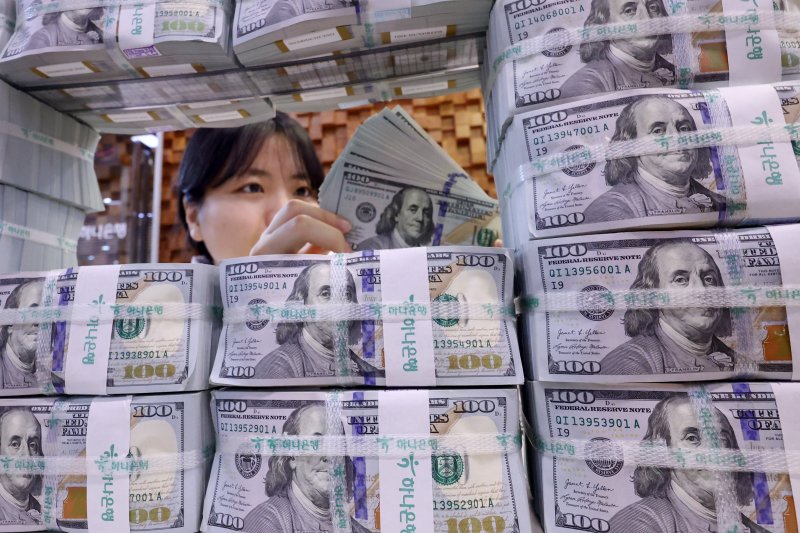
[The Financial News] An analysis by the International Monetary Fund (IMF) has found that the amount of South Korea’s dollar assets exposed to foreign exchange (FX) risk is equivalent to 25 times the size of its foreign exchange market. This level is overwhelmingly higher than that of major economies and is being interpreted as a warning that the country could be vulnerable to exchange rate volatility amid rising uncertainty in global financial markets.
According to the International Monetary Fund (IMF)’s Global Financial Stability Report released on the 18th, the scale of South Korea’s unhedged dollar-denominated assets is about 25 times the size of its foreign exchange market, measured by monthly trading volume. In other words, the volume of dollar assets fully exposed to exchange rate fluctuations is 25 times larger than the amount of FX transactions the South Korean market can handle in a month.
Among major economies, Taiwan recorded the highest ratio at about 45 times, while South Korea ranked near the top alongside countries such as Canada and Norway. Japan, by contrast, has a large absolute volume of assets but a much deeper foreign exchange market, keeping its ratio below 20 times, and major European economies such as Germany and France posted single-digit multiples.
South Korea is considered even more at risk because, unlike quasi-reserve-currency countries such as Japan or Canada, it is a non-reserve-currency country. The IMF pointed out that “in some countries, the scale of unhedged dollar assets is disproportionately large relative to the depth of their foreign exchange markets.”
An even bigger concern is the so-called “rush to hedge” phenomenon that can occur when market volatility spikes. If investors holding overseas assets in an unhedged position all move at once to sell FX forwards during periods of sharp exchange rate swings, the limited capacity of the foreign exchange market to absorb these trades can cause downward or upward pressure on the exchange rate to be amplified abnormally. The recent move by the National Pension Service (NPS) to adjust its strategic FX hedging ratio is seen as a preemptive step to address such potential risks.
At the same time, there is a growing call for risk management not only at the level of individual portfolio management but also from a macroeconomic perspective for Korean individual investors investing in overseas stocks, who generally invest in foreign equities without FX hedging.
The government has also recognized the seriousness of the situation and begun working on countermeasures. At the end of last year, the Ministry of Economy and Finance announced in its “Tax Support Measures for Domestic Investment and Foreign Exchange Stabilization” that it would introduce FX forward-selling products for individual investors through major securities firms. When an individual sells FX forwards at a specified exchange rate, the bank that takes the other side of the trade must sell spot dollars in the market to balance its dollar selling and buying positions. For individuals, this allows them to manage FX risk, while for the foreign exchange market, it is expected to have the effect of increasing the supply of dollars.
[email protected] Seo Young-jun Reporter