‘Stealing Lightly’ on the Rise as Unmanned Stores Proliferate, Petty Theft Surges and Investigation Burdens Snowball
- Input
- 2026-01-18 15:30:15
- Updated
- 2026-01-18 15:30:15

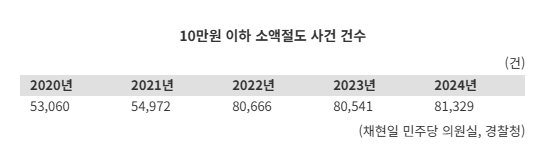
[The Financial News] Petty theft involving amounts of 100,000 won or less is becoming rampant. As unmanned stores spread and face-to-face monitoring disappears, critics warn that theft is turning into an everyday crime that is casually repeated. Experts advise that even if the financial damage per case is small, appropriate countermeasures are needed in light of the investigative burden and social costs.
According to data on the status of petty theft cases obtained by the office of Rep. Chae Hyun-il of the Democratic Party of Korea from the Korean National Police Agency (KNPA) on the 18th, there were 81,329 theft cases in 2024 in which the property damage amounted to 100,000 won or less, the highest figure in five years. This represents a 53% increase compared with 2020, when there were 53,060 such cases. Figures for 2025 have not yet been compiled. However, given that petty theft has exceeded 80,000 cases for three consecutive years since 2022 and that the number of unmanned stores—where most of these crimes occur—is increasing, observers expect the figure to remain at a similar level or set a new record.
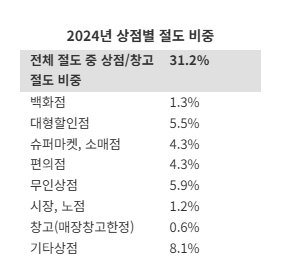
In fact, the share of theft crimes targeting commercial facilities such as shops and markets out of all theft offenses rose from 20.1% in 2020 to 31.2% in 2024, showing a rapid upward trend. More than three out of every ten theft cases now target shops. The increase in theft at unmanned stores is particularly striking. Since unmanned stores began to be tallied as a separate category in 2023, there were 10,847 such cases that year (5.7%), surpassing thefts at large discount stores (8,861 cases, 4.7%) and at supermarkets and retail shops (8,585 cases, 4.5%). In 2024, the number reached 10,769 (5.9%), remaining the highest among major commercial facilities.
In April last year, Samsung Card Co., Ltd. released a study stating that “tracking the number of unmanned franchise outlets nationwide from 2020 through early 2025 showed that the number of unmanned stores increased fourfold (314%) over that period.”
The ‘non-face-to-face environment’ is cited as a key factor behind the repeated thefts at unmanned stores. Because the crime is committed without directly confronting the victim, a mindset can take hold in which offenders either fail to recognize their actions as criminal or regard them as something trivial.
This trend is borne out in actual cases. In November last year, four unmanned stores in Icheon, Gyeonggi Province and Yeoju were hit in a series of burglaries. The suspects broke open cash boxes to steal money and moved from store to store to continue their crimes, with each store suffering losses in the hundreds of thousands of won. The previous month, in October, police also received a report that two men had gone around three unmanned stores in the Bupyeong District, Incheon area in the early morning hours and stolen about 1.4 million won in cash.
On the ground, police say the investigative burden is considerable. Even when the amount stolen is small, once a case is reported, an investigation cannot be avoided, adding strain to efforts to handle other serious cases. At the same time, because most reports are filed only after store owners belatedly review closed-circuit television (CCTV) footage, it is difficult to apprehend offenders in the act.
An official identified as A, head of the Crime Prevention and Response Division at a police station in Seoul, noted, “Even if the damage amounts to only a few thousand won, we have to go through very cumbersome procedures, such as sending a search and seizure warrant to a bank to trace financial accounts or checking CCTV footage from nearby shops, alleyways, and transportation facilities to identify suspects,” adding, “Police resources are being significantly wasted.”
Experts agree that, as the spread of unmanned stores is an unavoidable trend, petty theft should not be dismissed as a minor offense; instead, both crime awareness and the prevention framework need to be reviewed together.
Yeom Gun-woong, a professor in the Department of Police and Fire Administration at Yuwon University, said, “It is important first to create an environment that makes it difficult to attempt crimes by strengthening entry procedures for unmanned stores—such as verifying credit cards or IDs upon entry—and by expanding security systems so that alarms sound when theft occurs,” adding, “There also needs to be a shift in perception so that store owners do not neglect their shops simply because they are unmanned, but instead take responsibility by conducting real-time CCTV monitoring and patrols.” He went on to stress, “To firmly establish the perception that theft at unmanned stores is clearly a crime, it is necessary to apply a principle of zero tolerance.”
Lee Ung-Hyeok, a professor in the Department of Police Science at Konkuk University, said, “Viewed individually, each case may amount to nothing more than petty theft, but there are many instances where this develops into a pattern of targeting multiple stores,” and advised, “To ease the burden on police resources, cooperation among the police, unmanned store owners, and private security companies should be considered as part of a broader public safety network.”
[email protected] Kim Ye-ji Reporter