Prodded by Trump? EU and MERCOSUR Seal Trade Deal After 26 Years
- Input
- 2026-01-18 03:47:46
- Updated
- 2026-01-18 03:47:46
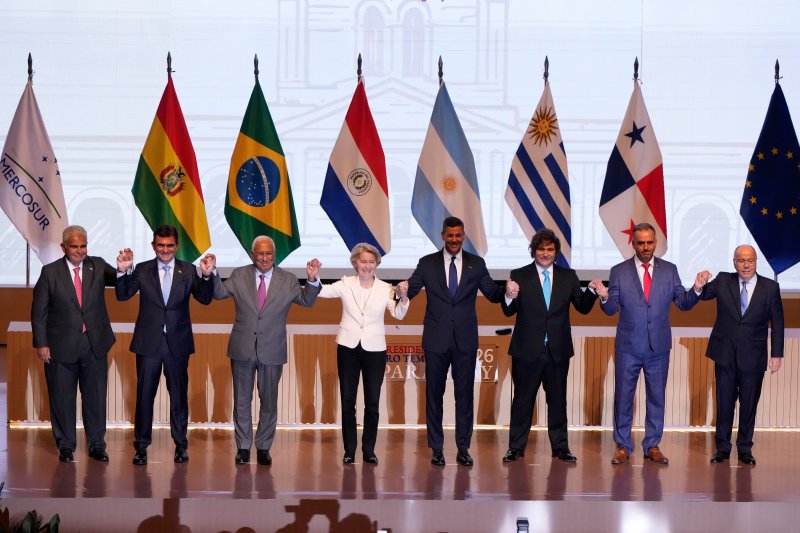
The European Union (EU) and the South American economic bloc Southern Common Market (MERCOSUR) on the 17th (local time) signed a trade agreement, concluding negotiations that have stretched over 26 years.
Although the details still need to be fine-tuned, the long-running trade talks that began in 2000 have finally been wrapped up. With United States of America (US) President Donald John Trump pressuring countries on multiple fronts, the two sides joined hands for their own survival.
According to the Financial Times (FT), the signing ceremony in the Paraguayan capital Asunción was attended by European Commission President Ursula von der Leyen and other European representatives, as well as the presidents of Argentina, Uruguay and Paraguay and the foreign minister of Brazil. The EU and the South American economic bloc will gradually eliminate more than 90% of tariffs between them.
Once the member states of each bloc ratify the agreement, it will create the world’s largest free trade area, encompassing a population of more than 700 million people. In 2024, trade in goods between the EU and MERCOSUR reached 111 billion euros (about 190 trillion won).
European Commission President Ursula von der Leyen declared, “The signal we are sending to the world is clear: the EU and MERCOSUR have chosen cooperation over competition, and partnership over polarization (tilting toward either the US or China).”
Because of the manufacturing-heavy structure of the EU and the dairy- and agriculture-centered economies of South America, trade talks between the two regions have often been described as a deal of “selling beef to buy cars.” Launched 26 years ago in 2000, the negotiations went through repeated suspensions and resumptions before the two sides finally reached agreement.
The fact that talks dragging on for 26 years have now been concluded appears to reflect a strong sense of urgency that they can no longer afford to suffer losses by being caught in the US–China power struggle. In effect, they have declared a move toward a more diversified, multipolar system.
Through this agreement, the two sides also sent a symbolic message of support for the “rules-based international order” that US President Donald John Trump has been undermining.
The economic benefits are also substantial.
The EU will no longer have to pay tariffs of up to 35% on auto parts and 28% on dairy products. It will be able to cut tariffs by about 4 billion euros a year. This is expected to serve as a lifeline for Europe’s automobile and chemical industries, which have been struggling under a flood of Chinese exports.
MERCOSUR, for its part, will gain access to the vast European market. Exports of South American agricultural and livestock products to Europe are expected to increase.
However, despite the conclusion of the agreement, the EU in particular will have to quell internal opposition.
Farmers in France, the EU’s largest agricultural producer, and elsewhere in Europe fear an influx of cheap South American agricultural products. This suggests that ratification by each member state will not be easy.
To placate them, the EU has promised additional subsidies and has allowed for the activation of a “safeguard measure” (an emergency import restriction) that would temporarily suspend tariff exemptions if import volumes surge.
In South America as well, ratification by national parliaments is expected to face hurdles. With election schedules overlapping, the agreement is unlikely to take effect before next year at the earliest.
MERCOSUR is composed of six member states: Argentina, Bolivia, Brazil, Paraguay, Uruguay and Venezuela. In addition, Chile, Colombia, Ecuador, Guyana, Panama, Peru and Suriname participate as associate members.
However, Venezuela’s membership has been suspended indefinitely since 2016 for violations of democratic principles, among other reasons. Bolivia became a full member in 2023.
[email protected] Song Kyung-jae Reporter