Academia Warns: Limits on Virtual Asset Exchange Equity Stakes Could Run Counter to the Times [Crypto Briefing]
- Input
- 2026-01-16 17:40:42
- Updated
- 2026-01-16 17:40:42
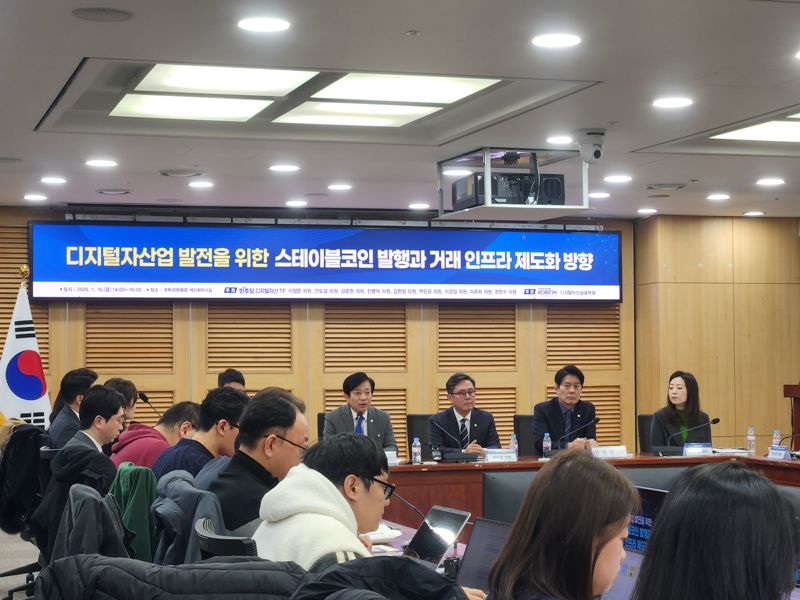
[Financial News] "Korea Exchange (KRX) has decided to push ahead this year with the launch of new products such as virtual asset exchange-traded funds (ETF) to boost the Korea Composite Stock Price Index (KOSPI). As the role of virtual assets in expanding investment opportunities and the investor base is growing, there are concerns that imposing equity limits on virtual asset exchanges may run counter to this broader trend."Professor Kim Yoon-kyung of Incheon National University made these remarks during a forum titled "Institutionalization of Digital Assets as a Turning Point for Innovation," held on the 16th at the National Assembly Members' Office Building in Yeouido, Seoul. The forum was hosted by the Democratic Party of Korea (DPK) Digital Asset Task Force and organized by the Korea Fintech Industry Association (KFIA) and the Korean Society of Digital Asset Finance.
Professor Kim took part in the event with a presentation on the theme of "Regulatory Direction for the Governance of Virtual Asset Exchanges." She explained, "Looking at cases such as Binance and Coinbase, major global jurisdictions are implementing suitability regulations for shareholders and executives of related businesses, but there is no precedent for imposing a cap on the shareholdings of major shareholders."
She went on to say, "While I share the sense of urgency regarding governance discipline, we need to be wary of excessive regulatory tools," adding, "It is concerning that the same rationale could be used to introduce identical regulations in other innovative financial industries."
She further stressed, "We need a serious awareness of the background that gave rise to the debate on regulating the equity ratios of major shareholders," and pointed out, "There must be a renewed review of how virtual asset exchanges are actually operated, along with improvements to the board's responsibility for management, internal control systems, and ethical standards."
Professor Kim also suggested that, alongside implementing suitability reviews for major shareholders, it is important in the longer term to establish a foundation for voluntary initial public offerings (IPO). She said, "The current limitations of virtual asset exchanges are driving the need for systematic governance rules," and added, "The second-stage legislation of the General Act on Digital Assets could specify mechanisms such as suitability reviews for major shareholders, conduct regulations, and board structures."
She continued, "As companies grow, they need to pursue IPOs as a means to achieve both capital raising and equity dispersion," noting, "In the case of the U.S. virtual asset exchange Coinbase, the founder has maintained control over voting rights even after its initial public offering through dual-class shares."
yimsh0214@fnnews.com Lim Sang-hyuk Reporter