Former President Yoon Sentenced to 5 Years in Prison in First Trial for Obstructing Arrest... Yoon’s Side Says It Will Appeal Immediately [Comprehensive]
- Input
- 2026-01-16 16:19:14
- Updated
- 2026-01-16 16:19:14
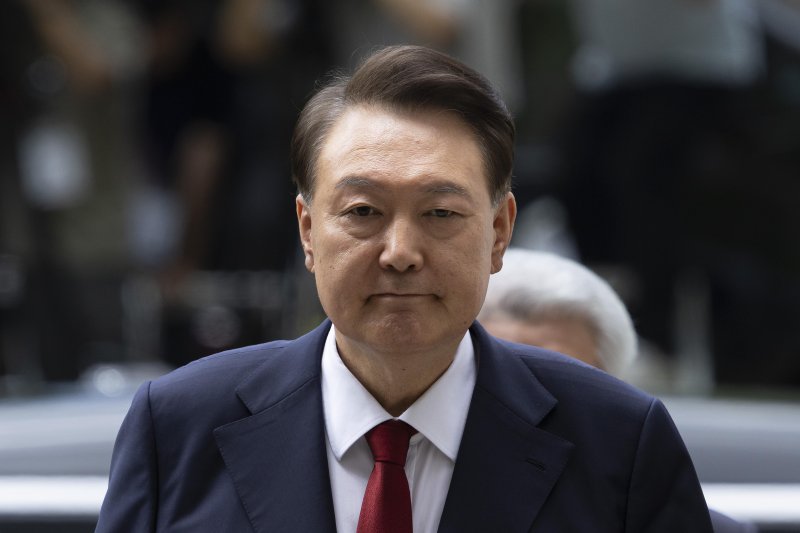
[Financial News] Former President Yoon Suk Yeol, who was brought to trial on charges including obstructing the execution of an arrest warrant by the Corruption Investigation Office for High-ranking Officials (CIO) and the police and infringing on State Council members’ rights to deliberate and vote, has been sentenced to five years in prison in the first-instance trial. However, he was acquitted of charges related to exercising a post-facto emergency martial law proclamation and issuing false briefings to foreign media, which led to a reduction in the sentence.
Criminal Division 35 of the Seoul Central District Court (presiding judge Baek Dae-hyun, Chief Judge of the Criminal Division, Seoul Central District Court) on the 16th sentenced former President Yoon to five years in prison on charges including obstruction of the execution of special official duties, abuse of authority to interfere with the exercise of rights, falsification of official documents, and violation of the Presidential Records Act.
First, the court ruled that both the first and second attempts to execute the arrest warrant against former President Yoon were lawful, and found him guilty on all counts related to obstructing the arrest.
The court emphasized that at the time the arrest warrant was being executed, former President Yoon’s presidential authority had already been suspended due to his impeachment by the National Assembly. Under Article 110 of the Criminal Procedure Act, searches and seizures cannot be conducted in locations requiring military secrecy without the consent of the person in charge, but such consent cannot be refused except where it would seriously harm the vital interests of the state. Since former President Yoon had already been suspended from duty, the court explained that his arrest did not constitute harm to the vital interests of the state. It added that former Presidential Security Service Chief Park Jong-joon’s consent to the execution of the warrant should have been obtained.
The court interpreted the constitutional provision on presidential immunity from criminal prosecution as exempting the president only from being prosecuted, not from being investigated. It held that investigation and prosecution must be clearly distinguished, and therefore the CIO was permitted to investigate former President Yoon not only on charges of being the ringleader of an insurrection but also for abuse of authority.
Regarding the arrest and search-and-seizure warrants issued by the Seoul Western District Court at the request of the CIO, the court found that they fell under the jurisdiction of the Seoul Western District Court because both the December 3 Martial Law and the Presidential Residence where former President Yoon lived are located in Yongsan. In addition, the court rejected all of the defense’s arguments that △ Yoon’s right to assistance of counsel was violated during the execution of the arrest warrant, △ the authorities unlawfully entered areas outside the locations specified in the warrant by approaching from the perimeter, and △ there was illegal video recording in a military secret area.
The court stated, “As president, he had a greater duty than anyone else to uphold the Constitution and maintain constitutional order, yet he arbitrarily abused presidential powers and displayed a disregard for the law, which is deserving of strong condemnation,” adding, “While under investigation, he used public officials of the Presidential Security Service to block the lawful execution of warrants against himself and to attempt to destroy evidence, and he abused the president’s immense influence to have public officials obstruct the execution of the arrest warrant.”
The court continued, “This effectively turned public officials who are supposed to be loyal to the Republic of Korea into his private guards for the sake of his personal safety and private interests,” and added, “This constitutes a serious crime that neutralizes the legitimate exercise of public authority and undermines the national legal order. The defendant’s culpability is extremely grave.”
The court also found that former President Yoon infringed on State Council members’ rights to deliberate and vote. It held that it was unlawful for Yoon to convene only the minimum number of ministers needed to meet the quorum for declaring the December 3 Martial Law at the State Council meeting held prior to the proclamation. The court reasoned that, even considering the urgency and confidentiality associated with declaring martial law as president, merely notifying ministers to attend without specifying the agenda could not be justified as an exception. It further emphasized that the mass impeachment of public officials from the Democratic Party of Korea (DPK) and other opposition parties and alleged election irregularities did not amount to an emergency so grave as to justify failing to notify all members in advance of the meeting.
The court stated, “Seven State Council members who did not receive notice to attend were prevented from deliberating on the proclamation of martial law and the appointment of the martial law commander,” and explained, “By preventing them from attending the State Council meeting, their right to deliberate on the proclamation of martial law and the appointment of the martial law commander—decisions that would have a profound impact on the constitutional order and fundamental rights—was infringed.”
The court further stated, “A proclamation of martial law can only be issued in extremely exceptional circumstances where there is no other means or method available, as it infringes on the rights and interests of the people in multiple ways,” and added, “The fact that the Constitution explicitly requires State Council deliberation on a presidential proclamation of martial law is intended to prevent the misuse and abuse of the president’s emergency powers, which carry potential unconstitutionality, and to check arbitrary decision-making. Yet the defendant violated the Martial Law Act as prescribed by the Constitution by convening the meeting after notifying only some State Council members, an unprecedented practice in relation to a martial law proclamation.”
The court also found Yoon guilty in relation to the martial law proclamation document that was drafted as if the State Council had deliberated on martial law after it had already been lifted. It accepted that the document falsely stated that former Prime Minister Han Duck-soo and former Defense Minister Kim Yong-hyun had signed off on Yoon’s martial law proclamation, thereby making it appear that there were no procedural issues. The court explained that the content of the emergency martial law proclamation, Yoon’s signature, and the endorsements by Han and Kim were all intended to secure procedural legitimacy, and therefore the document must be regarded as an official document and a presidential record. Although the document was actually drafted on December 6, after the proclamation of emergency martial law, the court held that the fact it was written as if it had been prepared on the day martial law was declared made it a falsified official document.
As a result, the fact that the post-facto proclamation document was destroyed following former Prime Minister Han’s objection on procedural grounds was also recognized as constituting the crime of invalidating public documents, etc. and destroying public property.
The court also accepted that former President Yoon ordered former Deputy Chief of the Presidential Security Service Kim Sung-hoon to delete records from secure communication phones. Although the secure phone server was not actually deleted and thus the abuse of authority to interfere with the exercise of rights did not materialize, the court held that the order itself was issued with the intent to obstruct the investigation targeting him, thereby constituting the offense.
However, the court found Yoon not guilty of abuse of authority to interfere with the exercise of rights in relation to former Minister of Land, Infrastructure and Transport Park Sang-woo and Minister of Trade, Industry and Energy Ahn Duk-geun, who had been summoned but were unable to attend the State Council meeting. It also acquitted him of the charge of exercising the post-facto martial law proclamation document. Because former Presidential Secretary for Aides Kang Eui-gu did not disclose the document but instead kept it and later disposed of it, the court did not find that public trust had been endangered.
The court also acquitted Yoon of the charge that he instructed the overseas public relations secretary and others to disseminate to foreign media a Press Guidance (PG) stating that he “never had the slightest intention of destroying the constitutional order.” The main reason was that, under the Government Organization Act and other relevant laws, secretaries affiliated with the Office of the President of South Korea are obligated to comply with presidential orders. The court explained that, because PGs issued by the Office of the President of South Korea are reported together with information from other sources, it is difficult to conclude that the public’s right to know was infringed even if they contain some statements that do not fully align with the facts. The court stated, “In this case, it cannot be said that the public relations secretary who received the order to disseminate the PG had a duty to assess its veracity and either modify its content before transmission or refuse to carry out the order.”
Former President Yoon listened to the verdict with his face flushed red just before sentencing.
Yoon’s side immediately expressed its intention to appeal. After the sentencing, his side told reporters, “It appears the court has created a legal doctrine that contradicts existing Supreme Court precedents,” criticizing the ruling as a political judgment.
[email protected] Jung Kyung-soo, Choi Eun-sol Reporter