"Richard Parker!" Why the Stage Adaptation of "Life of Pi" Is So Special [A Glass of Performances for the Weekend]
- Input
- 2026-01-17 10:00:00
- Updated
- 2026-01-17 10:00:00
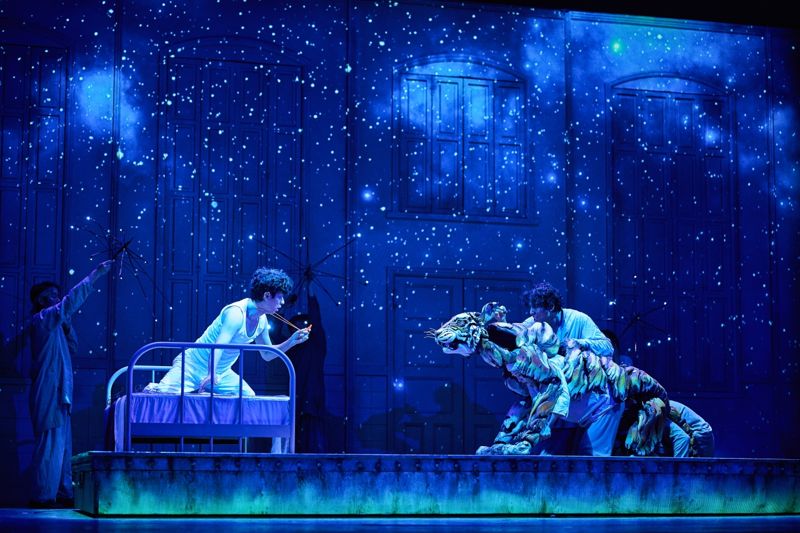
An ocean unfolds on stage. Rolling waves, a sky full of stars pouring down, and at the very center, a single lifeboat floats with a boy and a tiger facing off against each other. The tiger’s vivid movements make it look as if it might leap at any moment and tear into the boy, and a quiet murmur of awe escapes from the otherwise silent audience.
[The Financial News] Yann Martel’s Booker Prize–winning novel, also widely known through Ang Lee’s film adaptation, Life of Pi, has come to Korea in a new genre that is neither straight play nor musical, but something called Live on Stage. Now running at the GS Arts Center in Yeoksam-dong, Seoul, Life of Pi magically brings to the stage the survival story of 17-year-old Pi, who drifts at sea for 227 days with a Bengal tiger named Richard Parker.
“It’s not a real tiger?” The aesthetics of puppetry that turn doubt into conviction
Much of the early buzz focused on the fact that Park Jeong-min, an actor whose performances have been acclaimed in numerous works, is returning to the stage for the first time in eight years. But in some ways, the true stars of this production may not be the actors, but the puppets and the puppeteers—the performers who operate them.
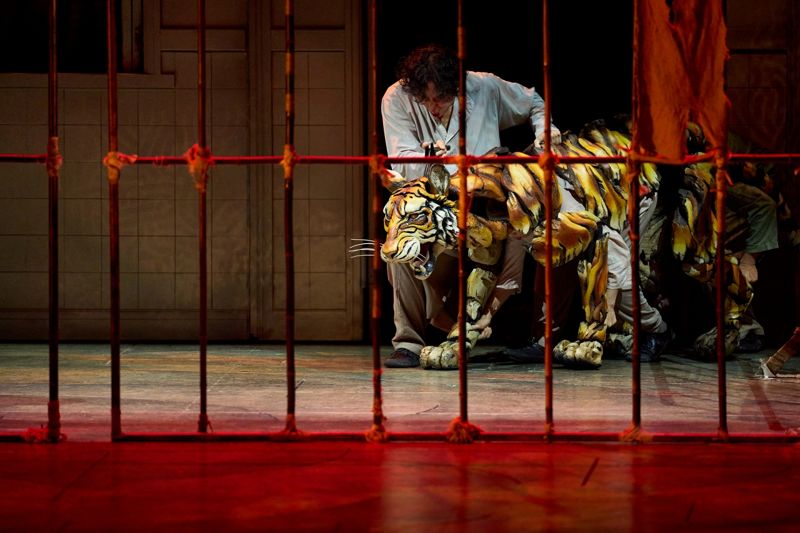
Any doubts about how “real” animals on stage could possibly look are completely dispelled soon after the first act begins, when, along with Pi’s recollections, the zoo in Pondicherry, India, unfolds before the audience’s eyes. What makes the puppets in Life of Pi so special is that they are designed based on the actual skeletons, muscles, and movements of each animal. On top of that, the puppeteers’ skilled physicality and nuanced acting breathe life into the puppets, making them feel not like mere figures, but like living, moving animals.
The puppeteers who perform the puppets do not hide themselves. Yet as the goats, zebras, hyenas, and orangutans move freely across the stage, the puppeteers seem to vanish like an illusion, melting into the animals’ movements. Then, in front of an audience whose eyes are already captured by this meticulous choreography, Richard Parker finally appears, breathing heavily as he stares out into the seats—and in that moment, doubt turns into wonder.
What we want to believe, or what we must believe... Two stories laid before our eyes
As you marvel at the visual spectacle, you eventually find yourself confronted with the weighty questions that Life of Pi poses. Having lost his family and survived alone, Pi tells the story of his drift at sea with the animals after he is rescued, but the investigators who come to learn how the ship sank refuse to believe him. In the end, Pi offers another version of events, this time with humans instead of animals—a story far more brutal and realistic. And then he asks:"Which of the two stories would you choose?"
The play probes what people choose to believe in extreme circumstances in order to preserve their dignity, and how they reconstruct their memories. Sitting in the audience, we gaze at the tiger Richard Parker moving on stage and find ourselves thinking deeply about what he represents. Was Richard Parker truly a real tiger who drifted with Pi? Was he a terrifying presence, yet at the same time the driving force that kept Pi from giving up on life—a being onto whom Pi projected his own wildness?
Returning to the stage for the first time in eight years since the 2017 play Romeo and Juliet, Park Jeong-min answers this question by saying, “The conclusion I reached after repeated rehearsals was that it doesn’t really matter which version is the truth. In the end, what matters is the boy’s faith and his determination to live well, even after losing everything.”

He adds, “I’m not someone who cries easily, so I’m known as an actor who can’t cry, but with Life of Pi I find myself in tears at every performance, to the point where I can’t control my emotions. As I perform, I keep discovering new things in the piece.” Musical theater star Kang-hyun Park shares the role of Pi in a double casting with Park Jeong-min, and a total of 27 seasoned actors, including Seo Hyun-chul, Hwang Man-ik, Joo-ah, and Song In-seong, fill the stage. The Live on Stage production of Life of Pi runs at the GS Arts Center in Yeoksam-dong, Seoul, through March 2.
"What’s worth seeing on stage these days?"Every weekend, this performance-obsessed reporter shares stories about the stage with you. For audiences wondering what to choose amid the flood of productions, I introduce works that I have personally seen and carefully selected. For handy tips to enrich your weekend with cultural outings,[A Glass of Performances for the Weekend]stay tuned.
bng@fnnews.com Hee-sun Kim Reporter