Korea Ranks First Worldwide in Patent Applications for Next-Generation AI Memory Ferroelectric Devices
- Input
- 2026-01-18 12:00:00
- Updated
- 2026-01-18 12:00:00
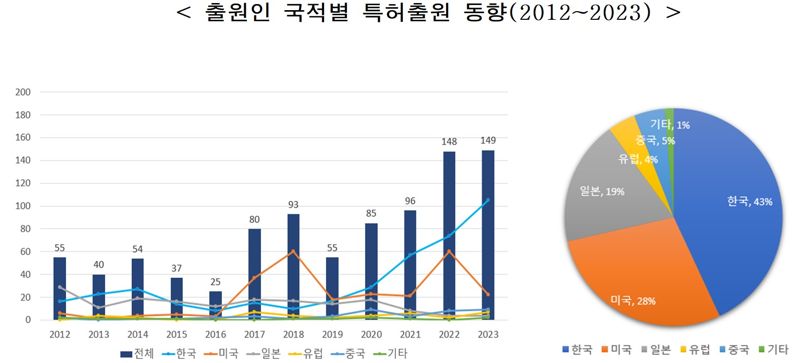
The Ministry of Intellectual Property announced on the 18th that an analysis of patents in the field of ferroelectric devices filed over the past 12 years (2012–2023) with the five IP offices (IP5) of Korea, the United States, China, the European Union (EU), and Japan showed that Korea accounted for 43.1% (395 cases) of all applications, ranking first. Korea also recorded the highest average annual growth rate at 18.7%, indicating that the country is leading next-generation memory technology in both application volume and growth rate.
Ferroelectric materials are dielectrics that maintain electric polarization even without an applied electric field, thereby providing non-volatility, and achieve fast charge response speeds through polarization switching. Devices utilizing ferroelectrics can be produced using existing semiconductor manufacturing facilities, unlike other next-generation technologies, making production possible without new capital investment. In addition, their unique scalability, which preserves ferroelectric properties even at nanometer-level thicknesses, overcomes the physical limitations of conventional materials. Thanks to this process compatibility and miniaturization performance, ferroelectric devices offer optimal conditions for manufacturing highly integrated AI chips and are establishing themselves as a core material that will lead the next-generation AI memory industry.
The memory market related to ferroelectrics is also growing rapidly. The global 3D NAND flash memory market, which stood at 21.8 billion dollars in 2024, is projected to grow at an average annual rate of 21.8% to reach 149.4 billion dollars by 2034. The ferroelectric random access memory (FeRAM) market has been growing at an average annual rate of 3.8% since 2021 and is expected to reach 380 million dollars by 2028.
Korea Ranks First Globally in Application Volume and Average Annual Growth Rate
By nationality of applicants over the past 12 years, Korea filed the most applications with 43.1% (395 cases), followed by the United States with 28.4% (260 cases), Japan with 18.5% (170 cases), China with 4.6% (42 cases), and the European Union with 4.1% (38 cases).
During the same period, Korea also recorded the highest average annual growth rate at 18.7%, followed by China (14.7%) and the United States (12.5%). The EU (5.8%) and Japan (-19.8%) showed growth rates that were significantly lower than, or even below, the 9.5% average annual growth rate of the major countries.
Samsung Electronics and SK hynix Rank Among Global Top Three
Among major applicants, Samsung Electronics (Korea, 27.8%, 255 cases) filed the most patents, followed by Intel Corporation (United States, 21.0%, 193 cases), SK hynix Inc. (Korea, 13.4%, 123 cases), Taiwan Semiconductor Manufacturing Company Limited (TSMC) (Taiwan, 10.1%, 93 cases), and Nanya Technology Corporation (Taiwan, 5.3%, 49 cases).
In particular, over the most recent three years (2021–2023), Samsung Electronics (139 cases) and SK hynix (86 cases) ranked first and second, respectively, demonstrating that Korea is leading global research and development in ferroelectric devices for AI memory.
Kim Heetae, Head of the Semiconductor Examination Promotion Team at the Ministry of Intellectual Property, said, “As the level of technological maturity in the field of ferroelectric devices increases, competition to secure patent rights for the early commercialization of technologies is intensifying. We will actively support our companies so they can continue to lead in next-generation AI memory technologies by building cooperative frameworks with related agencies such as the Ministry of Science and ICT and the Ministry of Trade, Industry and Energy, and by sharing the results of our patent analyses with industry.”
[email protected] Kim Won-jun Reporter