"People Trying to Make Easy Money Without Lifting a Finger"... Scam Ring That Swindled 3.8 Billion Won While Mocking Small Business Owners Exposed (Comprehensive)
- Input
- 2026-01-15 13:47:29
- Updated
- 2026-01-15 13:47:29
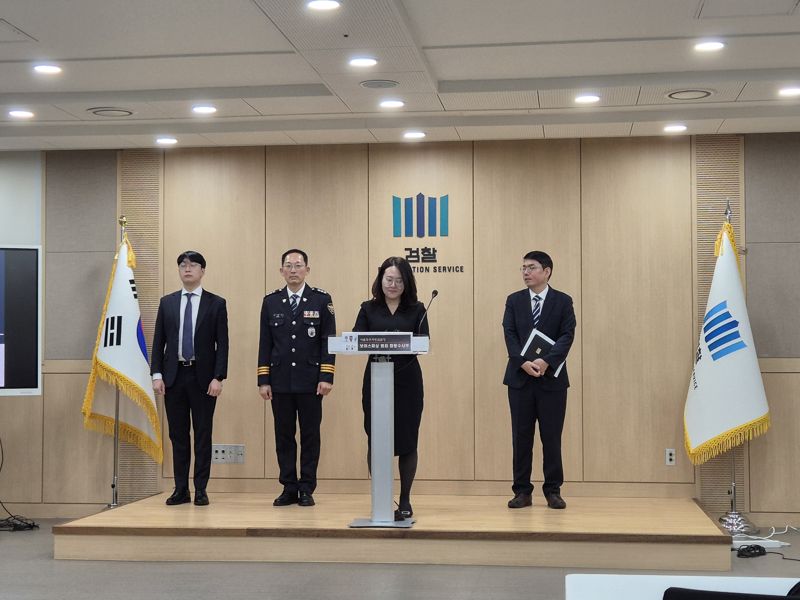
[Financial News] A criminal organization behind a so-called "no-show" scam has been uncovered by prosecutors after it posed as hospitals, military units, and universities to make restaurant reservations and then induced proxy purchases of high-priced wine and other goods.
On the 15th, Prosecutor Kim Bo-sung, chief prosecutor of the Joint Investigation Division on Voice Phishing Crimes at the Seoul Eastern District Prosecutors' Office, held a briefing and announced, "We have indicted and detained all 23 members of the organization on charges of extorting a total of 3.8 billion won from 215 small business owners, while operating out of hubs such as Sihanoukville in the Kingdom of Cambodia."
According to Prosecutor Kim, the ring is believed to have carried out its scheme from May to November of last year. A foreign ringleader targeted domestic small business owners, and under a Korean general manager, the team leaders and members were all Korean, operating in a "corporate-style" structure. There was also a systematic division of roles: recruiters gathered members in Korea and sent them overseas, while separate distributors were tasked with securing bank accounts and passbooks to be used in the crimes.
Their method involved a two-step lure. In the first step, a caller posing as an employee of a hospital or military unit would build trust by making a restaurant reservation and then ask, "Could you purchase wine or military equipment on our behalf?" In the second step, another member would approach the victim while pretending to be the actual supplier, receiving the funds that the victim was induced to transfer.
Throughout this process, the crime unfolded in stages under the guise of a legitimate transaction. They would first go through normal procedures, such as confirming the purchase of a power drill, to gain trust. Then they would mention items that hardware stores do not usually carry, such as a fire blanket, saying things like, "We have military approval, but we are having trouble with payment. Could you obtain it for us instead?" After that, the second-step lure, posing as a specific supplier, would contact the victim and induce a bank transfer, and the money sent by the small business owner would be pocketed in full. Prosecutor Kim explained, "The damage occurs not from the reservation itself, but in the second-stage proxy purchase process."
In doing so, the organization carefully exploited small business owners' desire to earn a profit margin. Lee Dong-wook, lead investigative prosecutor at the Joint Investigation Division on Voice Phishing Crimes, explained, "The first-step caller would approach them by saying something like, 'We urgently need this, but the supplier has raised the unit price,' leading the victims to mistakenly believe that by making the purchase on their behalf, they would earn a profit from the price difference."
For example, when posing as a military unit, they would claim that the normal purchase price for a piece of military equipment was around 500,000 won per unit, then say, "We can get it for you cheaply at about 400,000 won," causing the victim to expect a margin of about 100,000 won per unit and to believe that the larger the quantity, the greater the expected profit. In the case of proxy wine purchases under the guise of a hospital, they would say things like, "We used to drink it at 4.2 million won, but we can supply it for 3.5 million won," thereby inducing the victims to expect hundreds of thousands of won in profit if they bought several bottles. It is reported that within the organization, members mocked such victims as "people trying to make easy money without lifting a finger."
The group had also prepared fake business cards, official documents, and purchase requests that looked like legitimate paperwork, and even scripted their lines and the amounts they would demand. In cases where they posed as hospitals or universities, they are believed to have exploited publicly available lists of medical staff and professors on official websites to create business cards using the names of real individuals.
Psychological analysis of the victims was also used to facilitate the crimes. The Joint Investigation Division on Voice Phishing Crimes explained that they induced transfers by, for example, setting amounts just under 9 million won to make the burden feel smaller. The amounts swindled were treated internally as "sales," with higher "sales" leading to larger incentives, and there were indications that when a scam succeeded, the group would post "congratulations on the deposit" messages in group chat rooms to celebrate.
The arrests and extraditions were carried out at speed. The Joint Investigation Division on Voice Phishing Crimes launched its investigation after the National Intelligence Service (NIS) provided early-stage information on the scheme in June last year. They first arrested members who had returned to Korea, and then, in October and November of the same year, arrested 17 members at a local crime center in the Kingdom of Cambodia through real-time cooperation with Cambodian investigative authorities. It took 40 days from the last local arrest to the completion of final extraditions, and including six members who were in Korea, all 23 were indicted and detained. When asked whether the members themselves could be seen as victims in light of how they were recruited and joined the organization, Prosecutor Kim said, "Some of them traveled back and forth between Korea and the Kingdom of Cambodia, so it is difficult to view them as victims of confinement."
The nationality and identity of the foreign ringleader, as well as the exact remaining size of the organization, were not disclosed on the grounds that the investigation is ongoing. Prosecutor Kim stated, "Including those who have been detained so far, we estimate the total number of members at roughly a little over 30."
[email protected] Reporter Kim Ye-ji Reporter