Seoul Home Prices Jumped 7% Last Year, While Nationwide Increase Stayed in the 1% Range
- Input
- 2026-01-15 14:00:00
- Updated
- 2026-01-15 14:00:00
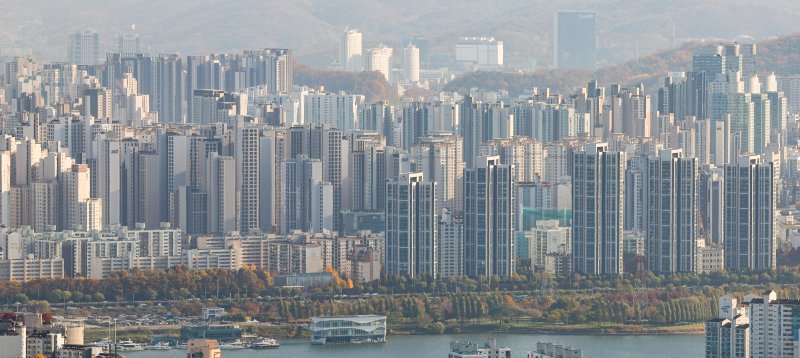
According to Financial News, while nationwide home prices rose only in the 1% range last year, Seoul recorded an increase of more than 7%, sharply widening the regional gap. With apartment prices in Seoul climbing markedly, trends diverged clearly between the Greater Seoul area and the provinces, as well as among different housing types.
According to the "National Housing Price Trend Survey for December 2025" released by the Korea Real Estate Board (KREB) on the 15th, the Nationwide Composite Housing Sales Price Index rose 1.02% year-on-year in 2024. This figure covers not only apartments but also row houses, multi-family units, and detached houses. Nationwide housing prices had surged 9.93% in 2021, then declined in 2022–2023 before turning upward again in 2024 with a 0.13% gain.
By region, trends in the Greater Seoul area and the provinces moved in opposite directions. Last year, the Comprehensive Housing Sales Price Index for the Seoul Metropolitan Area rose 2.89%, while the Comprehensive Housing Sales Price Index for Non-metropolitan Areas fell 0.71%. Within the Greater Seoul area, Seoul led the upward trend, with Gyeonggi Province up 1.10% for the year and Incheon Metropolitan City down 0.75%. Unlike Seoul, where end-user demand is concentrated, some areas of Gyeonggi Province and Incheon Metropolitan City saw subdued transaction activity, which limited price gains. In the provinces, the overall market was weak except for a few major cities such as Busan Metropolitan City (up 0.12%) and Ulsan Metropolitan City (up 0.55%).
The scale of the increase in Seoul far outpaced the national average. The Seoul Comprehensive Housing Sales Price Index climbed 7.07% last year, roughly seven times the nationwide growth rate. Analysts attribute this to cumulative price gains in areas of Seoul and the Greater Seoul area with strong school districts and transportation infrastructure, as well as in neighborhoods near subway stations, large-scale complexes, and redevelopment or reconstruction sites that attracted concentrated end-user transactions. In contrast, older complexes in outlying districts and areas with large volumes of new supply experienced price declines.
By housing type, apartment prices showed particularly strong growth. The Nationwide Apartment Sales Price Index rose 1.04% in 2024. Over the same period, the Seoul Apartment Sales Price Index jumped 8.98%, far exceeding the national average. This is the highest annual increase since KREB began compiling housing price statistics in 2013, surpassing the peaks recorded during the Moon Jae-in administration in 2018 (8.03%) and 2021 (8.02%). In the longer-term statistics, 2006 remains the highest on record with a 23.46% gain.
Non-apartment housing types also rose, mainly in Seoul. Last year, prices for row houses in Seoul increased 5.26%, marking the highest level since 2013. Detached house prices in Seoul climbed 3.23%, the fifth-highest annual growth rate on record. In contrast, prices for row and multi-family houses and detached homes in the provinces were either only modestly higher or declined.
The jeonse and monthly rental markets also trended upward. The Nationwide Comprehensive Jeonse Price Index for Housing rose 0.93% last year, while the Nationwide Composite Monthly Rent Price Index for Housing increased 1.44%. In the Greater Seoul area, the Jeonse Price Index for the Seoul Metropolitan Area climbed 1.78%, and the Monthly Rent Price Index for the Seoul Metropolitan Area rose 2.25%. In Seoul, the Seoul Jeonse Price Index increased 2.99%, and the Seoul Monthly Rent Price Index gained 3.27%, both outpacing the national averages.
[email protected] Jang In-seo Reporter