Countdown to the ‘dream’ 5,000-point KOSPI...“Caution over foreign selling and exchange rate”
- Input
- 2026-01-15 08:01:21
- Updated
- 2026-01-15 08:01:21
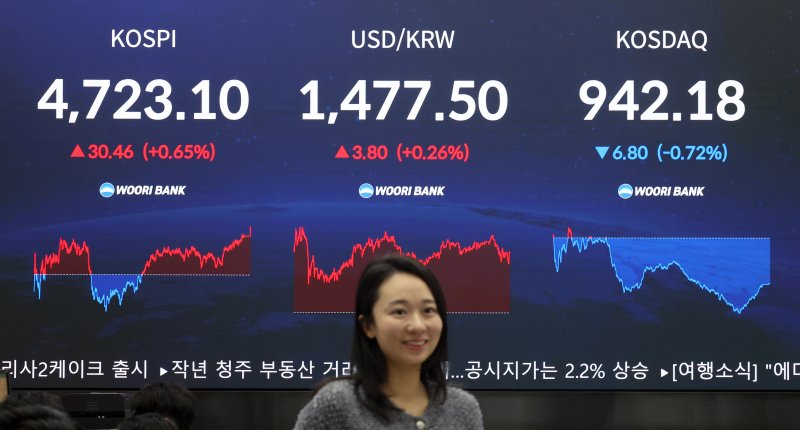
With the Korea Composite Stock Price Index (KOSPI) closing above the 4,700 mark for the first time ever the previous day, the so-called “dream” 5,000-point level has come into view. However, the expanding net selling by foreign investors centered on Samsung Electronics and SK Hynix, as well as the continued rise in the US Dollar–South Korean Won exchange rate, are cited as factors that could cap further gains in the KOSPI.
According to the Korea Exchange (KRX) on the 15th, since the start of the new year the KOSPI had risen 12.08% as of the previous day (the 14th).
The KOSPI opened the first trading day of the year at 4,214.17 and immediately broke through the 4,300 level that day. It then went on to surpass 4,400 on the 5th, 4,500 on the 6th, and 4,600 on the 12th in succession. On the 14th, the KOSPI finished trading at 4,723.10, up 0.65% from the previous session.
On this day, the index opened at 4,685.11, down 0.16% from the previous close, but quickly turned upward after the market opened and succeeded in breaking through the 4,700 level for the first time in history. It achieved this just two trading days after crossing 4,600. As a result, the KOSPI is now only a little over 270 points away from the 5,000 mark.
Semiconductor stocks have led the rally in the equity market at the start of the year. Samsung Electronics, the largest company by market capitalization in Korea, has risen 17.1% so far this month, while SK Hynix has gained 13.1%.
However, as the KOSPI surges higher, selling pressure from foreign investors is also increasing. Foreign investors have been net sellers in the KOSPI market for five consecutive trading days from the 8th to the 14th. During this period, they sold a net total of 2.7272 trillion won.
Looking at the top stocks by net foreign selling during this period, Samsung Electronics (2.8929 trillion won in net selling) and SK Hynix (1.2632 trillion won in net selling) occupy the highest ranks. This is interpreted as demand for profit-taking after their sharp share price gains since the beginning of the year.
Alongside foreign selling, the US Dollar–South Korean Won exchange rate has also been rising rapidly. In the Seoul Foreign Exchange Market the previous day, the weekly closing price of the US Dollar–South Korean Won exchange rate finished at 1,477.5 won, up 3.8 won from the day before. This is the highest level since December 24 last year (1,484.9 won), when the foreign exchange authorities announced market stabilization measures. The US Dollar–South Korean Won exchange rate has been on an upward trend for six consecutive trading days since the 8th.
Some analysts warn that net foreign selling centered on Samsung Electronics and SK Hynix, together with the US Dollar–South Korean Won exchange rate, could partially limit upward pressure on the KOSPI. Lee Sang-heon, a researcher at iM Securities, said, “Although Gross Domestic Product (GDP) is expected to grow by 2% this year, the money supply is projected to increase much more sharply than in other countries, which has led to a structural rise in the US Dollar–South Korean Won exchange rate.” He added, “If the exchange rate rises, concerns about a larger fiscal deficit or additional interest rate hikes may emerge, so the external environment is not entirely favorable for further gains in the KOSPI.”
He went on to explain, “The expansion of net foreign selling since last Friday reflects a sense of burden over the valuation of the domestic stock market, which has prompted selling centered on Samsung Electronics and SK Hynix,” adding, “For the time being, the stock market is likely to move within a trading range as it digests this valuation burden.”
[email protected] Park Ji-yeon Reporter