Why Is the High Exchange Rate Persisting? Aging Population, Korean Individual Investors in Overseas Stocks, and the National Pension Service
- Input
- 2026-01-14 15:46:14
- Updated
- 2026-01-14 15:46:14
[Financial News] Koo Yun-cheol, Deputy Prime Minister for Economic Affairs and Minister of Finance and Economy, cited the increase in “overseas securities investment” as a recent reason for the high exchange rate. Economic experts also diagnosed that the weakness of the won stems from a combination of factors, including population aging, slowing growth, and Korean individual investors investing in overseas stocks. Some argued that a policy to expand currency hedging by the National Pension Service (NPS) is needed. As the NPS increases its overseas investments, it pushes the exchange rate higher, but it must also prepare for the possibility that the exchange rate could fall when it later sells overseas assets as the fund is depleted. There were also recommendations that room should be left for raising the policy interest rate.
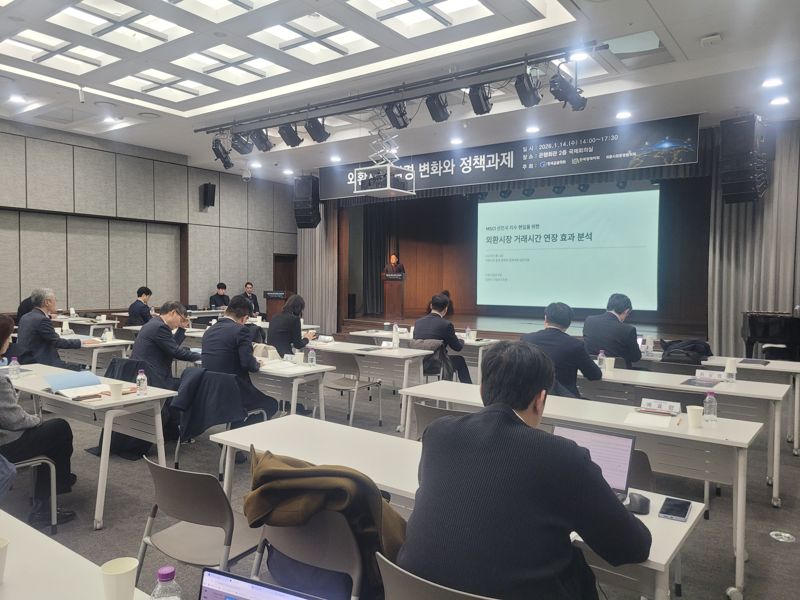
At the “Changing Foreign Exchange Market Environment and Policy Challenges” symposium held on the 14th in the international conference room on the second floor of the Seoul Bankers Association Building, Deputy Prime Minister Koo said in a video congratulatory message, “Recently, even though the foreign exchange market is recording an all-time high current account surplus, volatility of the won has increased and one-sided herd behavior is occurring.” He went on, “I believe that behind this lies a supply–demand imbalance in our foreign exchange market, driven by the rapid increase in overseas securities investment.” He added, “To resolve this, the government will focus above all on improving economic fundamentals through a super-innovation economy and a major transition to artificial intelligence (AI), while at the same time pursuing short-term market responses and efforts to improve supply and demand in order to ease excessive herd behavior.”
The event, hosted by the Korea Money & Finance Association (KMFA), The Korean Economic Association, and the Foreign Exchange Market Operation Council, was organized to review recent foreign exchange market trends and the structure of supply and demand, and to explore medium- to long-term policy directions. The symposium featured presentations by Yongo Kwon, head of the International Finance Research Team, Bank of Korea, and Professor Kang Kyunghoon of Dongguk University, and a panel discussion that included Kim Jae-hwan, Director-General for International Finance, Ministry of Finance and Economy.
Deputy Prime Minister Koo again stressed his intention to engage in dialogue with the NPS, a major player in the foreign exchange market. He also reaffirmed the government’s plan to continue pushing for inclusion in the MSCI World Index in order to increase overseas demand for the won.
He said, “The National Pension Service (NPS), which holds more overseas assets than our current foreign exchange reserves, is also a very important participant in the foreign exchange market. We must find an ideal solution that allows both pension returns and foreign exchange market stability to be achieved in harmony, creating a win–win outcome,” adding, “To that end, we will work with relevant institutions to accelerate discussions on the National Pension Service New Framework.”
Economic experts assessed that, in the long term, the weakening of the won has intensified as the economy’s growth potential has declined due to factors such as population aging and the erosion of competitiveness in key industries. In the short term, they pointed to the widening gap in stock market returns between South Korea and the United States, which has led to a sharp increase in overseas equity investment by domestic investors, including the NPS.
However, Yongo Kwon, head of the International Finance Research Team, Bank of Korea (BOK), viewed the current pessimism over the high exchange rate as excessive.
He said, “It is difficult to see the high exchange rate in the upper 1,400-won range as being in line with the fundamental conditions of the Korean economy. Excessive pessimism about the Korean economy, concerns over capital outflows under investment agreements with the United States, and short-term supply–demand imbalances driven by one-sided expectations on the exchange rate have all been reflected,” adding, “In the medium term, it is necessary to enhance the attractiveness of the domestic stock market. The ongoing push for inclusion in the MSCI World Index is an appropriate step.”
Kang Kyunghoon, professor of business administration at Dongguk University, emphasized the importance of currency hedging, given the large volume of overseas investment by the NPS. Currency hedging is a financial strategy that fixes the exchange rate at which foreign currency will be traded in the future at the current point in time, in order to avoid potential losses arising from exchange rate fluctuations. As the NPS is in a fund accumulation phase and expanding its overseas investments, upward pressure on the exchange rate increases, leading it to purchase overseas assets at high prices. However, when the fund enters a drawdown phase, downward pressure on the exchange rate will grow during the process of selling overseas assets, meaning those assets may be sold at progressively lower prices.
He also argued that the Bank of Korea should maintain strategic ambiguity about the possibility of raising the base interest rate, since currencies with higher interest rates generally tend to be stronger. Another reason is that when the interest rate gap between South Korea and the United States is large, capital flows are more likely to move overseas. Professor Kang said, “Given the record-long duration of the interest rate gap between South Korea and the United States and the household debt problem, it is necessary to leave room for a base rate hike.”
[email protected] Choi Yong-jun Reporter