No One Welcomes the Serious Crime Investigation Agency and Public Prosecution Office Bills: What Is the Solution for Prosecution Reform?
- Input
- 2026-01-14 15:33:29
- Updated
- 2026-01-14 15:33:29
[Financial News] A draft bill by the Government of South Korea to dismantle the Prosecutors' Office and establish a new Serious Crime Investigation Agency and Public Prosecution Office is facing both internal and external turmoil. Some within the ruling party are opposing it, warning that "the Serious Crime Investigation Agency could become a second Prosecutors' Office." Even many advisory members who participated in drafting the bill have expressed opposition to the government proposal and resigned. As the draft was led by former prosecutors within the advisory group, there are concerns that it could become not "prosecution reform" but a "deterioration of the prosecution system." Although the bill is only at the pre-announcement stage and can still be revised at any time, many observers say the core issue is ultimately the dismantling of the prosecution's entrenched privileges.
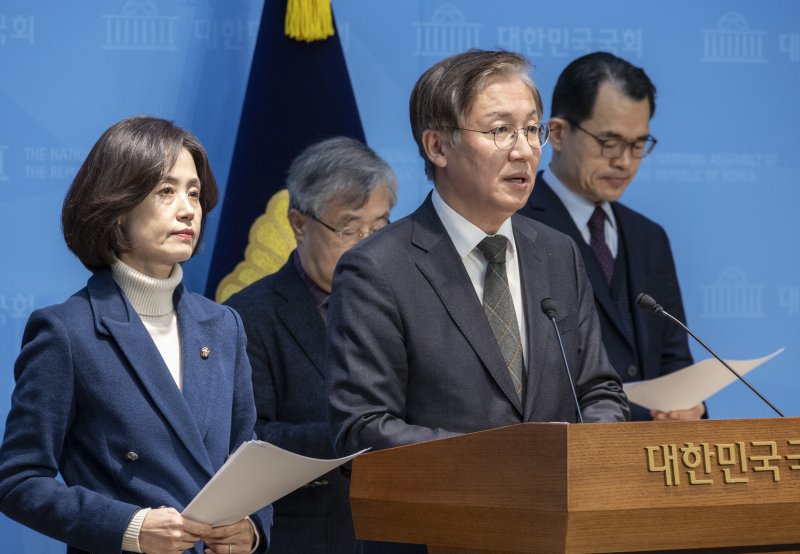
According to the legal community and other sources on the 14th, six members of the Advisory Committee to the Prosecution Reform Promotion Team under the Prime Minister's Office tendered their resignations the previous day and held a press conference at the National Assembly of the Republic of Korea that day, strongly criticizing the Serious Crime Investigation Agency and Public Prosecution Office bills.
The Prosecution Reform Task Force consists of 16 members in total, and the six who resigned are Seo Bohak, professor at Kyung Hee University School of Law; Hwang Moon-gyu, professor at the Department of Police Administration, Joongbu University; and attorneys Kim Pil-sung, Han Dong-soo, Jang Beom-sik, and attorney Kim Sung-jin. They said, "We suspect that former prosecutor and Senior Presidential Secretary for Civil Affairs Bong Wook, who chaired weekly meetings with the Prosecution Reform Task Force, exerted considerable influence in drafting the Public Prosecution Office and Serious Crime Investigation Agency bills, which further solidify the prosecution cartel." They also criticized, "The Serious Crime Investigation Agency bill is effectively an attempt to elevate the prosecution's 'special investigations division' into the Serious Crime Investigation Agency and thereby create a second Prosecutors' Office."
They explained that although they had proposed limiting the Serious Crime Investigation Agency's direct investigative authority to four major categories of crime, the scope was instead expanded to nine categories that had not even been substantively discussed. This is three more than the six major crime categories that were previously subject to direct investigation by the prosecution. They further stated that while many members argued that the Serious Crime Investigation Agency's organization should be unified under investigators, the bill adopted a dual-track structure that favors prosecutors and attorneys. The core of the Serious Crime Investigation Agency and Public Prosecution Office bills is supposed to be the reform of prosecutorial power, but because prosecutors—the very targets of reform—were involved in drafting them, the result is effectively a bill that preserves the prosecution's vested interests.
Minister of Justice Jung Sung-ho of the Ministry of Justice of the Republic of Korea told reporters on his way to work that day, "The Government of South Korea's bill was produced after extensive deliberation, but there will inevitably be shortcomings, so I hope it will be discussed calmly in the National Assembly of the Republic of Korea."
Even within the ruling party, which has been leading the push for prosecution reform, there is strong criticism. Choo Mi-ae, a Democratic Party of Korea (DPK) lawmaker and Chairperson of the Legislation and Judiciary Committee of the National Assembly, appeared on a YouTube channel that day and criticized, "The government proposal undermines the fundamental principle of separating investigation and prosecution."
This is because the government bill does not include a provision abolishing the Public Prosecution Office prosecutors' authority to order supplementary investigations. Article 196 of the current Criminal Procedure Act allows prosecutors to order supplementary investigations, meaning that direct investigations by prosecutors could be revived at any time under the pretext of supplementary investigation.
Rebuilding Korea Party lawmaker Park Eun-jung, a former prosecutor, argued, "Transplanting prosecutors into the Serious Crime Investigation Agency is extremely dangerous and would create a monstrous Serious Crime Investigation Agency." Kim Yong-min, the Democratic Party secretary of the National Assembly Legislation and Judiciary Committee, also criticized, "If prosecutors do not transfer to the Serious Crime Investigation Agency, positions as 'investigative judicial officers' will be filled by people from large law firms, which will lead to a 'legal corruption cartel centered on large law firms.'"
Those who agree on the need for prosecution reform argue that the Public Prosecution Office prosecutors' authority to order supplementary investigations should be abolished and that the organizational structure of the Serious Crime Investigation Agency should be unified. However, there are concerns that in such a case, the capacity to respond to power-related crimes or major conglomerate corruption cases could be weakened. Critics also point out that if the Serious Crime Investigation Agency is organized as a unified structure, capable investigative prosecutors or attorneys may have less incentive to apply to the agency.
Attorney Han Dong-soo, who previously served as Director of the Inspection Department of the Supreme Prosecutors' Office, said on a YouTube channel the previous day, "There is no such thing as a perfect system or legal provision," adding, "To correct a pendulum that has swung toward the prosecution, we must move not to the middle but in the opposite direction—toward more radical reform—in order to eventually find the right balance."
hwlee@fnnews.com Lee Hwan-joo Reporter