Industry and opposition both voice concerns over proposed equity cap for virtual asset exchanges: What it means for the market [Crypto Briefing]
- Input
- 2026-01-14 13:56:43
- Updated
- 2026-01-14 13:56:43
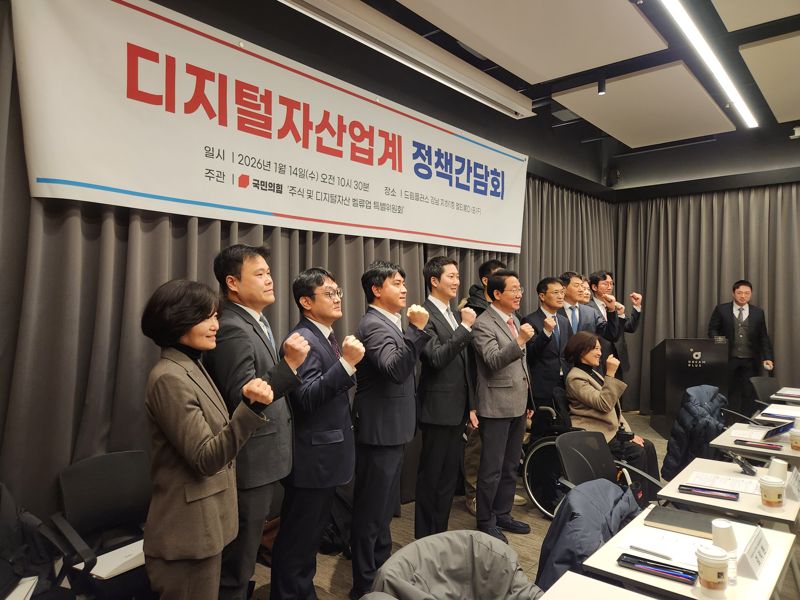
[Financial News] The People Power Party and the virtual asset industry have expressed concern over the government’s review of a plan to cap the equity stake of major shareholders in virtual asset exchanges at 15–20%.
Representative Kim Sang-hoon, who serves as chair of the People Power Party’s Special Committee on Stock and Digital Asset Value-up, said at the “Digital Asset Industry Policy Meeting” held on the 14th at Dreamplus Gangnam in Seocho District, Seoul, “We learned that the Financial Services Commission (FSC) has suddenly begun reviewing a measure to limit major shareholders’ stakes in virtual asset exchanges to around 20%.”
Kim said, “We need to reflect on what it really means for the current market to restrict achievements built up by the private sector through administrative regulation,” adding, “Forcing equity dispersion can blur lines of responsibility and may cause various side effects, including capital outflows overseas.”
The meeting was attended by lawmakers on the Special Committee as well as Kyungseok Oh, CEO of Dunamu Inc.; Oh Se-jin, CEO of Korbit; Cha Myung-hoon, chair of the Coinone board; and Shin Won-geun, CEO of Kakao Pay.
It is reported that concerns over the proposed equity cap were also raised during the subsequent closed-door discussion. After the closed session, People Power Party lawmaker Choi Bo-yoon told reporters, “There were views that the government’s plan to limit major shareholders’ stakes in exchanges could hinder the development of the virtual asset industry and market,” adding, “Some also pointed out that this would amount to reverse discrimination, as it would be a Korea-only regulation not found in global markets.”
Choi added, “There were also opinions questioning whether it is appropriate to apply stock market regulations as they are,” and said, “Since virtual asset exchanges directly hold users’ assets, there were views that a different regulatory framework from that of the stock market is needed.”
The discussion also covered regulation of South Korean won-denominated stablecoins, which is part of the framework of the General Act on Digital Assets. Choi explained, “Global stablecoin leaders such as Tether (USDT) and Circle are all private, non-bank-centered companies,” and added, “Based on these cases, there was a suggestion that the business structure for South Korean won stablecoins should be adjusted to be centered on private companies.”
However, it is also reported that some participants argued that, in light of the potential impact on monetary policy, preparations should first be made within the banking sector, and only then should the system be gradually opened up to innovative private companies.
In addition, industry representatives and committee members exchanged views on issues such as allowing domestic virtual asset investments by corporations and foreign investors, easing the one-exchange-one-bank rule, the need for domestic virtual asset-related derivatives, and ways to distribute and utilize South Korean won stablecoins.
Asked whether there are plans to jointly introduce the General Act on Digital Assets with the ruling Democratic Party of Korea (DPK), the response was, “At this stage, there are no discussions on jointly sponsoring the second-phase legislation again,” adding, “Once the second-phase legislation is stabilized, there is a possibility that third-phase legislation will be pursued after considering various circumstances, and once positions are finalized, each side is expected to introduce its own bill as the main sponsor.”
yimsh0214@fnnews.com Lim Sang-hyuk Reporter