Deepening Employment Polarization: Young People Idle as Companies Halt New Hiring, While Seniors Keep Working
- Input
- 2026-01-14 11:08:02
- Updated
- 2026-01-14 11:08:02
[Financial News] Amid the ongoing economic slump, the number of employed people in construction and manufacturing fell by nearly 200,000 last year, the largest drop in up to 12 years. Weak economic conditions have reduced the total number of jobs in key industries, while new hiring of young people has been sharply curtailed by the spread of artificial intelligence (AI). As a result, the total number of employed people increased by only around 100,000 for the second consecutive year, the lowest range of growth. This underscores the deepening polarization in the labor market by generation and skill level, between young and prime working-age adults on one side and older workers on the other. The government’s employment targets for this year are an increase of 160,000 in the number of employed people and an employment rate of 63%.
Industrial slowdown further erodes job quality
On the 14th, the Ministry of Data and Statistics released its annual employment trends report for last year. According to the report, employment in the construction sector decreased by 125,000, while manufacturing shed 73,000 jobs. These sectors have now seen employment decline for 20 and 18 consecutive months, respectively. For construction, it was the largest drop since 2013, and for manufacturing, the steepest decline since 2019.
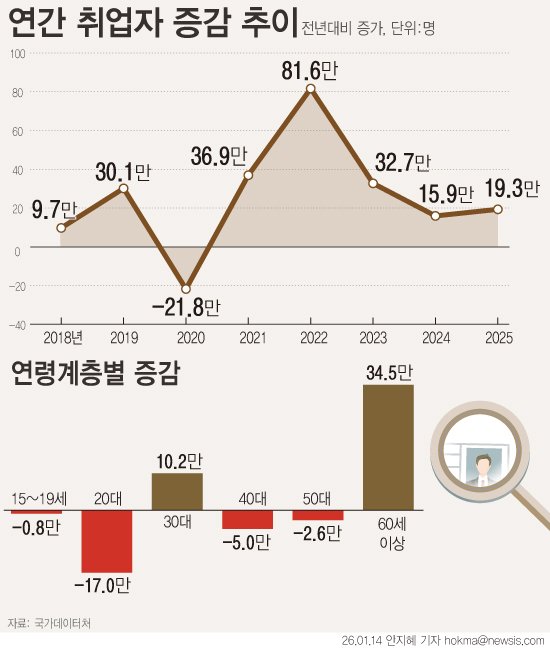
In total, the number of employed people last year was 28,769,000, an increase of 193,000 from the previous year. This marks the second consecutive year in which employment has grown by only around 100,000. After the COVID-19 pandemic, there was an exceptional year in 2022 when employment surged by 816,000, but typically the number of employed has steadily increased by 300,000 to 400,000 a year. Since 2024, however, the pace of growth has shrunk sharply to the 100,000 range.
While the headline number of employed people has increased, the underlying quality of employment has deteriorated. The number of employed people aged 15 to 64 fell by 148,000. This is the second straight year of a six-figure decline, following a drop of 122,000 in 2024, and the scale of the decrease has widened.
By age group, the number of employed people in their 20s fell by 170,000, those in their 40s by 50,000, and those in their 50s by 26,000. In contrast, employment among those aged 60 and older increased by 345,000. Among those aged 15 to 29, the number of employed fell by 178,000 last year, marking a third consecutive year of decline and the largest drop on record. The number had already fallen by 98,000 in 2023 and 144,000 in 2024, and the pace of decline is accelerating.
Kim Tae-ung, director of workforce policy at the Ministry of Finance and Economy, said, “Young people are struggling because of job losses in key industries due to the economic slowdown, mismatches in low-skilled jobs driven by the spread of AI, and hiring practices that favor experienced workers.”
It was those aged 65 and older who propped up the overall employment figures last year. A major factor was the increase of 237,000 jobs in health and social welfare services, where older workers are heavily concentrated. This was a key reason the employment rate for those aged 15 and over rose to a record high of 62.9%. Given that many of these positions are publicly funded jobs created with government finances, the rise can be seen as a distortion of the employment rate.
An ‘employment illusion’: low-skilled young people have nowhere to work
The job structure is becoming increasingly polarized and aging rapidly. The sharp decline in employment in construction and manufacturing—sectors that employ the largest share of young and prime working-age adults and that drive domestic demand and production—shows that the economy’s capacity and competitiveness to generate quality jobs are steadily weakening.
This trend is also evident in the increase in the number of people outside the labor force who reported they were “taking a break.” Last year, this group numbered 2,555,000, up by 88,000 from a year earlier. Among them, 428,000 were young people aged 15 to 29, the second-highest figure on record after 2020, when it stood at 448,000.
Among those in their 30s—an age group typically most active in the labor market—the number of employed people increased by 102,000 last year, but at the same time the number who said they were “taking a break” reached the highest level since statistics have been compiled. Bin Hyun-jun, director general of social statistics at the Ministry of Data and Statistics (KOSTAT), said, “The increase in people in their 30s who report they are taking a break is analyzed as being driven by rising low birth rates and non-marriage, along with the expansion of rolling and experienced-hire recruitment.”
Looking only at December of last year, the number of employed people was 28,209,000, up 168,000 from the same month a year earlier. This was the smallest increase in four months, since August last year, when employment rose by 166,000. Employment in both construction and manufacturing fell by 63,000 in December.
The employment rate for those aged 15 and over was 61.5%, up 0.1 percentage points from a year earlier. The number of unemployed people was 1,217,000, an increase of 103,000, the highest December figure on record. The unemployment rate rose 0.3 percentage points to 4.1%, the highest since 2020, when it also stood at 4.1%. Bin added, “Employment conditions remain poor in accommodation and food services, manufacturing, and construction, and as a result the decline in youth employment is continuing.”
[email protected] Jeong Sang-geun, Kim Chan-mi Reporter