[Number 112] "Eighty Percent of My Police Career Is Traffic... My Goal Is to Send Every Citizen Home Safely"
- Input
- 2026-01-14 13:24:40
- Updated
- 2026-01-14 13:24:40
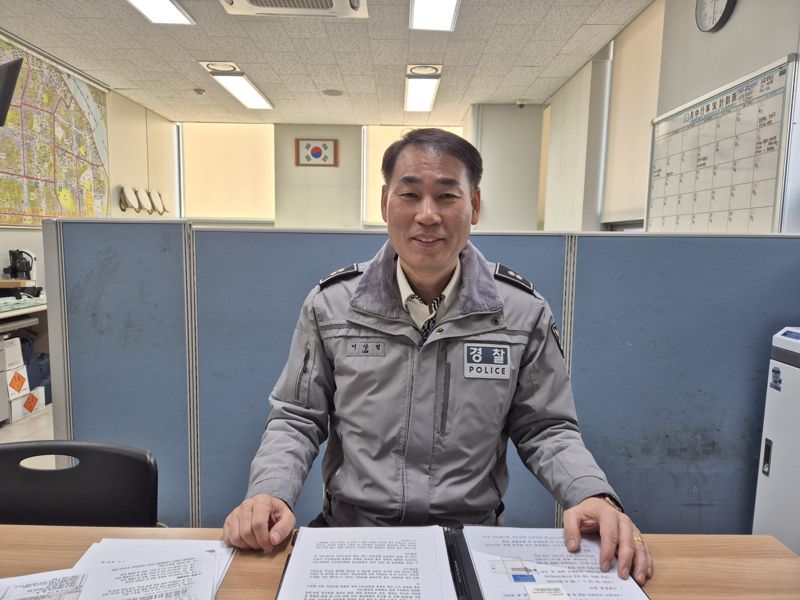
[Financial News]"Handling accidents after they occur is important, but what matters even more is creating an environment where citizens can leave home and return safely."On the 14th, Lee Sang-beom, Head of the Traffic Safety Section at Seoul Gangnam Police Station, said, "The value I consider most important in the traffic field is accident prevention," emphasizing this point.
■ Eighty percent of his police career spent in the field of traffic
Of his 36-year police career, Lee has spent 28 years in the traffic field. He has served in the Traffic Patrol Unit of the Seoul Metropolitan Police Agency (SMPA), as well as in the traffic investigation and traffic management divisions of front-line stations such as Bundang Police Station and Suseo Police Station. His career also includes security operations for major national events such as the presidential inauguration ceremony and presidential retirement ceremony, the papal visit, and the G20 Summit.Lee’s day starts at 6:30 a.m. After checking the situation on the ground through traffic control during the morning commute, he reviews the previous day’s accidents and civil complaints. He then draws up enforcement and management plans focusing on major intersections and chronic congestion points and shares them with field officers. There are many days when he personally visits enforcement sites to check the traffic flow.
Lee explained, "When I first started working in traffic, enforcement was focused on detecting violations of the law and imposing penalties—a regulation-centered approach. Today, good enforcement means improving traffic flow and reducing accident risks," adding, "If congestion eases or accidents decrease in a particular section after enforcement, that is the very definition of success."
■ Beyond enforcement: changing the structure through ‘redesign’
Gangnam is one of the areas in Seoul with the highest volume of pedestrians and vehicles, and consequently, a high number of traffic violations and drunk driving cases. As a result, violations such as cutting in and illegal U-turns are frequent, and chronic congestion persists day and night.To respond to this situation, Seoul Gangnam Police Station is actively implementing the Seoul Traffic Re-Design Project, a key initiative of the SMPA. Lee describes the project as "a comprehensive initiative that goes beyond simple enforcement to design and improve the traffic environment itself in a citizen-friendly way." In fact, by the end of last year, 2,315 citizen suggestions related to the redesign had been received, 76% of which focused on improving the traffic environment, including signals, pedestrian facilities, and infrastructure. A total of 1,198 cases—66% of all submissions—have been improved, and Seoul Gangnam Police Station has completed work on 33 of the 47 cases it received.
The redesign initiative is largely divided into two pillars: "traffic environment (facilities)" and "traffic culture (enforcement)." In the traffic environment area, citizen feedback is reflected in adjusting signal systems in congested sections and improving crosswalks and school routes where pedestrian safety is vulnerable. In the jurisdiction of Seoul Gangnam Police Station, tangible improvements have been made, including: converting the school route to Cheongdam Elementary School into a one-way street and installing a new sidewalk; creating a safe drop-off and pick-up zone near Seoul Nonhyeon Elementary School; and improving the signal system for four consecutive crosswalks in front of CJ CGV on Gangnam-daero.
In the traffic culture area, enforcement focuses on violations that citizens feel most acutely. The "Refreshing Enforcement" initiative is a representative policy in this pillar, prioritizing crackdowns on behaviors that pose a high risk of accidents—such as drunk driving and crossing the centerline—as well as those that cause everyday inconvenience, including blocking the intersection, illegal parking and stopping, and reckless driving by motorcycles. Enforcement is accompanied by publicity and education efforts. Requests for improvement submitted through citizen reports are reflected in actual policies and on-site measures, and the resulting changes are shared with the public. Lee said, "A major strength of the redesign project is that it shifts the structure so that traffic issues are not seen solely as a task for the police, but as problems to be solved together with local governments and citizens."
■ "Enforcement is not punishment, but a promise"
The area Lee is most concerned about is accidents involving Personal Mobility (PM) devices such as motorcycles and electric scooters. When the lack of protective gear, signal violations, and riding on sidewalks overlap, accidents can quickly lead to serious injury or death. He said he still cannot forget the 2022 early-morning accident near the Gangnam POSCO Sageori Intersection, where two people in their twenties died while riding a single scooter together without helmets. Lee pointed out, "Simply banning people from riding scooters is not the answer," adding, "Institutional measures such as mandatory PM licensing and the introduction of education-related legislation must go hand in hand."Currently, Seoul Gangnam Police Station has created around 300 PM parking zones, and it plans to gradually expand PM no-go zones in pedestrian-dense areas such as the restaurant alleys near Gangnam Station and Sinsa-dong Garosu-gil. Going forward, smart crosswalks will also be introduced in stages, focusing on areas with frequent accidents. Under this system, the signal automatically extends and the remaining time is displayed when pedestrians are still crossing.
The goal Lee hopes to achieve before retirement is not grandiose. He wants to make citizens think, even just one more time, "I shouldn’t jaywalk" or "I need to get through today safely." He said, "In the future, traffic enforcement must become more sophisticated, focusing on accident prevention and citizens’ sense of safety, and it should move in a direction that proactively removes risk factors," adding, "What I want to tell citizens is that enforcement is not about punishment, but a promise for safety."
[email protected] Kim Ye-ji Reporter