Has too much money been pumped out? Korea’s money supply relative to GDP is twice that of the U.S.
- Input
- 2026-01-14 09:03:51
- Updated
- 2026-01-14 09:03:51
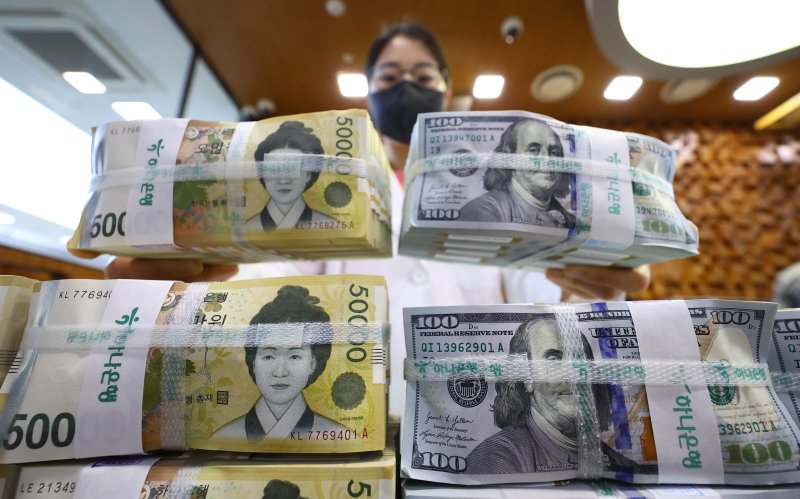
[Financial News] Korea’s broad money supply (M2) as a share of nominal gross domestic product (GDP) has been found to far exceed twice the level of the United States of America (U.S.). As the amount of money in circulation appears large relative to the size of the real economy, debate over monetary policy is flaring up again.
According to data the Bank of Korea (BOK) submitted on the 14th to People Power Party lawmaker Park Sung-hoon, a member of the National Assembly’s Strategy and Finance Committee, Korea’s M2-to-GDP ratio stood at 153.8% as of the third quarter of last year. This figure applies the BOK’s new standard, which excludes income securities such as exchange-traded funds (ETFs) from the conventional M2. Under the previous definition, the ratio reached 167.5%.
Korea’s M2-to-GDP ratio first exceeded 100% in the third quarter of 2008, right after the global financial crisis, coming in at 100.1%, and has since shown a steady upward trend. It successively broke through 110% in the third quarter of 2009, 120% in the third quarter of 2015, and 130% in the third quarter of 2019, and then surpassed 150% in the second quarter of 2021 following the spread of COVID-19. After peaking at 157.8% in the first quarter of 2023, it edged down somewhat before rebounding again last year.
The gap becomes even clearer when compared with the U.S. As of the third quarter of last year, the U.S. M2-to-GDP ratio was 71.4%, less than half of Korea’s level.
The U.S. ratio, which had been in the 60% range just before COVID-19, surged to 90.9% in the second quarter of 2020, but has fallen back below 80% since the end of 2022.
Even compared with other major economies, Korea’s figure is on the high side. The euro area’s M3-to-GDP ratio in the third quarter of last year was 108.5%, while that of the United Kingdom of Great Britain and Northern Ireland (UK), based on M4, was 105.8%.
By contrast, Japan, which has maintained an ultra-low interest rate policy for an extended period, recorded 243.3% (M3) as of the third quarter of last year, the highest among major economies.
The pace of monetary expansion in Korea is also relatively fast. As of October last year, Korea’s M2 growth rate was 5.2% year-on-year, higher than that of the U.S. (4.6%), the euro area (3.1%), the UK (3.6%), and Japan (1.1%). Under the previous definition, Korea’s growth rate would reach 8.7%.
In light of these figures, some argue that the government’s distribution of consumption coupons and the Bank of Korea (BOK)’s accommodative monetary policy have excessively expanded the money supply, fueling the depreciation of the won and driving up housing prices.
The logic is that the won has become too abundant in the market, causing its value to fall.
However, the BOK maintains that the surge in the money supply is not the main driver of the rise in the exchange rate or asset prices.
The BOK cites, as a key factor behind the recent rise in the won–dollar exchange rate, an imbalance in foreign exchange supply and demand stemming from increased overseas stock investment by domestic investors, particularly so-called “Seohak Ants” who invest in foreign markets.
A BOK official said, “Given the current economic conditions, it is hard to conclude that liquidity, as measured by the money supply, has been excessively expanded,” adding, “It cannot be definitively stated that the exchange rate or housing prices have risen solely because of liquidity.” The official went on to explain, “Korea has a bank-centered financial system, whereas the U.S. has a highly developed capital market, and this structural difference leads to a gap in the M2-to-GDP ratio.”
According to views inside and outside the BOK, if the policy rate were abruptly raised as some have demanded, sharply shrinking the money supply and liquidity, the growth gap between Korea and the U.S. could actually widen, potentially pushing the exchange rate even higher.
[email protected] Hong Ye-ji Reporter