The embattled Jee Kui-yeon bench: verdict coming in February
- Input
- 2026-01-14 06:00:00
- Updated
- 2026-01-14 06:00:00
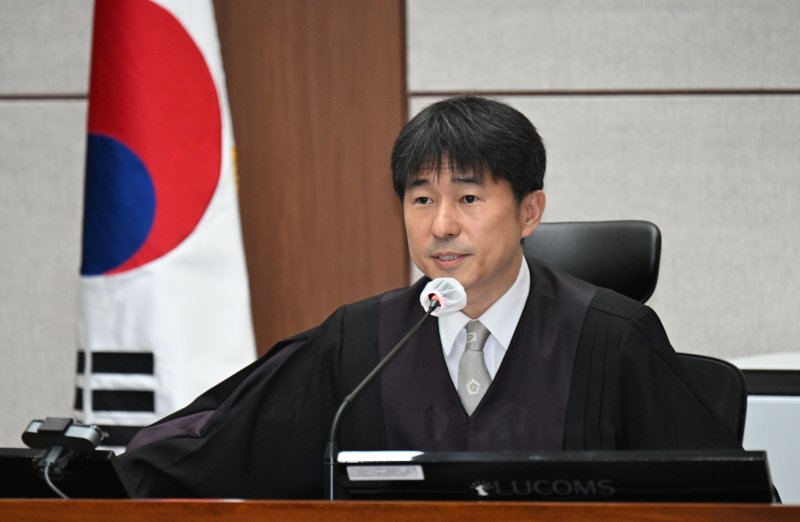
[Financial News] With Special Prosecutor Cho Eun-seok and the Special Prosecutor Team for Insurrection and Treason seeking the maximum penalty under the law—death—for former President Yoon Suk Yeol on charges of leading an insurrection, attention is now focused on the first-instance verdict to be handed down next month by the bench led by Jee Kui-yeon. Despite a series of controversies, including allegations of "drinking-party entertainment" and the cancellation of Yoon’s detention, in the end it is the court that will speak through its judgment.
According to the legal community on the 13th, Criminal Division 25 of the Seoul Central District Court (Presiding Judge Jee Kui-yeon) is expected to deliver its first-instance rulings on the insurrection charges against former President Yoon, former Minister of National Defense Kim Yong-hyun, former Commissioner General of the Korean National Police Agency Jo Jiho, and five other senior military and police officials before the regular judicial personnel reshuffle scheduled for late February.
In addition to the insurrection trial in which he stands accused as the ringleader, Yoon is facing multiple related proceedings, including the trial on charges of "obstructing arrest and infringing on the deliberative authority of Cabinet members" (presided over by Baek Dae-hyun, Chief Judge of the Criminal Division, Seoul Central District Court) and the Pyongyang unmanned aerial vehicle espionage case (Presiding Judge Lee Jeong-yeop). Yet it is the Jee Kui-yeon bench that has been dogged by particularly intense controversy.
To begin with, Criminal Division 25, to which Presiding Judge Jee belongs, has mainly handled cases related to food and pharmaceuticals. The fact that an insurrection case was assigned to this division sparked suspicion that the case had been "designated" rather than randomly allocated. In addition, the bench led by Jee Kui-yeon drew criticism as unprecedented when it cancelled Yoon’s detention after calculating the detention period in hours rather than days. The court was also attacked for allegedly failing to properly control courtroom disorder by Yoon’s defense counsel and appearing to be pulled along by the lawyers. On top of this came allegations of entertainment at drinking gatherings at nightlife establishments in the Gangnam District, further souring public opinion.
Despite the various controversies, many inside and outside the legal community rate Presiding Judge Jee Kui-yeon’s legal knowledge and trial management skills as outstanding. Given that the insurrection trial carries significance far beyond an ordinary criminal case, it has inevitably drawn a wide range of political attacks, but the prevailing expectation among legal professionals is that a rational judgment will be rendered.
Lee Heon-hwan, President of the Constitutional Court Research Institute and professor at Ajou University Law School, said, "The Jee Kui-yeon bench has produced some highly unusual situations, which is certainly cause for concern. Nevertheless, it is difficult for the court to lightly go against the will of the Korean people as a whole," adding, "The Supreme Court has already established, through precedent, the specific elements of the crime of insurrection, and the December 3 Incident can be applied to those elements without deviation."
On this day, the special counsel likewise sought the death penalty for former President Yoon, noting that although the death penalty has in effect become a dead letter in our country, Yoon has shown no remorse or repentance, has shifted responsibility onto his subordinates, has incited his supporters, and has fueled social division and public antagonism, thereby enraging the public. The special counsel further argued that Yoon had no grounds for mitigation, having obstructed his own arrest, stirred up public opinion, and thereby contributed to incidents such as the Seobu District Court riot incident, and therefore requested the maximum penalty under the law, death.
Throughout the trial, Yoon’s defense team has consistently argued that the emergency martial law in question was a warning measure without intent to disrupt the constitutional order, and that it was a form of martial law that caused no loss of life.
Professor Lee said, "It was only because the military and police acted passively that matters did not escalate; had even a single shot been fired, it would be difficult to imagine what might have followed," adding, "The very sequence of actions—deploying the military to the National Assembly, smashing the windows of the main chamber, and cutting off power—cannot be justified or overturned by any excuse or argument."
From the court’s perspective as well, given that the prosecution has sought the maximum penalty of death, even if the sentence is reduced, it is highly likely that at least life imprisonment will be imposed. However, considering that our country is in practice an abolitionist state with respect to the death penalty, a death sentence would have no real effect. The general view in the legal community is that the likelihood of the guilty-or-not-guilty determination being reversed at first instance is extremely low.
A legal community source said, "The Jee Kui-yeon bench’s highly unusual decision last March to cancel former President Yoon’s detention came at a time of great political uncertainty due to the presidential election," adding, "But now more than a year has passed since the declaration of emergency martial law, and the probability that the court will hand down a decision that defies the common sense of the public, as some fear, is not high—legally, historically, or for Presiding Judge Jee personally."
Meanwhile, following the first-instance verdict for former President Yoon, the case is expected to be reassigned from the second instance onward to a Special Panel for Insurrection Cases to be established at the Seoul High Court. However, Yoon’s side may ask the court to request a constitutional review of the statutes governing the Special Panel for Insurrection Cases, and the People Power Party has also announced its intention to file a constitutional complaint, suggesting that further turbulence lies ahead.
hwlee@fnnews.com Lee Hwan-joo Reporter