[Editorial] Expanding Supply Chain Cooperation Among Eight Nations into a Resource Alliance to Counter China
- Input
- 2026-01-13 18:10:24
- Updated
- 2026-01-13 18:10:24
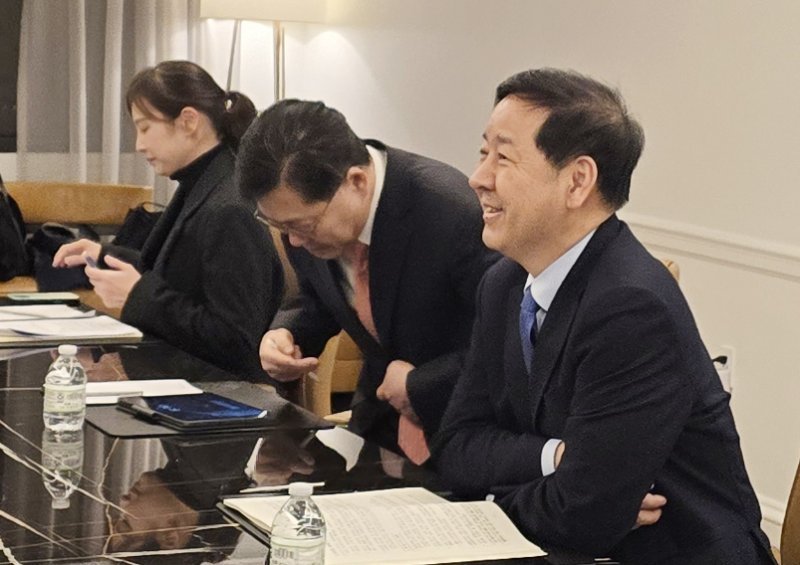
This is not the first time the United States has mounted an organized response to check China’s monopoly over resources. In October last year, it rallied key allies, including South Korea, to form “Pax Silica,” an alliance aimed at ensuring stable supplies of Silicon, rare-earth elements (REE), and other core materials for cutting-edge technologies such as Artificial Intelligence (AI) and semiconductors. It can be viewed as an economic security bloc for the AI era. The grouping began with seven countries—the United States, South Korea, Japan, Australia, Israel, Singapore, and the UK—but on the 12th, Qatar was abruptly added, expanding it to a total of eight nations.
The United States recently announced that it will restart domestic mines and, over the next decade, mobilize astronomical levels of public and private investment for resource extraction, refining, and processing. It is also pushing ahead on all fronts to deepen cooperation with resource-rich countries such as Australia and Vietnam. Australia, which holds 8% of the world’s REE reserves, is a core member of the REE alliance led by the United States. Australia is pursuing a plan to guarantee stable supplies by selling allied nations rights to a certain share of its strategic stockpiles of critical minerals. In this regard, not only the United States but also the UK, France, and Japan are reportedly in talks with Australia.
China, which controls a substantial portion of the world’s critical minerals, is using them as a tool of diplomatic and trade pressure. It is no surprise that China, after clashing with Japan over the Taiwan issue, has pulled out the card of export controls on dual-use items that include REE. South Korea painfully learned the importance of resource independence through the urea solution crisis with China. The problem is that, despite understanding better than most countries the damage caused by China’s resource hegemony, South Korea’s response remains sluggish. More than 80% of South Korea’s REE imports come from China. And it is not just REE; most major critical minerals are still heavily concentrated in China. Japan once relied on China for 90% of its REE, but has gradually reduced that share to about half. Even so, China’s export controls have still triggered an emergency there.
Normalizing relations between South Korea and China is the direction we must ultimately pursue, but decoupling critical minerals from China and diversifying supply sources is an equally urgent and non-negotiable task. Critical minerals such as REE possess absolute value: even a small shortfall can bring entire advanced manufacturing processes to a halt. The public and private sectors must throw their full weight behind efforts to broaden supply channels with allied nations. South Korea also needs to be bolder in acquiring stakes and ownership in overseas mines. The resource recycling technologies that Deputy Prime Minister Koo Yun-cheol mentioned just before the Washington, D.C. meeting are also crucial. The government must provide strategic support so that companies with refining and recycling capabilities can fully play their part. South Korea cannot afford to relax for even a moment in the increasingly fierce global competition for resources.