Government of South Korea to Strengthen Cooperation on Critical Minerals with Allies Including USA, Japan and Australia
- Input
- 2026-01-13 09:49:25
- Updated
- 2026-01-13 09:49:25
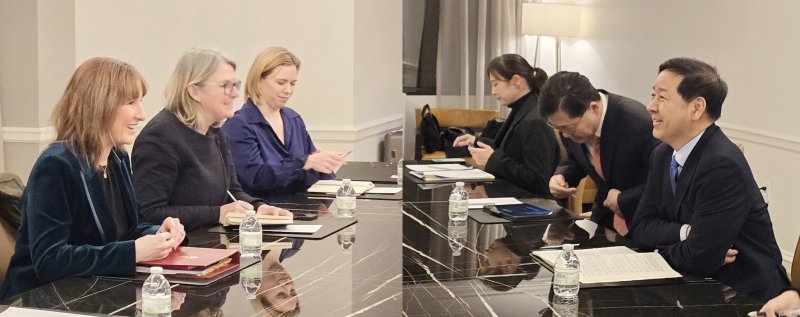
[Financial News] The Government of South Korea has agreed to strengthen cooperation with major partners including the United States of America (USA), Japan and Australia to stabilize global supply chains for critical minerals and other key materials.
On the 13th, the Ministry of Finance and Economy announced that Deputy Prime Minister and Minister of the Ministry of Finance and Economy Koo Yun-cheol attended a Group of Seven (G7) finance ministers’ meeting on critical minerals held in Washington, D.C., USA, where he discussed international cooperation measures to stabilize supply chains along these lines.
The meeting was convened by the U.S. Department of the Treasury (Treasury Department) to counter the threat of weaponization of critical minerals originating from China, including rare earth elements, and to strengthen supply chains among allied nations. Finance ministers from G7 members—the European Union (EU), France, Germany, Italy, Japan and the United Kingdom of Great Britain and Northern Ireland (UK)—as well as from South Korea, Australia, India and Mexico took part.
These major countries shared the view that vulnerabilities in critical minerals supply chains must be addressed swiftly.
The USA stressed the need for concrete actions and investment, proposing that “cooperation among allies be strengthened.” Rather than pursuing decoupling, it called for de-risking so that each country can enhance the resilience of its supply chains.
Deputy Prime Minister Koo highlighted South Korean companies’ strong capabilities in refining and processing critical minerals, saying, “Let us strengthen linkages in the global value chain by leveraging comparative advantages among countries.” He went on to propose promoting the re-utilization and recycling of critical minerals to restore supply chain stability and suggested, “Let us create a platform where companies can cooperate around concrete, project-based initiatives.”
Resource-rich countries for critical minerals such as Canada and Australia stated that they can help strengthen the resilience of global mineral resource supply chains through technological cooperation with South Korea in refining, smelting and recycling.
Prior to the finance ministers’ meeting, Deputy Prime Minister Koo met with Japan’s Finance Minister Satsuki Katayama, and the two agreed to strengthen bilateral economic cooperation as well as coordination in multilateral fora such as the Group of Twenty (G20) and the ASEAN Plus Three (ASEAN+3) finance ministers’ meetings.
Koo also asked for strong interest from Japanese investors regarding South Korea’s planned inclusion in the World Government Bond Index (WGBI) in April. In response, Minister Katayama pledged active cooperation.
The two countries agreed to hold the 10th Korea-Japan Finance Ministerial Dialogue in Tokyo, Japan, on March 14.
Deputy Prime Minister Koo also met with UK Chancellor of the Exchequer Rachel Reeves, and they agreed to strengthen cooperation in areas such as the recycling and re-utilization of critical minerals.
The finance ministers of the two countries welcomed the conclusion of negotiations to upgrade the Korea–United Kingdom Free Trade Agreement (FTA) and discussed ways to further enhance bilateral economic cooperation going forward.
[email protected] Jung Sang-geun Reporter