[Editorial] Worst-Ever Youth Employment Crisis Demands Fundamental Structural Reform
- Input
- 2026-01-12 18:31:59
- Updated
- 2026-01-12 18:31:59
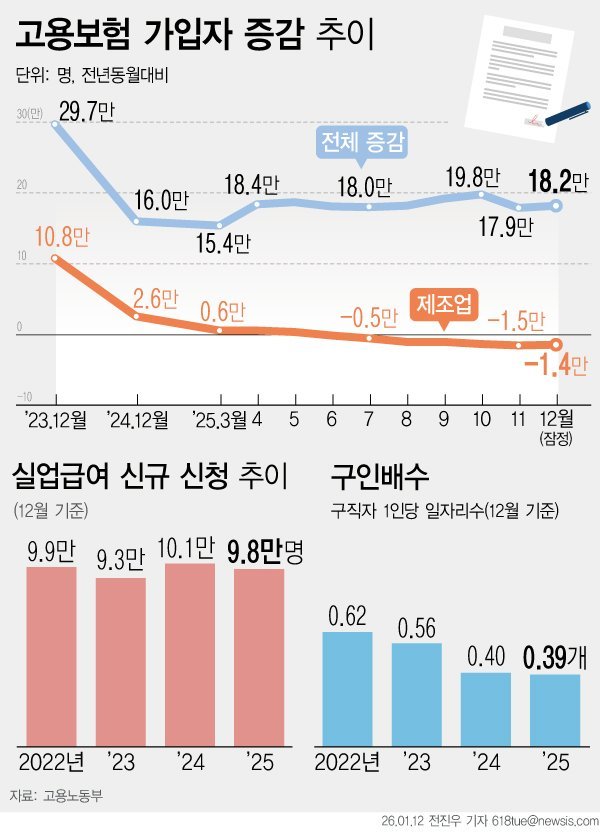
Previous administrations also made efforts to tackle youth unemployment, but in practice they focused on inflating employment figures. Once the president emphasized the issue, the relevant ministries felt compelled to produce favorable statistics by any means. The easiest way to increase the number of jobs was to expand public-sector positions. This was nothing more than a temporary numbers game. Many young people worked as short-term interns only to be left frustrated when these positions did not lead to permanent employment.
Even the jobs that were created were often low-quality positions, such as simple administrative assistance, that did not allow young workers to acquire real job skills. This was a textbook case of desk-bound, bureaucratic policymaking. In the end, policies that relied on public-sector jobs were criticized as mere statistical padding through low-wage, short-term employment and ultimately ended in failure. Employment policy must now focus on quality rather than quantity. We need to create quality jobs so that past failures are not repeated.
Another clichéd prescription is to ask companies to increase hiring. The president and senior aides at Cheong Wa Dae hold meetings with the heads or executives of the Top 10 Conglomerates in South Korea to discuss ways to expand employment. Yet simply encouraging companies to hire more cannot resolve a structural employment crisis. Companies, in any case, hire the personnel they actually need based on market conditions and their management environment. Hiring done merely to accommodate the government’s wishes is bound to be limited both in quantity and in quality.
The youth employment crisis has not even fully begun. This is because the introduction of Artificial Intelligence (AI) is accelerating, fundamentally transforming the landscape of the labor market. AI is beginning to replace humans not only in simple, repetitive tasks but also in professional fields. This implies not just a reduction in jobs, but a restructuring of the entire labor market. In such an era, stopgap measures modeled on past approaches cannot solve the problem of youth unemployment.
This is no time to pay lip service to concern over youth unemployment or to rely on ad hoc, makeshift measures. Youth employment is the foundation of people’s livelihoods and an issue that determines the country’s future. It cannot be addressed through desk-bound, bureaucratic approaches. We must first understand how the industrial ecosystem is changing. We need to estimate the workforce required in declining manufacturing sectors and in emerging industries, and then train people accordingly. Only then can we reduce mismatches in the labor market. Comprehensive reform of the education system must be accelerated to resolve the structural causes of youth unemployment. If we do not tighten the reins of structural reform now, there will be no future for the Republic of Korea (South Korea).