Microsoft: “Korea’s AI Adoption Rate Showing Remarkable Growth”
- Input
- 2026-01-12 14:27:06
- Updated
- 2026-01-12 14:27:06
According to Financial News, a new study has found that Korea’s adoption rate of generative artificial intelligence (AI) is experiencing exceptional growth compared with the rest of the world.
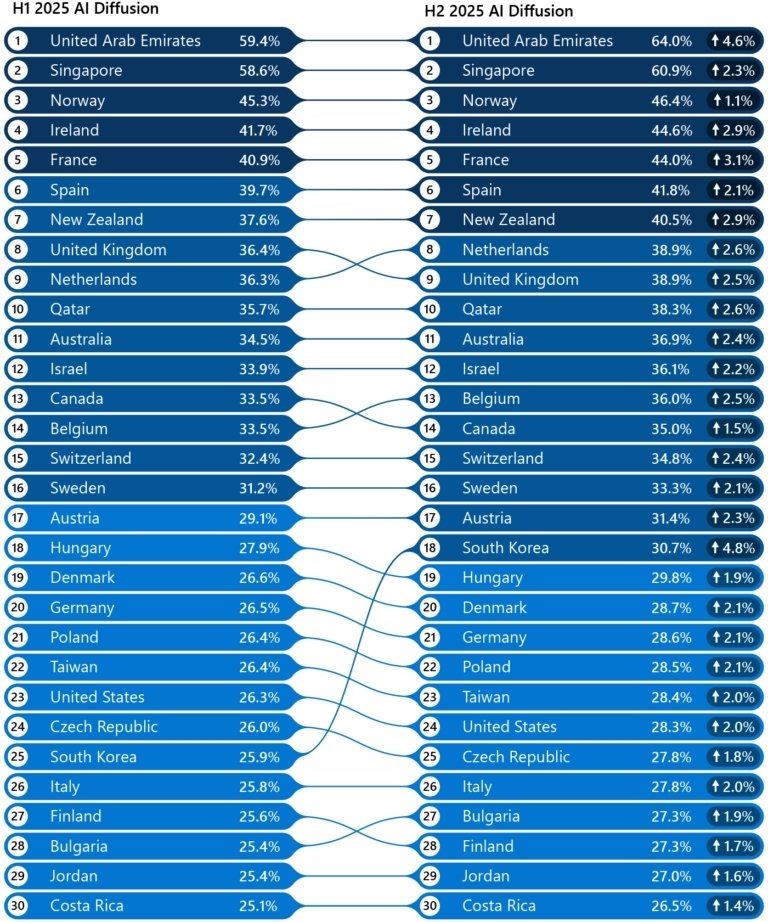
The Microsoft AI Economy Institute (AIEI), a think tank of Microsoft Corporation, announced on the 12th through a report analyzing the state of AI adoption and digital divides in the second half of last year that Korea’s generative AI adoption rate had climbed seven places to rank 18th worldwide.
The report includes country-by-country estimates of adoption rates—defined as the share of the working-age population that used generative AI at least once during the period—as well as the latest trends in AI technology.
According to the report, the usage rate in Korea has surpassed 30% of the total working-age population, and its cumulative growth rate since October 2024 has exceeded 80%, far outpacing both the global average of 35% and the 25% growth rate in the United States of America (U.S.). The report explains that this rapid expansion is the result of three converging drivers: national policy, advances in model performance, and mass cultural phenomena.
On the technical side, a key factor was the dramatic improvement in the Korean-language capabilities of frontier models. State-of-the-art models such as GPT-4o and GPT-5 have delivered outstanding results on the College Scholastic Ability Test (CSAT) benchmark, which in turn has boosted their practical use in professional work settings and in education.
The report notes in particular that the Korean case serves as an important indicator that as a model’s language capabilities become more sophisticated, actual usage can increase proportionally. This suggests that in other language markets with limited training data, AI adoption could also grow explosively as performance in local languages improves.
In addition, mass cultural phenomena such as “Studio Ghibli-style” image generation have helped attract new users, and these initial experiences are increasingly settling into long-term usage rather than remaining a short-lived fad.
Meanwhile, the global adoption rate of generative AI reached 16.3% in the second half of 2025, up 1.2 percentage points from the first half, continuing a steady upward trend. However, the gap in AI adoption between the Global North, centered on advanced economies, and the Global South, centered on emerging economies, has widened, deepening regional digital divides depending on the level of early infrastructure investment.
The adoption rate in the Global North, at 24.7%, was nearly twice as high as the 14.1% recorded in the Global South, and the gap between the two regions expanded from 9.8 percentage points in the first half of 2025 to 10.6 percentage points in the second half.
By country, early investors in digital infrastructure such as the United Arab Emirates (UAE) at 64.0%, Singapore at 60.9%, Norway at 46.4%, and Spain at 41.8% continued to lead in adoption rates.
By contrast, the United States of America (U.S.) maintained the highest level of absolute usage in the world, but its per-capita usage rate lagged behind that of smaller digital economies with highly concentrated infrastructure, placing it 24th in the global rankings.
[email protected] Joo Won-gyu Reporter