[Financial News] With the basic principles for ensuring the safety, reliability, and accountability of artificial intelligence (AI) set to take effect on the 22nd under the Framework Act on the Development of Artificial Intelligence and Establishment of Trust, there is growing opinion that public debate on amending the law should begin simultaneously with its enforcement. Because the Framework Act on the Development of Artificial Intelligence was created before the pace of technological development and the forms of industry-specific applications were fully understood, many argue that the enforcement of this Framework Act should be used as a starting point for refining the norms of the AI era.
According to coverage by Financial News on the 12th, the Framework Act on the Development of Artificial Intelligence, which will be fully enforced on the 22nd, recognizes AI as a national policy agenda, establishes the National AI Strategy Committee chaired by the President, and mandates the establishment of a national AI master plan every three years. Its core purpose is to coordinate AI policies that had previously been scattered across different ministries within a single framework. It also provides a legal basis for promoting the AI industry by stipulating support measures such as designating an AI Specialized Complex, building an AI data center, and promoting AI utilization.
High-Impact, Generative, and high-performance AI subject to regulationThe scope of regulation covers: (1) High-Impact Artificial Intelligence (High-Impact AI), which may have a significant impact on or pose risks to human life, body, or fundamental rights; (2) Generative artificial intelligence (Generative AI), which produces various outputs such as text, voice, images, and video; and (3) high-performance artificial intelligence (high-performance AI), whose cumulative computing volume meets or exceeds the threshold set by Presidential Decree. Business operators that develop or operate such AI systems are obligated to ensure transparency and safety. The law applies not only to domestic companies but also to foreign companies. When foreign companies provide AI services or products in the Korean market, they must designate a local representative to assume responsibility.
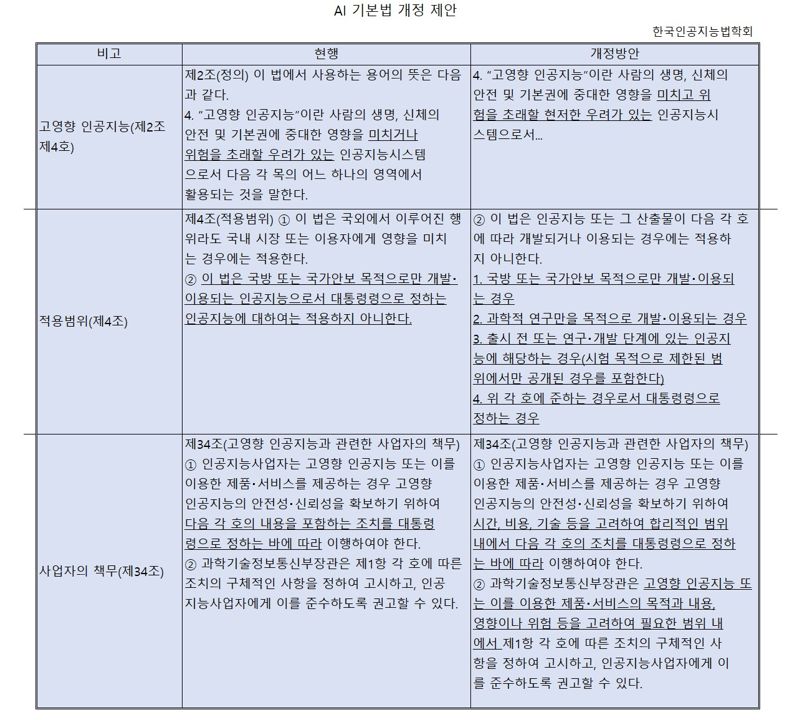
Rapid technological progress demands swift amendments to the Framework ActAcademia and industry are voicing concerns that laws, which are slow to be enacted and amended, may become outdated as soon as they are implemented, given the rapid evolution of AI technologies. One immediate issue raised is that the Framework Act on the Development of Artificial Intelligence does not yet provide provisions for Physical AI, largely because Physical AI was not anticipated when the Act was being drafted. Vague legal terms such as "High-Impact AI" are also cited as targets for amendment. Choi Kyoungjin, president of the Korea Artificial Intelligence Association and professor at Gachon University, pointed out, "What is worse than strict regulation is unclear regulation," adding, "The most representative example is the definition of High-Impact AI in Article 2, Subparagraph 4." Choi stressed, "The current Framework Act on the Development of Artificial Intelligence conflates the concepts of 'high impact' and 'high risk' and merely defines High-Impact AI as something that 'may have a significant impact or pose a risk,' and this must be clarified." The Korean Association of Artificial Intelligence Law has already studied provisions of the current Framework Act on the Development of Artificial Intelligence and submitted proposed amendments to the National Assembly.
Amendments to related laws are also urgentWith the enforcement of the Framework Act on the Development of Artificial Intelligence, the task of aligning related laws has also emerged as an urgent priority. Laws that govern data related to personal information in AI training and utilization, such as the Personal Information Protection Act, as well as the Broadcasting Act and the Act on Promotion of Information and Communications Network Utilization and Information Protection, which regulate user protection in media and content AI algorithms, and the Copyright Act and the Monopoly Regulation and Fair Trade Act (MRFTA), all need to be adjusted to align with the provisions of the Framework Act on the Development of Artificial Intelligence.
In this regard, Professor Choi Kyoungjin emphasized, "The enforcement of the Framework Act on the Development of Artificial Intelligence does not mark the completion of the basic law, but rather the first step in a phased process of amendment," and added, "Only if social debate on revising the Framework Act begins simultaneously with its enforcement will Korea be able to establish foundational AI norms that do not fall behind the times or technological progress."
[email protected] Lee Gu-soon Reporter