Deputy Prime Minister Bae Kyung-hoon: “We must accelerate commercialization of physical AI... The next AI is quantum”
- Input
- 2026-01-12 12:13:03
- Updated
- 2026-01-12 12:13:03
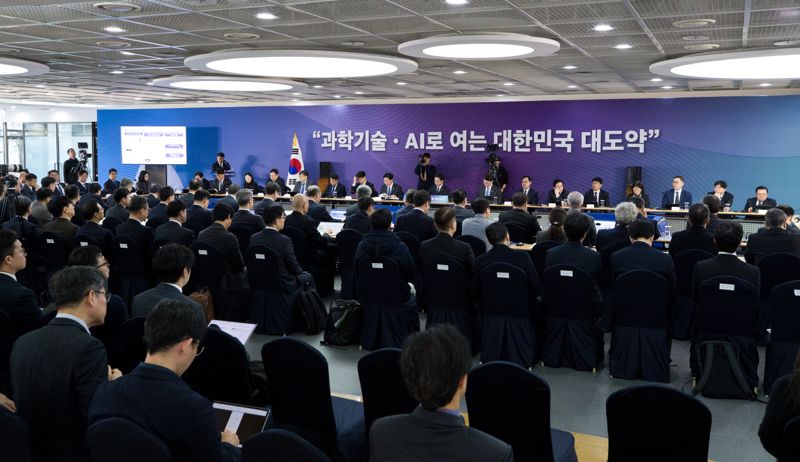
[Financial News] Bae Kyung-hoon, Deputy Prime Minister for Science and Minister of Science and ICT, stressed that physical AI "must be developed to a level where it can be commercialized in the near future," emphasizing collaboration among industry, academia, and research institutes, as well as rapid data acquisition. He went on to cite quantum technologies as the next-generation field following artificial intelligence (AI), calling for a strategy of “selection and concentration” in its development.
During the briefings held on the 12th at the National Research Council of Science & Technology (NST) in Sejong Special Self-Governing City for government-funded research institutes and public organizations in the science and technology sector, Bae Kyung-hoon took part in a discussion under the theme “A Great Leap Forward for Korea Driven by Science, Technology, and AI.” He stated, “Just as seven research institutions under the United States Department of Energy (DOE) announced joint missions with big tech companies, I believe we need a Korean-style Genesis Mission,” adding, “Rather than having separate goals for each government-funded research institute, I hope you will consider an integrated mission and practical plans for setting shared objectives with companies.”
The Genesis Mission was announced last year by the Trump administration. Its aim is to consolidate the vast troves of scientific data in the United States into a single integrated AI platform and, in cooperation with private-sector big tech companies, secure leadership in AI.
Bae Kyung-hoon noted, “At this year’s Consumer Electronics Show (CES), physical AI was also a major topic,” adding, “We are already seeing development progress to a level where AI integration can be commercialized in the near future.”
In this context, he underscored the need for swift development, highlighting collaboration among various government-funded research institutes such as the Korea Institute of Science and Technology (KIST), as well as close cooperation with companies and other research organizations.
In relation to this, Oh Sang-rok, President of the Korea Institute of Science and Technology (KIST), said, “For physical AI, we can address operational challenges through laboratory development and secure mass-production technologies for operation and design, and we have already achieved a certain level of motion control.” He continued, “What still needs to be secured is the physical AI component that can be applied to real-life use cases, and the key challenge there is data acquisition. To address this, we plan to build a collaborative platform together with 10 companies.”
In particular, Bae Kyung-hoon proposed that KONI (KISTI Open Natural Intelligence), the Korean-style ChatGPT developed by the Korea Institute of Science and Technology Information (KISTI), be developed this year into an independent Korean AI foundation model. He also mentioned the need to build the necessary infrastructure, including securing sufficient Graphics Processing Unit (GPU) resources.
Ryu Jemyoung, Second Vice Minister of Science and ICT, explained, “The government will supply 10,000 GPUs this year, with 50% allocated to national projects, 30% to industry, and 20% to academia and the research community. For the research sector, National Supercomputer System No. 6 will begin operation in July,” adding, “Supply will start in March, and the research community will receive stable support through the 20% GPU allocation in the first half of the year and additional capacity via the supercomputer in the second half.”
He also stressed the importance of quantum research as the next frontier following AI.
Bae Kyung-hoon stated, “Quantum is often called the next AI, and it is essential to increase corporate participation in this field,” adding, “Among the many areas within quantum technologies, we need an environment that allows us to first select the fields where we can excel and concentrate our efforts there.” The Ministry of Science and ICT plans to draw up a comprehensive national quantum strategy together with relevant government-funded research institutes by the end of this month.
Bae Kyung-hoon also remarked, “It is desirable for government-funded research institutes to take the initiative in proposing joint research to companies,” positively evaluating the joint research center established by the Korea Institute of Materials Science (KIMS), Hanwha Group, and Samsung Group as a good example. He added, “Not only the Ministry of Science and ICT but also our government-funded institutes and affiliated organizations must transform themselves to survive in the current AI era. If they do not adapt to the age of AI, they will be left behind.”
[email protected] Yeon Ji-an Reporter