"An 800 Million Won Home Is Now 1.5 Billion" – Does That Make Sense? Still, People Flock In Expecting Prices to Keep Rising
- Input
- 2026-01-12 08:00:00
- Updated
- 2026-01-12 08:00:00
According to Financial News, as of 2024, Seoul was found to be short by around 250,000 homes compared with the number of households. Although the housing supply rate improved slightly from the previous year, the shortage of housing supply combined with a sharp increase in the number of households has kept the gap wide. Another indicator, the number of homes per 1,000 people, was found to have increased by only about 5.3 homes.
An analysis of indicators such as the "housing supply rate (new housing supply rate)" and the "number of homes per 1,000 people" recently finalized and released by the Ministry of Land, Infrastructure and Transport (MOLIT) on the 12th showed these results.
First, according to MOLIT’s statistics on the new housing supply rate, the nationwide rate reached 102.9% in 2024, up 0.4 percentage points from 102.5% the previous year. In the provinces, it rose from 107.7% in 2023 to 108.4% in 2024, while in the greater Seoul metropolitan area it inched up from 97.2% to 97.3% over the same period.
In Seoul, which is experiencing a supply crunch, the housing supply rate rose only slightly from 93.6% in 2023 to 93.9% in 2024, an increase of just 0.3 percentage points. This is a smaller gain than the nationwide increase of 0.4 percentage points. As of 2024, Seoul had 4.159 million households but only 3.907 million homes. This translates into a shortage of about 252,000 housing units.
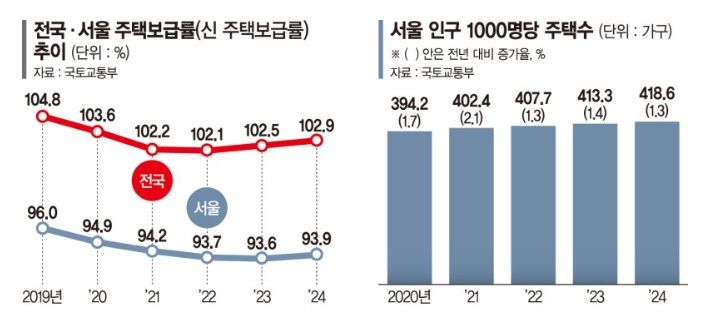
What stands out is that, compared with the previous peak in 2019, the housing supply indicators have still not recovered. In 2019, Seoul’s housing supply rate stood at 96.0%. It then fell into the 94% range and has now dropped into the 93% range.
A representative of the Housing and Construction Association pointed out, "In the case of Seoul, the drop from the previous peak is steep. While household fragmentation continues due to the increase in single-person households, the supply of non-apartment housing such as multi-family, row, and detached houses has also declined sharply, leading to an absolute shortage of housing supply."
The situation is not much different when looking at another indicator, the number of homes per 1,000 people. This statistic is used as an indicator that reflects actual housing conditions more accurately than the housing supply rate.
According to the statistics, in Seoul the number of homes per 1,000 people increased from 413.3 in 2023 to 418.6 in 2024, a modest rise of 1.3%. Looking at the annual growth rates, it was 1.7% in 2020, 2.1% in 2021, 1.3% in 2022, and 1.4% in 2023. The latest increase falls short even of the average for the past four years.
Even when comparing the number of homes per 1,000 people on a nationwide basis, the figure is far lower than in other countries.
According to the latest statistics from the Organisation for Economic Co-operation and Development (OECD), as of 2022 Korea had 430.2 homes per 1,000 people. The OECD average is 468 homes, and the European Union (EU) average is 514 homes. The figure is also lower than Japan’s 492 homes. The housing shortage in Seoul is dragging down the nationwide indicators.
Kim Deok-rye, a director at the Housing Industry Research Institute, said, "More important than the housing supply rate is the indicator for the number of homes per 1,000 people," adding, "When you compare Korea’s housing stock with that of major countries, it is clear that Korea is in an absolute shortage."
Meanwhile, according to KB Real Estate, the average apartment sale price in Seoul, based on December of each year, rose from 859 million won in 2019 to 1.26 billion won in 2022. As of December last year, it surpassed 1.5 billion won.
[email protected] Lee Jong-bae Reporter