[Editorial] The ‘2% Growth’ Target Is Empty Rhetoric Without Labor and Education Reform
- Input
- 2026-01-11 19:12:43
- Updated
- 2026-01-11 19:12:43
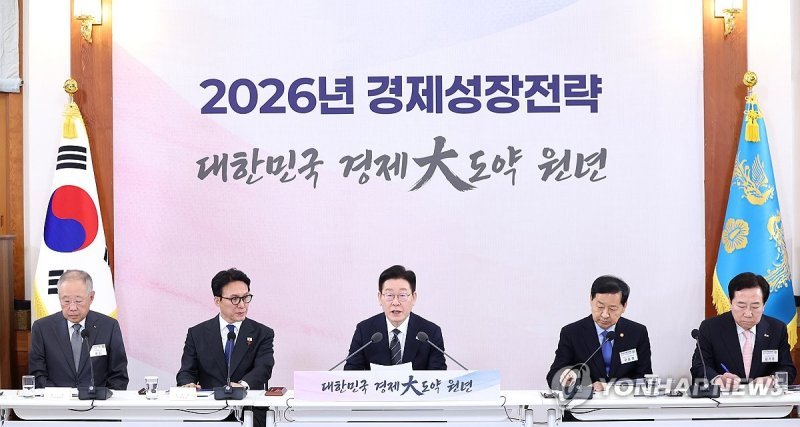
Given that last year’s growth rate remained in the 1% range, it will not be easy to double that figure within a single year. Barely a month ago, in its work report, the Ministry of Finance and Economy projected this year’s growth at “1.8% plus alpha.” Major institutions at home and abroad likewise forecast the Republic of Korea (ROK) to grow by around 1.8% this year. In the end, the “2% growth” target is closer to a goal that reflects the government’s policy will and expectations than to an objective forecast.
The government’s main tools for achieving this policy target can be summed up as tax incentives and financial support. It plans to expand tax benefits for flagship projects aimed at realizing an ultra-innovative economy and to channel funds into productive sectors through a 600 billion won National Growth Fund. It also reiterated its plan to actively invest in a wide range of industries via a Korean-style sovereign wealth fund, generate returns, and pass these gains on to the next generation.
However, if these policy instruments amount to nothing more than short-term stimulus, their limitations are obvious. Industrial support and fiscal injections matter, but the more urgent task is to raise the potential growth rate, which underpins the economy’s fundamental strength. The ROK’s potential growth rate has fallen by about 1 percentage point under each successive administration, and if this trend continues, it is feared that it could sink to around 1% in the 2030s and into the 0% range in the 2040s. In such a weakened state, pouring fiscal resources into the economy merely to push up the headline growth figure temporarily would be little more than throwing money into a bottomless pit.
To lift the potential growth rate, structural reforms are unavoidable in areas such as labor, education, finance, and welfare, all of which face strong social resistance. Rigidities in the labor market block the movement of workers and hold back productivity gains, while inefficiencies in the education system deepen the mismatch between industrial demand and the supply of talent. As long as financial capital remains tied up in real estate assets, innovative firms will struggle to secure sufficient growth engines. A welfare system that fails to keep pace with rapid population aging will also increase the fiscal burden and constrain future growth. Reform in these areas is not a matter of choice; it is a prerequisite for sustainable growth.
Managing the risk factors surrounding the ROK economy must proceed in parallel. The Ministry of Finance and Economy has already warned that, from a macroeconomic perspective, uncertainties in the foreign exchange and real estate markets, household debt, and risks related to the Korean Federation of Community Credit Cooperatives are all lurking beneath the surface.
The problem is that these risk factors may not remain short-lived shocks but could instead interact and spread into a systemic crisis. Without preemptive monitoring, transparent disclosure of information, and responsible follow-up measures, market anxiety could escalate rapidly.
Last year, the ROK’s per capita Gross Domestic Product (GDP) turned downward for the first time in three years, whereas Taiwan’s per capita GDP increased for the fourth consecutive year. While competitor economies have been delivering results through industrial upgrading and diversification of their export structures, the ROK is now paying the price for having postponed structural reform. Rather than clinging to temporary stimulus measures, the government must concentrate its policy capacity on boosting productivity and improving the structure of the economy. Responding swiftly to the warning signs of crisis and putting in place fundamental remedies is the government’s duty at this moment.