Gwangju–Jeonnam Integration Taking Shape: “President Lee Pledges Generous Support”
- Input
- 2026-01-09 16:07:03
- Updated
- 2026-01-09 16:07:03
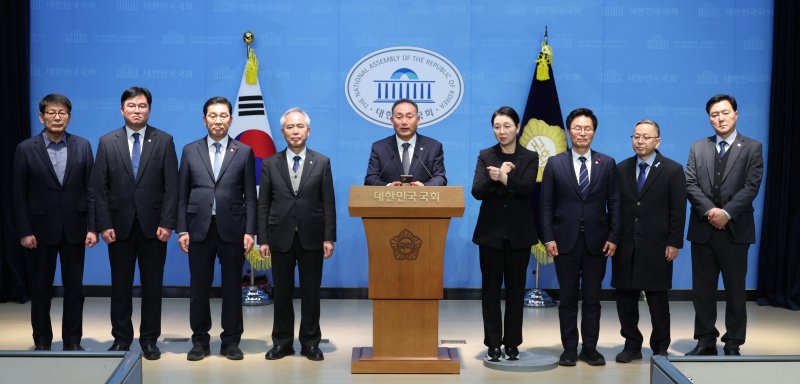
[The Financial News] Lawmakers from the Gwangju–South Jeolla region belonging to the Democratic Party of Korea (DPK) stated on the 9th that President Lee Jae-myung of South Korea had pledged generous support for the administrative consolidation of the Gwangju–South Jeolla region, adding that the integration of administrative functions in the area is expected to pick up speed. The process is projected to move ahead more quickly than the Daejeon–Chungnam Administrative Integration already under way, and is being interpreted as an effort to shore up a key support base.
DPK lawmakers from the Gwangju–South Jeolla region held a press conference at the National Assembly of the Republic of Korea the same day, saying they had discussed the administrative consolidation of the Gwangju–South Jeolla region during a luncheon meeting with the President of South Korea.
Kim Won-i, a lawmaker who serves as Chairperson of the Jeollanam-do Provincial Party Committee of the Democratic Party of Korea, explained that President Lee Jae-myung of South Korea had promised and prepared special compensation for Honam in recognition of its contribution to the development of democracy in the country, and had begun to put those plans into action. Kim added that, in line with the debate over integrating Gwangju Metropolitan City and Jeonnam (South Jeolla Province), the President pledged intensive support on a scale that could bring about a dramatic transformation in the development of Honam, including a major expansion of fiscal support, relocation of public institutions, and assistance in attracting industries and businesses.
He went on to say that lawmakers from Gwangju Metropolitan City and Jeonnam had expressed their support for the administrative consolidation of the Gwangju–South Jeolla region. They agreed to seek resolutions in the Gwangju Metropolitan Council and the Jeollanam-do Provincial Council affirming their commitment to integration, with the aim of holding an election for the Gwangju–South Jeolla Integrated Special Mayor in the upcoming June 3 Local Elections, and to hold briefings and other events to gather residents’ opinions.
In addition, DPK lawmakers from the Gwangju–South Jeolla region decided to formally propose that the party establish a Special Committee dedicated to the administrative consolidation of the Gwangju–South Jeolla region. The DPK has already launched a Special Committee to pursue the Daejeon–Chungnam Administrative Integration and is conducting integration discussions at that level.
Plans are also in place for the DPK and the government to unveil a joint integration package. After collecting opinions and holding a legislative public hearing, the DPK intends to draw up the Special Act on the Integration of Gwangju and South Jeolla Province and submit it to the National Assembly of the Republic of Korea on the 15th. On the same day, the government is expected to have Prime Minister Kim Min-seok of South Korea announce special measures linked to the Special Act prepared by the party.
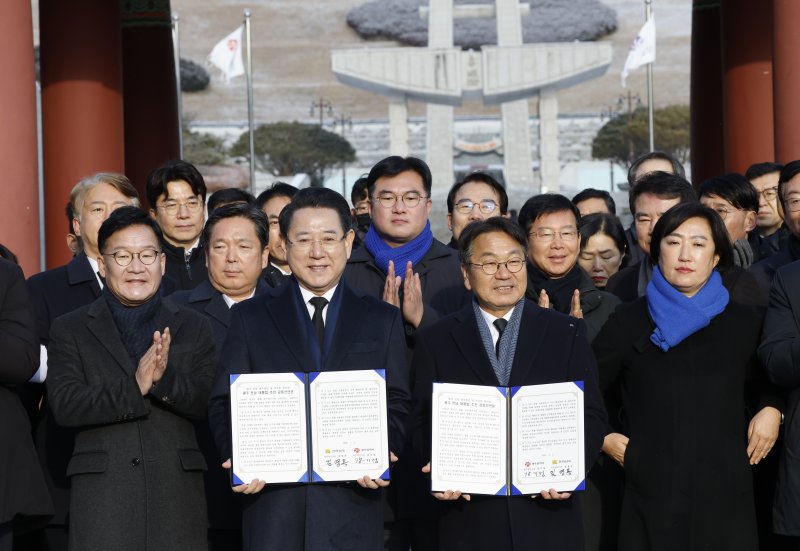
The administrative consolidation of the Gwangju–South Jeolla region appears to be moving ahead at a faster pace than the Daejeon–Chungnam Administrative Integration that had been promoted earlier. This is largely because all lawmakers in the region belong to the DPK, and both the mayoralty of Gwangju Metropolitan City and the governorship of Jeonnam are held by the DPK. The fact that local councils in the region are also dominated by the DPK is seen as another factor enabling rapid progress.
Lawmaker Shin Jung-hoon, who has declared his candidacy for Governor of Jeollanam-do Province, said he had proposed that, aside from powers essential to the existence of the state—such as national defense, foreign affairs, and the judiciary—most other powers be devolved to local governments so that a fully fledged self-governing administration can be established.
Regarding the possibility of a referendum, lawmaker Jeong Jin-uk noted that there was broad agreement that, given the timetable leading up to the local elections, there was not enough time to hold a referendum to gauge public opinion on integration. He added that, as a result, the plan is to proceed by having the metropolitan and provincial council adopt resolutions in favor of administrative consolidation, as provided for under the Local Autonomy Act.
The DPK also announced that it would move swiftly to achieve the administrative consolidation of the Gwangju–South Jeolla region under a principle of “integration first, candidates later.” The party intends to prioritize the act of administrative consolidation itself, leaving revisions to various related laws as follow-up measures.
[email protected] Kim Hyeong-gu Reporter