"Declaration of the Physical AI Era" DEEPX Hosts CES Foundry
- Input
- 2026-01-09 11:00:02
- Updated
- 2026-01-09 11:00:02
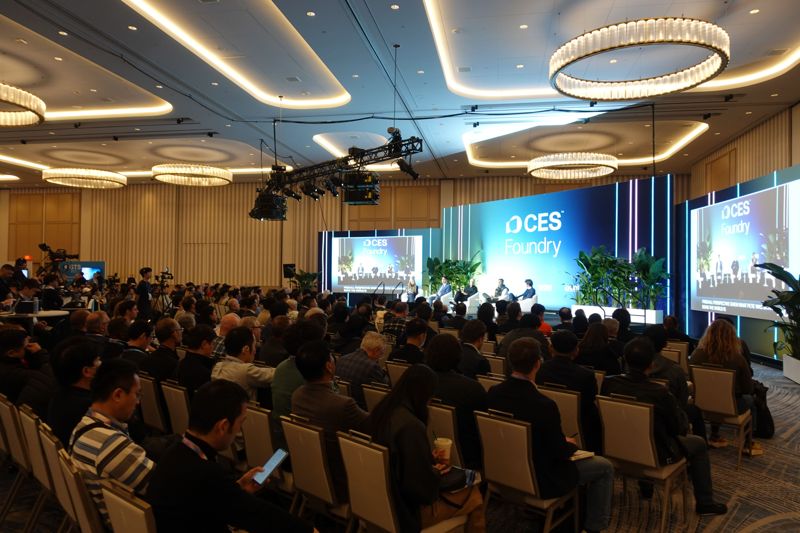
DEEPX announced on the 9th that it successfully hosted "CES Foundry," a studio event officially organized by the Consumer Technology Association (CTA), at the Consumer Electronics Show 2026 (CES 2026).
At the event, DEEPX and its global partners presented concrete solutions for moving beyond data center–centric artificial intelligence (AI) and driving a major shift toward Physical AI.
Held under the theme "Accelerating Physical AI," the event brought together global companies already engaged in mass production and commercial services to discuss the real-world challenges facing Physical AI and potential solutions.
Opening the event, Kim Nok-won, chief executive of DEEPX, stressed that Physical AI is no longer a concept of the future but an imminent reality. Kim noted, "The center of gravity of AI is shifting from data centers to the physical world," and emphasized the need for tight integration of hardware and software to accelerate this transition.
Panelists included Dong Jin Hyun, executive vice president at Hyundai Motor Group Robotics Lab; Raine Hua, global ecosystem AI manager at Baidu; Pete Bernard, chief executive officer of Edge AI Foundation; Sandeep Modhvadia, chief privacy officer (CPO) at Wind River Systems; and Francesco Mattioli, lead partner engineer at Ultralytics.
The panelists agreed that in real industrial settings such as robotics, smart factories, and edge IT services, several requirements are becoming essential: reducing dependence on data centers, ensuring low power consumption and low heat generation, and guaranteeing stable 24/7 operation.
“Robotics has now become core infrastructure that drives society and industry,” said Dong Jin Hyun. “The foundation that makes this possible is Physical AI, and on-device artificial intelligence that can make its own decisions even in environments with unstable networks is essential. Through our collaboration with DEEPX, we have secured on-device AI for robots that has been validated in real operating environments, and starting in 2026 we plan to apply it in earnest to next-generation robots and security solutions.”
Raine Hua remarked, "In the era of Physical AI, it is just as important for a model to work consistently everywhere as it is to have strong performance." Hua added, "Our collaboration with DEEPX offers a practical path to deploy models directly in edge environments without repeatedly redesigning them."
Pete Bernard noted, "Traditional data center–centric AI architectures have clear limitations in terms of cost, power consumption, and latency." He continued, "DEEPX is elevating Physical AI into a form of infrastructure by pursuing both tangible performance and ecosystem building at the same time."
The discussion also turned to a candid assessment of the obstacles hindering the spread of Physical AI. The panelists cited differing toolchains for each hardware platform, inconsistent performance metrics, and repeated re-optimization during model porting as some of the biggest barriers to commercialization.
“Developers can build models quickly, but there is a bottleneck at the actual deployment stage,” said Francesco Mattioli. “Working with DEEPX simplifies the path from training to deployment to commercialization, allowing developers to achieve real-world performance without having to become hardware experts.”
During the session, the Open-Source Physical AI Alliance led by DEEPX was introduced. Partner companies agreed that the success of Physical AI hinges on who can build a "plug-and-play" environment more quickly and easily, and they underscored the importance of ecosystem-wide collaboration.
Sandeep Modhvadia commented, "For AI to be applied in mission-critical industries such as defense and aerospace, it must be supported by security, predictable operations, and a stable lifecycle measured in years before it can truly be considered infrastructure." He added, "DEEPX’s solutions complete this picture by enabling the operation of trustworthy systems in real-world environments."
[email protected] Choi Hye-rim Reporter