‘Divorce of the Century’ enters round four: First retrial hearing on asset division for Chey Tae-won and Roh Soh-yeong set for today
- Input
- 2026-01-09 09:04:00
- Updated
- 2026-01-09 09:04:00
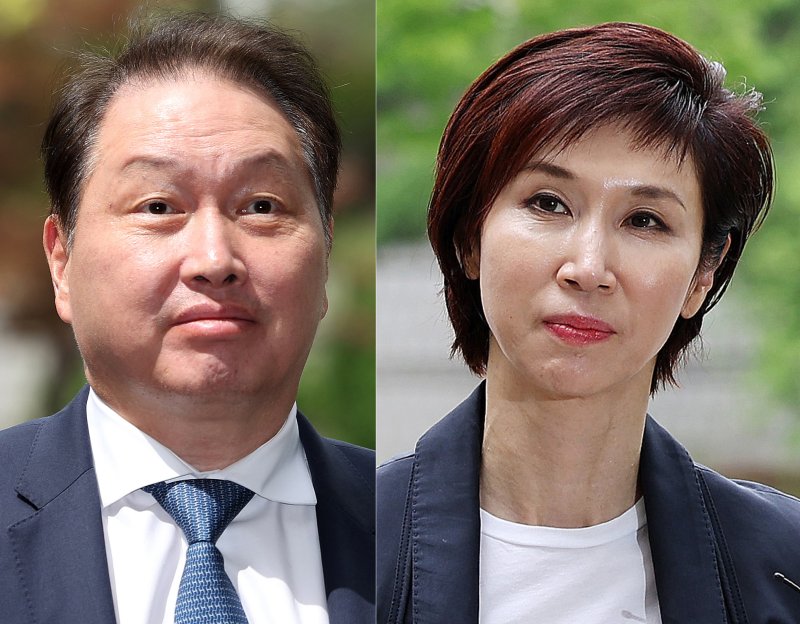
[The Financial News] The retrial on asset division in the divorce lawsuit between Chey Tae-won (66), chairman of SK Group, and Roh Soh-yeong (65), director of Art Center Nabi, will begin on the 9th.
Order for Chey to pay 1.3808 trillion won to Roh goes back to square one
Civil Division 1 (Family Affairs) of the Seoul High Court, presided over by Judge Lee Sang-joo, will hold the first hearing in the retrial on asset division between Chey and Roh at around 5:20 p.m. that day. The proceedings are expected to be held behind closed doors. Roh plans to appear in person and present her views in court.
It comes about three months after the Supreme Court of Korea in October last year overturned the second-instance ruling that had ordered Chey to pay Roh 1.3808 trillion won as part of the asset division and sent the case back to the Seoul High Court. Both sides submitted preparatory briefs on the 7th, and Chey’s side is also reported to have filed a separate opinion on how the proceedings should move forward.
In the retrial, the two sides are expected to clash again over which assets should be subject to division and how much Roh contributed to the accumulation of Chey’s wealth. The first-instance ruling had favored Chey, while the second-instance court reversed course and reached a conclusion more favorable to Roh. The Supreme Court of Korea then sided with Chey on all key issues, effectively accepting his legal arguments.
Following the Supreme Court of Korea’s decision to remand the case, the retrial court is expected to recalculate the division ratio after excluding so-called “Roh Tae-woo slush funds” from the scope of Roh’s contribution. Central issues include whether Chey’s stake in SK Inc. should be considered divisible property and to what extent Roh’s contribution to Chey’s assets should be recognized.
In December 2022, the court of first instance ordered Chey to pay Roh 100 million won in consolation money and 66.5 billion won in cash as part of the asset division. However, in May 2024, the appellate court reached a different conclusion, ruling that Chey must pay 2 billion won in consolation money and 1.3808 trillion won in asset division.
At the time, the appellate court found that former South Korean President Roh Tae-woo and Roh Soh-yeong had contributed to the rise of what is now SK Group. It also concluded that 30 billion won in slush funds from Roh Tae-woo had flowed to the late honorary chairman Chey Jong-hyun and, together with his existing assets, became seed money for then Sunkyong Group (now SK Group). On that basis, the court overturned the first-instance finding that Chey’s stake in SK Inc. was not subject to division, increasing the division amount twentyfold from 66.5 billion won to roughly 1.3 trillion won.
In October last year, however, the First Petty Bench of the Supreme Court of Korea, with Justice Suh Kyeong-hwan writing the opinion, accepted Chey’s appeal and overturned the appellate ruling, which had been premised on the assumption that 30 billion won in slush funds from Roh Tae-woo had flowed to SK.
Supreme Court did not rule on existence of ‘Roh Tae-woo slush funds’ but refused to recognize them as Roh’s contribution
The Supreme Court of Korea did not make a determination on whether the so-called “Roh Tae-woo slush funds” actually existed. It held, however, that even if such funds did exist and were in fact transferred to SK, they constituted illegal funds and therefore could not be taken into account as Roh’s contribution in the division of property. Recognizing them, the court stated, would run counter to notions of justice and fairness, and the act of providing bribe money to one’s children is so clearly anti-social and unethical that it falls outside the scope of legal protection.
Roh’s side had argued that they were not seeking the return of money provided by Roh Tae-woo, but merely asserting Roh’s contribution in the context of property division. The Supreme Court of Korea rejected this, stating that even in such a case, “the illegality cannot be severed, and since such conduct cannot be tolerated within the overall legal order, it has no value warranting protection in any form, including as a contribution in the division of property upon divorce.”
As for the 2 billion won in consolation money, the Supreme Court of Korea found no error in the lower court’s judgment and dismissed the appeal, thereby finalizing that part of the ruling.
Chey and Roh married in September 1988 and had three children together before their relationship broke down. In July 2017, Chey filed for divorce mediation against Roh in an attempt to reach an uncontested divorce, but when no agreement was reached by February 2018, the case proceeded as a formal lawsuit. In December 2019, Roh filed a countersuit, stating that she would agree to the divorce.
[email protected] Kim Hee-seon Reporter