‘SME Owners Are Aging’ – 70% of Bosses Are in Their 50s or Older, Sales Reach 2,085 Trillion Won
- Input
- 2026-01-09 08:55:05
- Updated
- 2026-01-09 08:55:05
This is why the government is hurrying to support business succession through mergers and acquisitions (M&A).
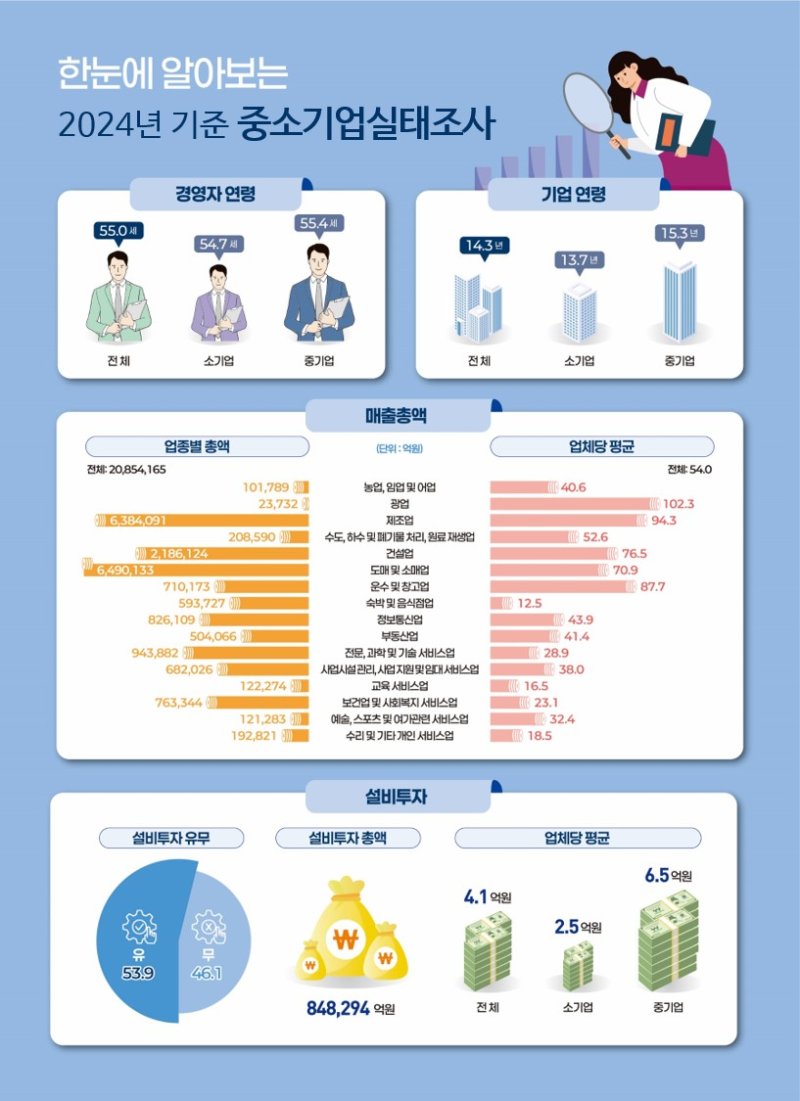
According to the 2024 Small and Medium Enterprises Survey released on the 9th by the Ministry of SMEs and Startups, the average age of SME managers last year was 55. Those aged 50 or older made up 70.2% of the total, while those 60 or older accounted for 33.3%. Managers under 40 represented only 4.9%.
In 2024, total sales of SMEs, excluding microbusinesses, came to 2,085 trillion won, with 7.92 million employees. By industry, wholesale and retail (31.1%) and manufacturing (30.6%) recorded the highest shares in both sales and employment.
Compared with the Basic Statistics of Small and Medium Enterprises, sales in 2023, which stood at 2,024 trillion won, rose slightly, while the number of employees, 8.14 million in 2023, edged down.
The average business history was 14.3 years. Firms operating for 10 years or longer accounted for 60.4%, the largest share, while those with less than five years of history made up 12.9%.
Total research and development (R&D) spending reached 16.4 trillion won, and 15.1% of SMEs were engaged in R&D activities.
Regarding subcontracting transactions, 16.7% of all SMEs were subcontractors supplying goods or services under such arrangements. Subcontracting sales accounted for 18.8% of their total sales.
Total sales of subcontractors amounted to 584 trillion won. Of this, 393 trillion won came from transactions with principal contractors, and subcontractors’ dependence on principal contractors stood at 67.3%.
By industry, manufacturing showed the highest share among subcontractors in both number of firms (47.9%) and sales (43.3%). Their dependence on principal contractors was also high at 72.5%, exceeding that of other sectors.
As for difficulties in subcontracting transactions (multiple responses allowed), the most frequently cited issues were “failure to reflect higher raw material costs in supply prices” (38.6%), followed by “frequent ad-hoc orders” (26%) and “shortened or tight delivery deadlines” (26%).
Based on these survey results, the Ministry of SMEs and Startups (MSS) plans to ease the trend of aging firms and managers caused by a lack of new entrants and to build a more dynamic ecosystem for corporate growth.
In particular, with one-third of SMEs now led by managers aged 60 or older, the government is pursuing, as a national policy task, the establishment of a business succession support system through M&A. The goal is to help aging SMEs that struggle with family succession continue operating and growing after the owner retires, instead of shutting down.
To address difficulties in subcontracting transactions, MSS will introduce a simplified dispute mediation procedure this year and expand the dispute mediation council.
The ministry will support amicable, voluntary settlement of disputes between companies and, in cooperation with the Korea Fair Trade Commission (KFTC), will create a new fund to remedy damages from unfair trade practices. This fund will provide upfront support for litigation costs and other expenses needed for relief, even before dispute mediation or court rulings are finalized.
Kim Dae-hee, Director-General for SME Strategy and Planning at MSS, stated, “Based on the findings, we will continue to identify and implement effective, tailored support policies, while also refining and upgrading the Small and Medium Enterprises Survey in more detail.”
The survey covered 20,000 SMEs across 16 industries classified under the major categories of the standard industrial classification, excluding microbusinesses.
[email protected] Kim Hyun-chul Reporter