"Foreigners Must Pay Double for Ramen?"... Japanese Ramen Restaurant Faces Backlash After Posting 'No Entry for Chinese' Sign
- Input
- 2026-01-07 07:09:34
- Updated
- 2026-01-07 07:09:34
A well-known ramen restaurant in Osaka has sparked controversy after posting a notice banning Chinese customers and being exposed for charging foreigners a higher price through dual pricing.
The ramen restaurant, located near Namba Station in Osaka, posted on Social Networking Service (SNS) on the 4th, "There was an incident where a Chinese customer caused trouble in the store, leading to the police being called. Since about 90% of the problems caused by foreigners are by Chinese, we will prohibit entry to Chinese customers from now on." This announcement ignited the controversy.
The notice posted on X (formerly Twitter) garnered over 26 million views in a single day and has been retweeted more than 12,000 times, spreading rapidly. The controversy intensified as online users discovered that the restaurant had been charging foreigners higher prices, fueling further debate.
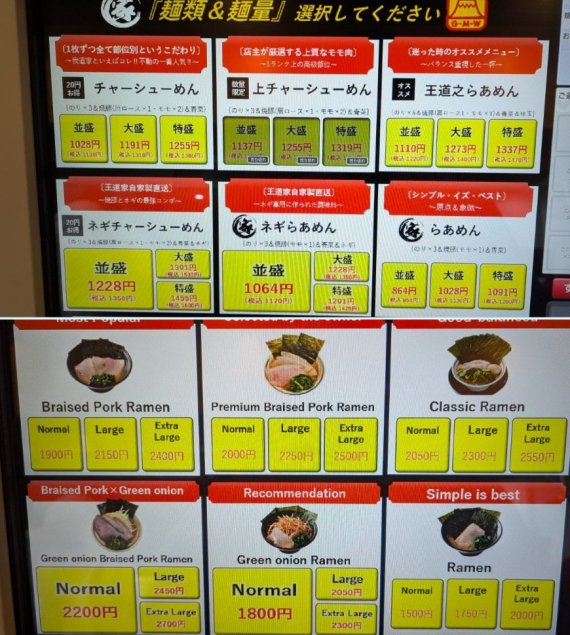
Netizens began quoting the post and sharing photos of the restaurant's kiosk screen, pointing out that the establishment had been charging foreigners more. According to the photos uploaded by users, the prices on the Japanese menu and the foreign language menus, such as English, were listed differently.
When selecting the Japanese menu, a basic bowl of ramen costs 950 yen (about 9,000 KRW) including tax, and the most expensive ramen with green onions and chashu is 1,350 yen (about 12,500 KRW). However, when ordering from the English or other foreign language menus, the basic ramen is priced at 1,500 yen (about 13,900 KRW), and the most expensive option is 2,200 yen (about 20,400 KRW). This means that ordering in a language other than Japanese could result in paying up to twice as much for ramen.
Several posts on the restaurant's Google Reviews point out this dual pricing for foreigners. Korean reviewers wrote, "The prices seemed strange, so I tried to check the Japanese menu, but the staff stopped me," and, "When I tried to order in Japanese, the staff insisted I order in Korean," expressing their frustration. Japanese users also commented, "Even as a Japanese person, I would advise people to avoid such a discriminatory establishment. I felt deeply ashamed as a fellow Japanese."
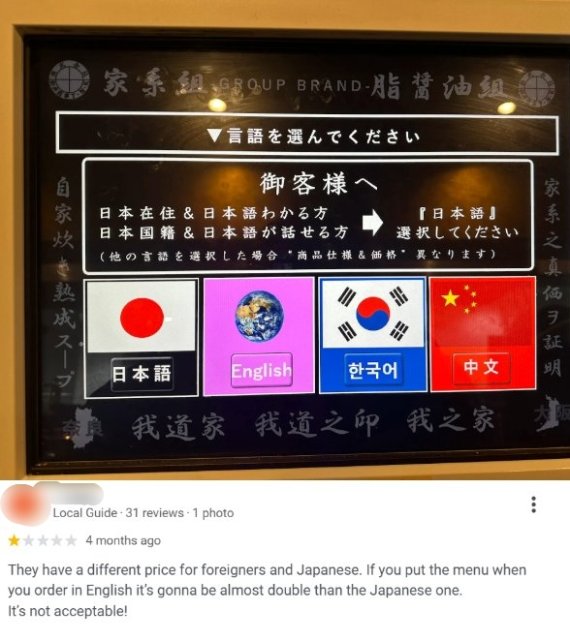
As this information spread, speculation arose that the reason for the 'No Entry for Chinese' notice was because Chinese customers discovered the dual pricing and protested, leading to such a commotion that the police had to be called.
[email protected] Kim Hee-sun Reporter