[Editorial] Broadening Content and Service Exchanges to Open New Paths for Korea-China Trade
- Input
- 2026-01-06 18:12:07
- Updated
- 2026-01-06 18:12:07
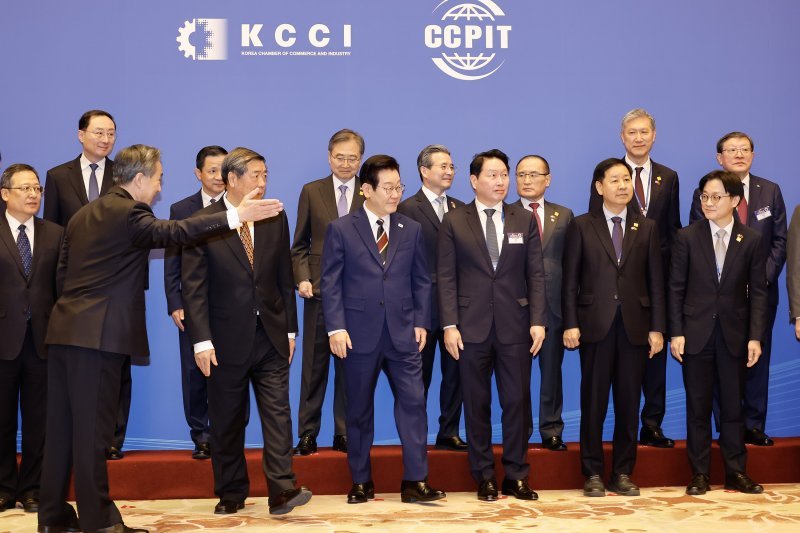
On June 6, Chinese media highlighted that the most notable aspect of President Lee Jae-myung’s visit to China was the large-scale economic delegation accompanying him. This evaluation stems from the fact that Korea’s leading business figures gathered in Beijing. During his visit, President Lee focused on further solidifying the Korea-China economic cooperation framework and laying the groundwork for new horizons in collaboration. The fact that so many business leaders from both countries could meet face-to-face and engage in candid discussions is itself a significant achievement.
Companies from both nations signed a total of 32 memoranda of understanding (MOUs) related to artificial intelligence (AI), autonomous driving platforms, consumer goods, food, and K-pop content. Notable progress was made in distribution and food businesses. Shinsegae and Alibaba Group agreed to jointly support the online export of Korean products, with Shinsegae sourcing goods and Alibaba Group providing access to the Chinese market through its platform. Food and medical companies also secured new opportunities in China at the event. Continued meetings between business leaders from both countries are likely to yield even more collaborative models.
Following the Terminal High Altitude Area Defense (THAAD) dispute, Korea’s industries—including automobiles, distribution, and gaming—suffered significant losses. With the restoration of relations, these sectors are expected to recover. Chung Eui-sun, Chairman of Hyundai Motor Company, stated, "We plan to increase production and sales in China with a humble attitude," reflecting this context. Domestic companies’ local semiconductor plants may also pursue new negotiations as relations normalize.
It is an urgent task to actively expand the framework of trade to include content and services. Compared to 10 or 20 years ago, China’s product technology has advanced dramatically. Korean technology, once overwhelmingly superior, now faces fierce competition. Korea’s trade deficit with China, now in its third year, is closely related to this shift. Therefore, it is necessary to accelerate the second phase of the Korea-China Free Trade Agreement (FTA).
In services and content industries such as healthcare, distribution, and culture, Korea maintains a clear advantage over China. However, strict Chinese regulations make it difficult to break into the local market. If the second phase of the FTA is fully implemented, the scope of market opening will expand to include not only finance, telecommunications, culture, and law, but also direct and indirect investment. Korea-China economic cooperation could reach a higher level. At the Korea-China Business Forum, President Lee referenced Byeongnando, which maintained trade even during diplomatic tensions, and called on business leaders to launch new waves of cooperation.
Naturally, launching such cooperation requires a solid foundation. It is regrettable that the visit did not yield concrete trade agreements or measures to lift the Korean Wave Ban (Han Han-ling), as many had hoped. This shows that there is still a long way to go. The same applies to finding solutions for the Denuclearization of the Korean Peninsula and the removal of West Sea structures. Achieving everything at once is unrealistic. Persistent and pragmatic diplomacy is needed.